During CherryTech 2026, the largest technical event for the Chilean cherry industry, Carlos Tapia, expert cherry consultant and founder of Avium, shared an updated overview of the sector in the country before 1,600 industry representatives.
Currently, cherry exports from the South American country account for 70% of global shipments and nearly 97% of shipments from the Southern Hemisphere. These figures highlight the consolidation of Chile as the world’s leading supplier of fresh cherries.
Tapia’s view of the industry was positive, as “we are in a privileged position (...), but this also brings a huge responsibility”.
Chile currently has around 82,000 hectares planted with cherry trees, although only around 70,000 are actually in production. This shows that a significant young area will gradually enter the production system in the coming years.
“We have 15% or 16% of the area in orchards that have not yet reached their production potential. These are one-, two- or three-year-old orchards that are about to enter production”, Tapia said.
However, the growth in planted area is also set against the reality of the removal of some orchards. According to the expert, it is estimated that between 4,000 and 5,000 hectares of orchards with low yields and structural competitiveness issues will be eliminated.
The great debt: productivity
Tapia stated that there is still a considerable gap compared with the real potential of orchards and said: “Until 2020, Chile produced an average of around 6.4 tonnes of cherries per hectare; today this figure is close to 9.7 tonnes per hectare, as a result of technological improvements, new varieties, more efficient rootstocks and greater professionalization of agronomic management”.
From this perspective, he noted that for years the sector has maintained that 12 tonnes per hectare should represent the minimum threshold for competing in the business. “Today we are still below this level”, he said.
He also specified that, across more than 11,000 productive hectares, the national average is close to 10,500 kilos per hectare, with around 69% of the fruit exceeding 2J size.
As for varieties, Tapia stated that Lapins, Santina and Regina will continue to lead the varietal landscape in the coming years.
“Lapins continues to be a super variety. A few years ago, many thought it needed to be removed, while today it continues to deliver highly competitive results”, he said.
He pointed out that this variety delivers yields close to 13 tonnes per hectare, high packing percentages and a share of fruit above 2J size exceeding 75%.
In the case of Regina, he noted that it continues to be one of the most important varieties in the export mix. The consultant predicted that its share should gradually decline in the coming years, due to issues related to size, fruit condition and its productive behavior in certain areas.
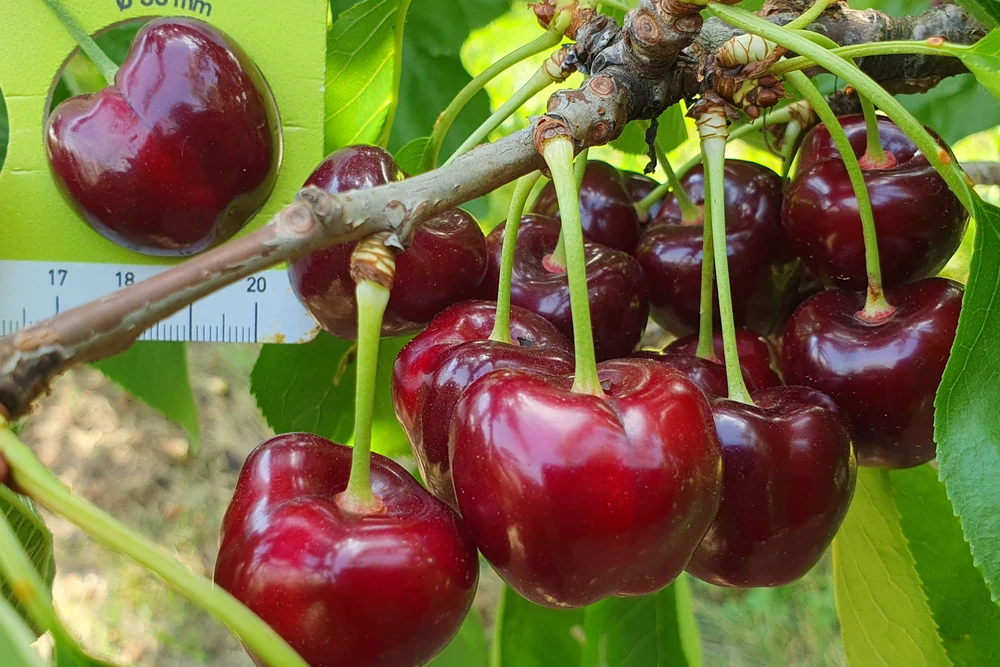
Regina
“The last two seasons have shown heat accumulation above the historical average. We do not know whether this will become a permanent trend, but we believe it is necessary to prepare”, he explained.
In this regard, he added that this phenomenon has direct consequences on critical variables for the industry, such as size, firmness, dry matter and post-harvest condition.
Tapia was categorical in reiterating the need to understand the physiological phases of fruit growth more precisely, in order to optimize agronomic interventions.
Adaptation: the key to maintaining leadership
Tapia stated that the future of the industry will depend less on increasing the planted area and more on the ability to produce high-quality fruit efficiently and sustainably.
In his view, the next phase must be characterized by production optimization, climate adaptation and greater technical sophistication.
“We have already achieved global leadership. Now the challenge is to maintain it. And this cannot be achieved simply with more hectares, but with better yields, better fruit and better technical decisions”, he concluded.
Source: Macarena Bravo, Portal Fruticola
Image source: Stefano Lugli
Cherry Times - All rights reserved