In the Ararat Valley in Armenia, an investment covering 80 hectares of early-ripening cherry orchards planted with Italian varieties aims to strengthen the country's presence in international markets. The project is led by Naughty Orchards, a company founded by entrepreneur Sergey Vardanyan, which has chosen to combine technological innovation, direct control of the supply chain and an export-oriented commercial strategy.
Following its first significant harvest in 2026, the company is focusing primarily on Persian Gulf markets and Europe, aiming to progressively increase volumes to a potential 2,000 tonnes, including production from an affiliated company.
The challenge is to establish a position in a competitive market, where Turkey and Uzbekistan are two major competitors in the early-ripening cherry segment.
From technology to agriculture: an 80-hectare investment
The project took shape in 2022, when Sergey Vardanyan decided to return to Armenia after spending eight years in the United States and selling a technology startup.
The entrepreneur identified fruit growing as a long-term investment opportunity, also supported by national agricultural financing policies.
In Armenia, the government provides interest subsidies on loans and a five-year grace period before principal repayments begin, in line with the time required for a cherry orchard to reach full productivity.
Establishing the orchard required the acquisition of numerous plots of land, reflecting the extensive fragmentation of agricultural land ownership following the country's independence.
In approximately one year, Naughty Orchards managed to consolidate 80 hectares in the Armavir region, in the Ararat Valley, at an altitude of around 1,000 metres.
The area benefits from water supplied by the public Akhuryan reservoir and approximately 2,700 hours of sunshine annually. These conditions, combined with advanced technologies and artificial intelligence-based systems, represent some of the project's main strengths.
Carmen, Sweet Gabriel and Sweet Lorenz: choosing Italian cherry varieties
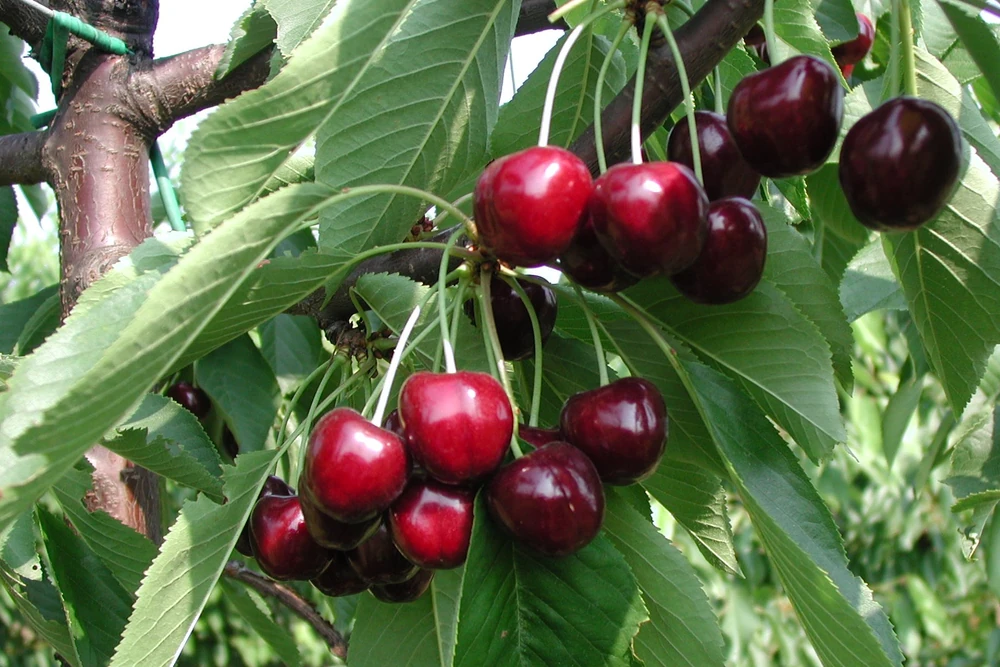
One of the investment's distinguishing features is its varietal selection. Naughty Orchards has focused on Carmen, Sweet Gabriel and Sweet Lorenz, early-ripening cherry cultivars of Italian origin.
This choice sets the company apart from much of the Armenian cherry industry, which has traditionally favoured later-ripening varieties such as Kordia and Regina.
The earlier harvest also addresses specific operational requirements. Labour availability is a major challenge for the local agricultural sector, and concentrating production in the first few weeks of the season helps reduce competition with other orchards when recruiting pickers.
Particular attention has also been paid to the commercial characteristics of the fruit.
According to figures provided by the company, 50% of the cherries have a diameter of between 28 and 34 millimetres, while the remaining half measure between 24 and 28 millimetres.
Fruit size is considered a determining factor in orchard profitability, particularly in more demanding export markets.
Compared with varieties traditionally grown in Armenia, the cherries selected by Naughty Orchards also stand out for their firmer skin, relatively small stones and greater suitability for sorting, packaging and transportation.
Spring frosts and labour shortages: the main production challenges
Managing climate-related risks is one of the company's priorities, particularly during flowering, when low temperatures can compromise production potential.
In 2026, faced with a forecast frost event, Naughty Orchards adopted a strategy involving flooding the orchard soil, achieving, according to Vardanyan, a temperature increase of approximately 1.5–2°C.
The company also evaluated air circulation systems, heating and overhead frost protection irrigation. However, measurements taken by sensors installed at a height of 30 metres showed temperatures similar to those recorded at ground level, making the use of wind machines relatively ineffective under the observed conditions.
In terms of employment, the first commercial harvest in 2026 required up to 350 workers during peak operations, which took place between 15 June and 15 July.
For 2027, as production increases, the company expects to need at least 600 pickers, while approximately 20 employees work on a permanent basis throughout the year.
Russian border closure reshapes the commercial strategy
The first significant production season coincided with a major commercial challenge.
Naughty Orchards had signed agreements with major Russian retail chains, but the closure of the border with Russia forced the company to rapidly reorganise its sales destinations.
The cherries were redirected to Ukraine, Iraq, Georgia and the domestic Armenian market, without any product losses, according to the entrepreneur.
Iraq, in particular, emerged as a new export destination, while domestic distribution absorbed between 25% and 30% of production, a share that had not initially been anticipated.
Despite a season characterised by low prices, Naughty Orchards managed to approach operating break-even.
According to Vardanyan, this result demonstrates the possibility of developing an export model that is less dependent on a single destination market.
Artificial intelligence and cold chain management to compete in export markets
To strengthen its international competitiveness, Naughty Orchards is focusing on vertical integration and direct management of post-harvest operations.
Its main tools include automated sorting powered by artificial intelligence, GlobalG.A.P. certification, flexible packaging and cold chain management.
The cherries undergo an initial cooling process using hydrocooling, with water at approximately 0.5°C, before proceeding to sorting and refrigerated storage.
According to the company, maintaining an uninterrupted cold chain makes it possible to achieve a shelf life of approximately one month.
An 8,000-square-metre logistics centre is also under construction, integrating cooling, sorting, packaging and refrigerated storage facilities.
The ability to offer different packaging solutions, ranging from 500-gram punnets to 2 kg and 5 kg packs, allows the company to adapt its offering to the requirements of international distributors.
A further competitive advantage lies in costs: according to Vardanyan, the company's operating cost per hectare is approximately half that of European growers.
Targeting 2,000 tonnes and new markets in the Gulf
The company's growth prospects are ambitious. Naughty Orchards expects production of between 600 and 700 tonnes in 2027, with the aim of reaching a yield of 15 tonnes per hectare at full production capacity.
Across the main orchard's 80 hectares, this would amount to approximately 1,200 tonnes harvested over four weeks.
Including the 40 hectares operated by an affiliated company, the combined production potential could reach 2,000 tonnes.
At national level, Vardanyan estimates Armenian cherry exports at approximately 2,000 tonnes in 2026, with potential growth to 6,000 tonnes by 2030.
Under this scenario, Naughty Orchards could account for a significant share of the country's cherry exports.
Commercially, the company's attention is focused primarily on the United Arab Emirates, Saudi Arabia and Qatar, markets characterised by high purchasing power and potential demand for premium products.
The free trade agreement between Armenia and the United Arab Emirates represents another favourable factor.
Entering European retail distribution, however, appears more challenging, as the company will need to demonstrate consistent quality, reliable supplies and the ability to guarantee adequate volumes.
The strategy adopted by Naughty Orchards thus highlights the potential of a relatively young Armenian cherry industry increasingly focused on innovative varieties, international standards and greater supply chain integration.
Developments over the coming years will be decisive in determining whether Armenia can establish itself as a new competitive origin in the international trade of early-ripening cherries.
Source: freshplaza.it
Image source: Stefano Lugli
Cherry Times - All rights reserved