Accurate determination of fruit maturity stage in sweet cherry is essential to ensure high quality standards, considering the non-climacteric nature of the fruit and the limited postharvest evolution of its main sensory attributes.
In this context, a recent study from China proposed an integrated approach based on epicarp colorimetry combined with physicochemical and metabolomic analyses, with the aim of validating fruit color as a quantitative and non-destructive indicator of ripening status.
The study was carried out on two cultivars with contrasting skin coloration patterns, ‘Tieton’ (dark red) and ‘Caiyu’ (yellow), monitoring five ripening stages over a period of approximately 12 days.
Biphasic dynamic
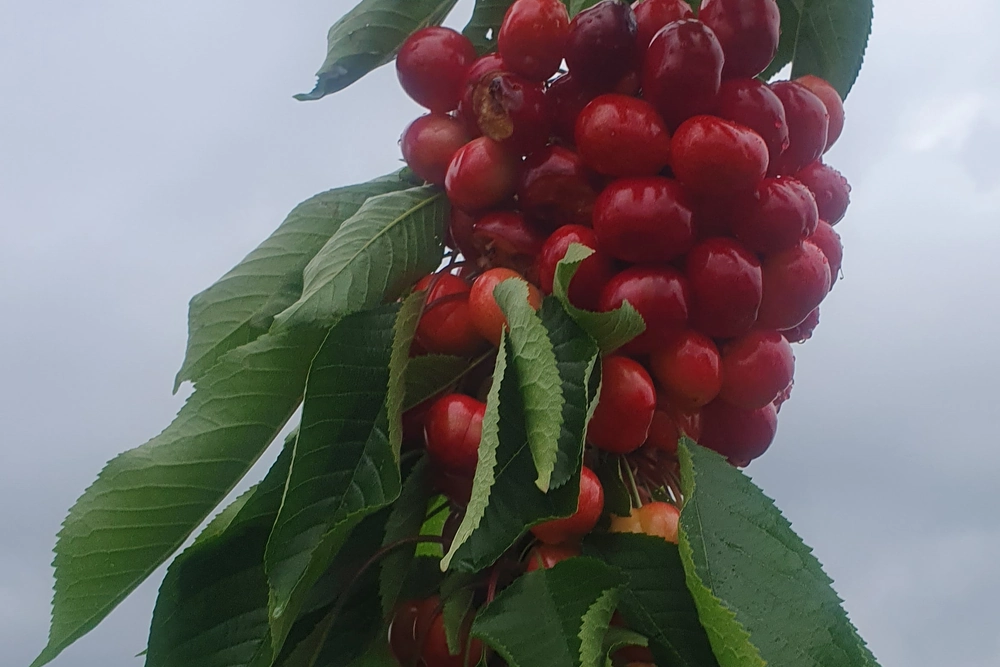
In ‘Tieton’ fruit, a biphasic dynamic was observed: an initial phase characterized by an increase in the red component (a* value), accumulation of soluble solids (TSS), fruit enlargement, and progressive softening; followed by a later phase dominated by exponential anthocyanin accumulation, responsible for fruit darkening and the decrease in chromatic parameters a*, b*, and C*.
This behavior highlights a close synchronization between color development and internal fruit quality.
Correlation analyses confirmed this relationship: in red fruit, CIE Lab* color parameters were strongly associated with soluble solids content, anthocyanin concentration, and flesh firmness, with high coefficients of determination (up to R2 ≈ 0.99 for some relationships).
In particular, the decrease in hue angle (h°) and b* values was associated with increasing sweetness and advanced ripening, while the initial increase in a* reflected the early stages of phenolic accumulation.
Predictive models
These findings enabled the development of predictive models for ripening stage based exclusively on chromatic parameters, with high accuracy (R2 up to 0.915 and low mean absolute error), demonstrating the potential application of machine-vision systems for precision harvesting.
Metabolomic analysis identified more than 2,400 metabolites, revealing a profound reorganization of secondary metabolism during fruit ripening.
In particular, anthocyanin biosynthesis emerged as the central process: initially activated through the phenylpropanoid pathway, it intensified during intermediate stages through flavonoid metabolism and culminated in a final phase characterized by massive accumulation of cyanidin derivatives, directly responsible for the dark red to purplish coloration.
This temporal sequence confirms that epicarp color represents the phenotypic expression of a complex metabolic reprogramming process.
Cultivar dependence
An interesting aspect highlighted by the study concerns the strong cultivar dependence of color–quality relationships.
While in the red cultivar ‘Tieton’ color proved to be a reliable and independent indicator of ripening, correlations were weak in the yellow cultivar ‘Caiyu’.
In the latter, the low anthocyanin content and the predominant role of carotenoids reduced the ability of color parameters to reflect the physiological stage of the fruit, making a multi-parameter approach necessary.
Practical implications
Overall, the study demonstrates that epicarp colorimetry, when supported by a solid metabolic framework and calibrated for specific cultivars, can serve as a robust, rapid, and non-destructive indicator of ripening in sweet cherry.
The practical implications are numerous, ranging from optimization of harvest timing to the development of automated harvesting technologies based on machine vision.
However, further extension of the model to a broader genetic background and integration with multi-omics data will be necessary to improve applicability to additional cultivars and operational reliability across different production environments.
Source: Wang, D., Chu, F., Zhang, J., & Wei, H. (2026). Evaluating the reliability of epicarp chromaticity as an independent indicator of maturity state during harvesting time for sweet cherry. LWT, 118939. https://doi.org/10.1016/j.lwt.2025.118939
Image source: Stefano Lugli
Andrea Giovannini
PhD in Agricultural, Environmental and Food Science and Technology - Arboriculture and Fruitculture, University of Bologna, IT
Cherry Times - All rights reserved