Cherries begin to lose quality from the moment they are harvested. While they wait in the field, remain at the collection point, travel to the packing facility or wait to enter the hydrocooler, they continue to lose water, respire and consume their reserves.
For this reason, time is more than just a logistical consideration: it is a fundamental postharvest variable. The first question we always ask ourselves is: what tool do we use to measure time?
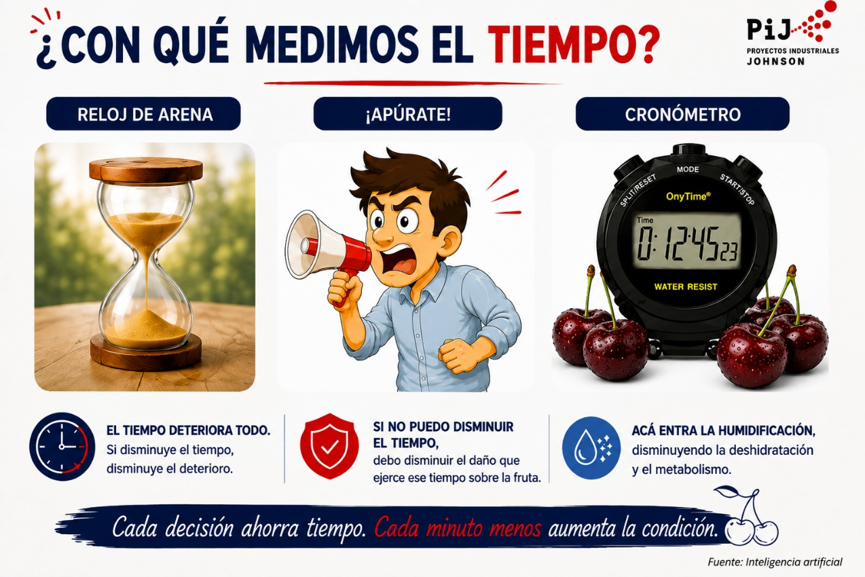
The only way to measure time is to use a stopwatch. Yet, in orchards and packing facilities, we often encounter the verbal clock: “Hurry up!” It sounds like a joke, but it happens more often than we think. This is precisely what we need to change: replace words with numbers.
Time multiplies the damage
Dehydration and metabolism act throughout the entire process. The longer fruit remains exposed to high temperatures and poorly controlled environments, the greater the accumulated damage. Even when fruit is at 0 °C, every passing day means one less day of shelf life.
A simple example helps illustrate this: five hours of processing mean five hours of dehydration and metabolism. However, if we work efficiently and reduce that time to two hours, we eliminate three hours of damage caused by these two processes.
In Chile, Peru and other countries, we have often observed limited awareness of the damage that time causes to fruit. Operational requirements frequently take priority over time management.
In Chile, for example, workers sometimes finish harvesting cherries at 1:00 p.m., but the fruit reaches the packing facility at 6:00 p.m. and is processed at 1:00 a.m. In other cases, processing is postponed until the following day or even later, depending on facility capacity. Improving turnaround times is not easy, but achieving different results requires us to change the way we operate.
One strategy could be to “think like cherries”, to understand the timing the fruit needs to arrive in good condition, taking its requirements into account alongside our own. Ultimately, we need to strike a balance between our schedules and the time requirements of cherries.
The following example shows how determination and professionalism can shorten certain processes. In this case, the reference is to the time it takes cherries to enter the P.I.T., drawing an analogy with Formula 1.
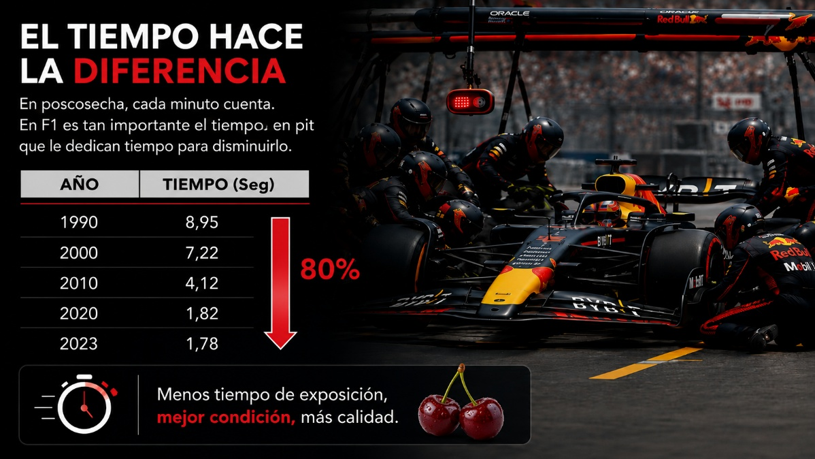
The following infographic shows how a few adjustments can reduce times in Formula 1. This analogy can be applied directly to postharvest processes.
Damage that accumulates without being visible
As with dehydration and metabolism, the effects of prolonged processing times may not become apparent during handling. Cherries may look good when packed, despite having accumulated deterioration that will emerge days or weeks later, at the destination market.
To understand the value of time and give it the importance it deserves, we must measure the deterioration in fruit condition for every hour of processing. Every company, orchard and packing facility must do this.
The postharvest process begins with harvesting itself and ends when the fruit reaches its destination. At Proyectos Industriales Johnson, we distinguish between two types of time: warm-fruit time, from harvesting until entry into the hydrocooler, and cold-fruit time, from the hydrocooler to the destination. Both cause damage, but at different intensities.
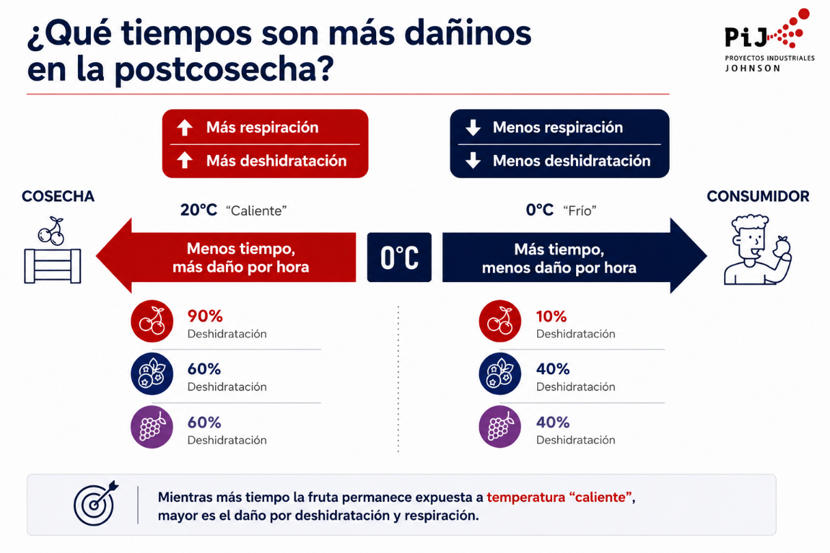
As the image shows, the damage caused by the time fruit spends warm during harvesting, holding at collection points, transport and reception at the packing facility is far more severe than the damage that occurs when fruit is at 0 °C.
We need to measure the time taken by every activity in the cherry handling process.
For example, what should we measure during harvesting?
- What time did harvesting begin and end?
- How long did it take to fill a bin?
- How long did it take to harvest each individual tote?
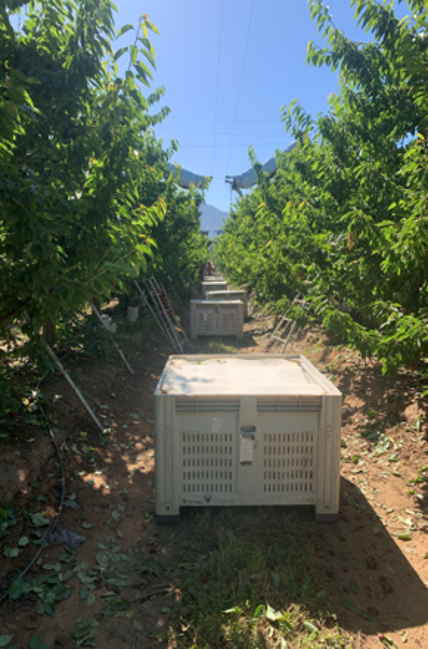
- How long did the full bin remain in the orchard before being collected?
- How long did it take to transport the bin from the alley between rows to the collection point?
After measuring the current time required for each activity, we must set ambitious time targets and plan how to meet them.
It is also essential to use technology to measure times in real time: GPS, electronic wristbands, QR codes and artificial intelligence tools that allow us to generate reports and make decisions.
Technology must send us alerts when targets are not met. For example, when there are more than five full bins that have not yet been collected.
Reducing times helps limit weight loss, sugar and acid consumption, increases in pulp temperature and overall fruit deterioration.
Total time is the sum of the time spent at each stage
Often, there is no single major delay. The problem arises from the sum of small waiting periods.
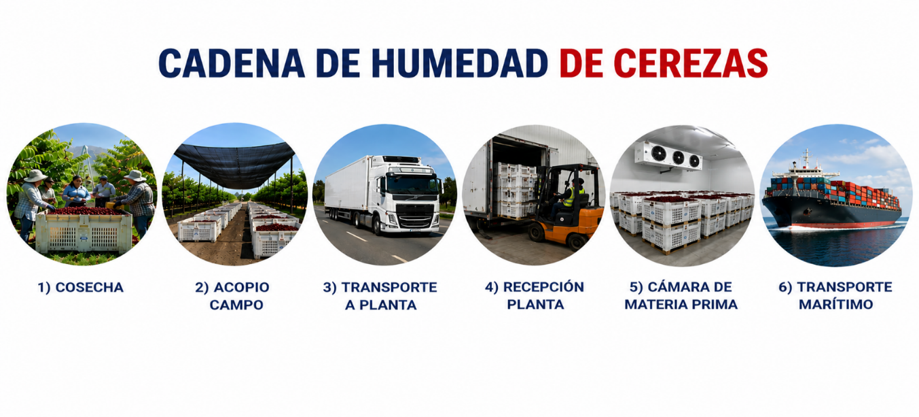
A delay of twenty or thirty minutes may seem insignificant. However, when repeated across several stages or affecting large quantities of fruit, the total time increases considerably.
For this reason, knowing the harvest time and the arrival time at the collection point is not enough. We need to measure how long each stage takes, how much fruit enters, how much leaves and how much product remains accumulated and waiting.
The challenge involves speeding up operations, but also balancing capacities and eliminating unnecessary waiting. These measurements allow us to compare incoming and outgoing flows, identify where fruit is accumulating and direct improvements appropriately.
More bottlenecks mean more time; more time means greater deterioration in fruit condition.
Not all waiting periods have the same impact. One hour in the sun, with a high pulp temperature, causes far more damage than one hour in a sheltered, refrigerated environment. Therefore, alongside measuring time, we must relate it to pulp temperature and environmental conditions.
In summary
Managing processing times means ensuring that fruit moves from harvesting to cooling with as few interruptions as possible. The aim is to reduce waiting, balance capacity across the different stages, prevent accumulation and identify bottlenecks before they compromise fruit condition.
The entire process must move forward in a coordinated way, without any single stage operating at maximum capacity at the expense of the others.
Good infrastructure loses effectiveness if it receives more fruit than it can process. Similarly, very rapid harvesting can become a problem if transport or hydrocooler capacity is insufficient.
At which stage is fruit accumulating, and what capacity do we need to adjust to achieve a continuous flow from harvesting to destination?
As a final point, although perhaps it should have been the first, before measuring times we must clearly understand our processes and the activities that make up each one. We cannot measure or improve what we have not clearly defined.
The first step is therefore to identify each process, break it down into its individual activities and establish what we want to measure in each one. Only then can we understand our actual times, identify where waiting occurs and define the necessary improvements.
Cover photo: Stefano Lugli
Source: Proyectos Industriales Johnson
Cherry Times - All rights reserved