Chile’s leadership requires a strong capacity for anticipation. With each season, production volumes continue to grow, while the pressure to comply with increasingly stringent quality standards intensifies. As a result, postharvest management has consolidated itself as the decisive turning point where the true profitability of the business is determined.
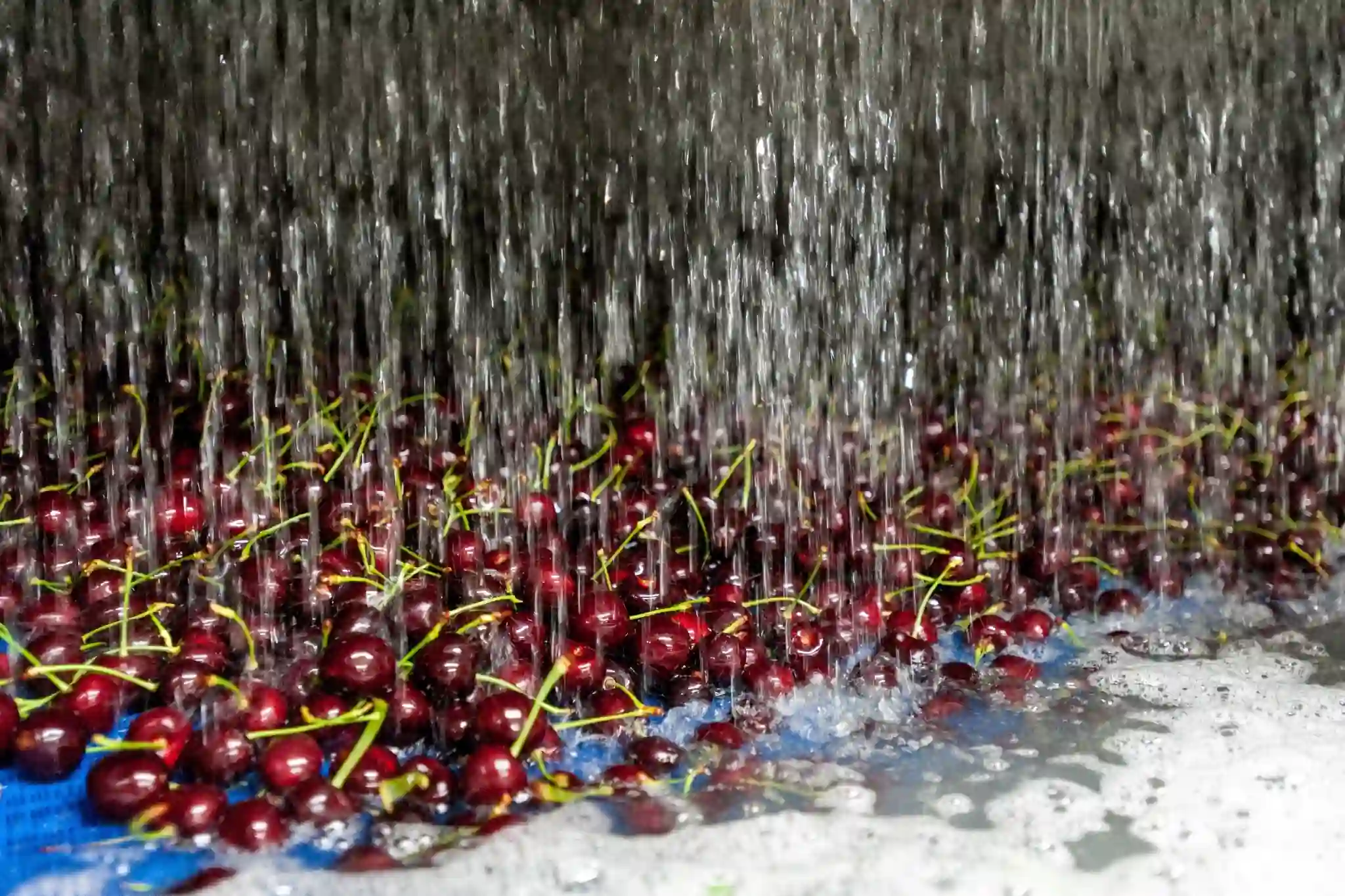 Source: Gateway Mechanical
Chilean cherries in the global context
Chilean cherries have established themselves as one of the country’s most emblematic fruits, symbolizing agro-export success and playing a leading role in the world’s most demanding markets, particularly in Asia. In just over a decade, the planted area has tripled, and today Chile accounts for more than 90% of Southern Hemisphere cherry exports.
With each season, volumes increase and the pressure to meet quality standards continues to intensify.
Production for the 2025/2026 season is expected to remain high, reflecting a dynamic and technologically advanced sector with a strong capacity for innovation. Although the most recent estimates, influenced by adverse spring weather events, place volumes slightly below the historic record reached in the previous season (2024/2025), overall production performance is still expected to be strong. For this campaign, the sector’s primary objective will be to ensure consistent quality and optimal fruit size in order to restore profitability, beyond the final volume figures.
This quality-driven imperative highlights a challenge that can no longer be ignored: volume alone does not guarantee value, and postharvest and logistics management can no longer be treated as passive variables. Postharvest has become the critical breaking point where real business profitability is defined.
 Valentina Vesely, Head of Research and Development, Johnson Industrial Projects.
Risk management and contingency planning
Year after year, it becomes increasingly evident that recurring challenges such as logistical disruptions, high temperatures, and extended waiting times must be addressed as systemic risks rather than isolated exceptions. In this context, anticipation becomes the new standard in postharvest management.
The 2024/2025 season delivered a lesson that cannot be overlooked: a catastrophic incident during maritime transport resulted in the loss of millions of dollars (equivalent to several million euros) and thousands of boxes of cherries, with severe economic and reputational consequences. Following that event, the need to insure fruit during transport is no longer questioned. It is now an established and structural component of the export business.
Applying the same logic, every stage following harvest should be supported by its own “operational insurer”: a contingency measure specifically designed to protect fruit quality from unforeseen events. Risks are not limited to transport alone, but are present throughout the entire supply chain, from the orchard to the final consumer.
These measures—whether a backup tractor, a humidification system, or an in-field hydrocooling unit—are not improvisation, but the result of preventive planning. They represent the practical expression of the ability to anticipate unexpected events and ensure that fruit maintains its quality throughout the journey.
From the orchard to the collection center
In cherry production, there is no room for improvisation. Anticipation, planning, and the availability of contingency measures not only protect the fruit, but also safeguard business profitability. Quality is not defended at the end of the process, but from the very first minute after harvest.
Cherry postharvest does not begin at the packing facility, but at the precise moment the fruit is detached from the tree. From that instant onward, the cherry shifts from a biologically hydrated system to complete dependence on human management. This is the point of maximum vulnerability: high solar radiation, extreme temperatures, low relative humidity, and wind transform the orchard into an environment that accelerates water loss.
The first barrier against dehydration is simple and widely recognized: covering harvest bins with materials capable of insulating and retaining moisture. Moist sponges are the industry standard, as they create a microclimate with high relative humidity that reduces the vapor pressure deficit (VPD) inside the bin. Alternatively, some orchards use insulating covers that provide comparable protection.
The key contingency measure at this stage is the availability of replacement materials: additional stocks of sponges or covers, replacement kits assigned to each harvesting crew, daily replenishment planning, and a clearly defined minimum inventory managed by a designated person.
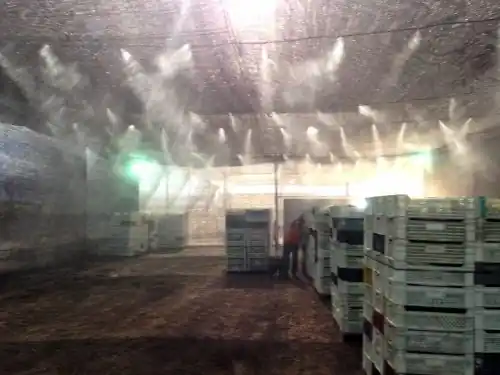 Storage with humidification.
Internal logistics and VPD management
It is also advisable to establish a plan B using alternative materials, such as shade nets placed over bins to protect fruit from solar radiation and allow sponges to function effectively. This ensures operational continuity in the event of damage, contamination, or loss of materials during harvest.
Internal logistics represent another frequent source of risk. A tractor or truck breakdown can interrupt fruit flow and prolong exposure to direct sunlight. Having a backup vehicle in verified working condition can make a significant difference, but it is not the only solution. Coordination with neighboring orchards or the design of short emergency routes using smaller equipment can enable bins to be moved when primary machinery becomes unavailable.
These are examples rather than an exhaustive list. Additional contingencies may include delays in fruit collection, labor shortages, or sudden weather changes. The critical factor is anticipating these risks through planned measures. In the orchard, quality is protected by decisions made in advance: each predefined alternative translates into time saved and fruit preserved.
Once removed from the orchard, fruit is concentrated at collection centers, where it often waits for trucks bound for packing facilities. In these environments, conditions can be particularly challenging: high temperatures combined with low relative humidity generate elevated vapor pressure deficit (VPD), creating an atmosphere with a strong capacity to extract water from the fruit.
Valentina Vesely
Head of Research and Development Industrial Projects, Johnson (PIJ)
Text and internal image sources: redagricola.com
Cherry Times – All rights reserved