In Quillón, Chile, technological innovation and the enhancement of local production come together in a project that looks toward the future of traditional cherry growing.
The “Agroclima Corazón de Paloma” program has provided small producers with digital tools and agroclimatic models, along with a new mobile app to improve orchard management and more effectively address the impacts of climate change.
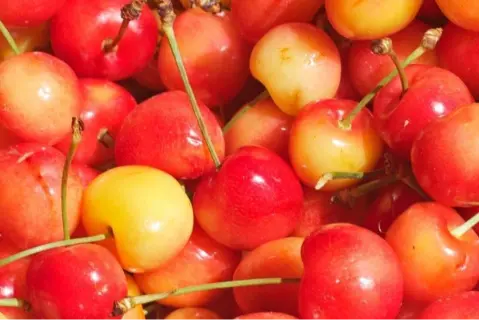 Source: Dario Fruticola
One year of work
The initiative brought together public authorities, academics, and farmers, who gathered for the closing of the Technology Diffusion Program (PDT) “Agroclima Corazón de Paloma”.
The project was led by the Faculty of Agronomy of the University of Concepción and the Municipality of Quillón, with funding from the Regional Productive Development Committee of Ñuble.
Over the course of one year, the program involved around 60 small farmers engaged in cultivating this historic cherry variety. The objective was twofold: on one hand, to recover and strengthen the local ecotype, and on the other to improve orchard management and support commercialization.
Technology and innovation
Macarena Dávila, regional director of Corfo Ñuble, highlighted the strategic value of the project for family farming. According to Dávila, this experience demonstrates how, through Corfo, it is possible to promote the adoption of technology and innovation in a key sector of the region.
Thanks to the work coordinated by the University of Concepción, producers in Quillón now have access to digital tools and agroclimatic models that will enable more efficient orchard management and a better response to climate change.
The director also emphasized that the initiative contributes to the recovery and strengthening of the heritage cherry Corazón de Paloma, a variety that can enhance its competitiveness and open new opportunities for producers in the Ñuble region.
A mobile app
Among the most significant outcomes of the program is the development of a mobile application designed to support producers in daily orchard management. The tool provides real-time agroclimatic information and supports farm-level decision-making in response to critical events such as frost, heatwaves, or water deficit.
The project director, Professor Richard Bastías from the Faculty of Agronomy at UdeC, noted that the initiative included five training courses, activities on demonstration plots, and the training of professionals specialized in agroclimatic models.
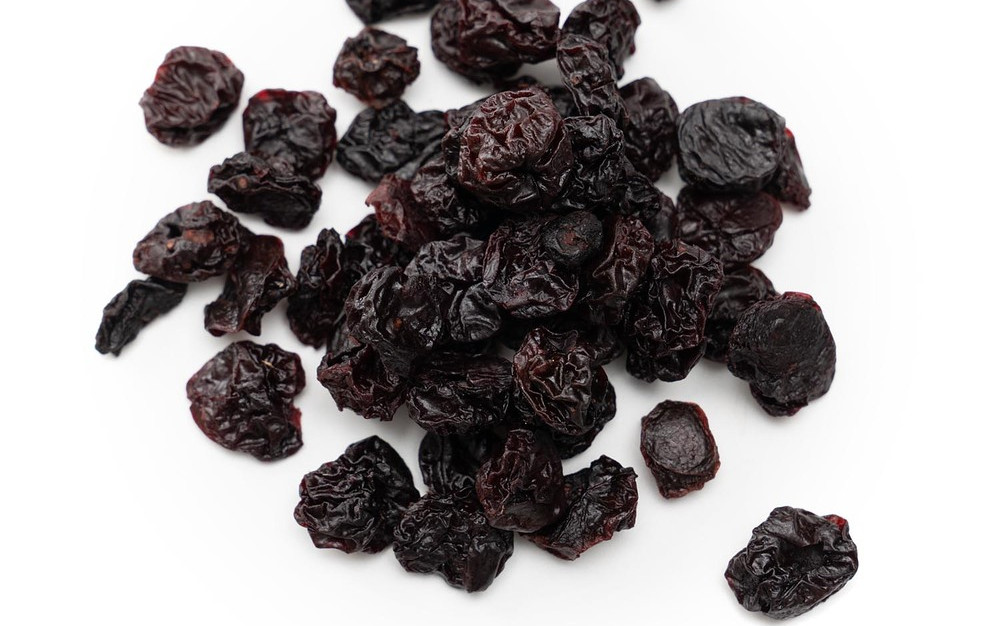
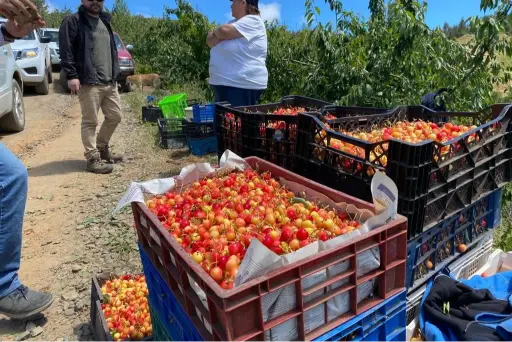 Corazon de Paloma cherry. Source: Bionoticias
Weather stations and models
Bastías also highlighted a key aspect for the continuity of the project: technological adoption in cherry farms. In three orchards selected by the Municipality of Quillón, high-end automatic weather stations were installed, enabling the generation and validation of agroclimatic models now integrated into a digital platform and the new app.
Through this technology, producers will be able to monitor their orchards directly from their smartphones, accessing useful data such as crop evapotranspiration levels and heat or cold stress indices, along with other production indicators.
Bastías described this as an unprecedented opportunity for family farmers, adding that the Agroclima Corazón de Paloma model could also be replicated in other agricultural sectors or production systems across the country.
The value of partnerships
The mayor of Quillón, Felipe Catalán, also expressed appreciation for the joint effort developed within the project. Catalán praised the producers who participated, noting that Quillón, a rural and tourism-oriented municipality, relies on its roots, its land, vineyards, and horticultural crops.
According to the mayor, partnerships built with the Regional Government, the University of Concepción, and other institutions made it possible to develop an initiative capable of combining advanced technologies with local production expertise, aiming to achieve better fruit and support community development.
Raúl Súnico, head of the Promotion and Industry Division of the Regional Government of Ñuble, shared a similar view, emphasizing the importance of transferring technical knowledge directly to producers.
Competitiveness and adaptation
The dean of the Faculty of Agronomy at UdeC, Manuel Faúndez, pointed out that the project was created with a clear goal: to strengthen the competitiveness of small farmers cultivating around 176 hectares of this variety.
Faúndez noted that these producers face an increasingly complex reality shaped by climate change, water scarcity, frost, and heatwaves, all factors that directly threaten orchard balance and fruit quality.
In this context, the project promoted a concrete and strategic solution: introducing management tools based on applied agroclimatic information, capable of providing operational autonomy and practical decision support.
The voice of producers
The application has also been positively received by the farmers involved. Maeva Durán, a producer from Peñablanca, stated that the training process left an important body of knowledge.
She also highlighted how the strong climate variability of the area, with very hot or rainy days and periods of intense cold, makes a tool capable of supporting orchard management directly from a mobile device particularly valuable.
Producer Jorge Valenzuela also emphasized the identity value of “Corazón de Paloma”, describing it as a unique agricultural heritage. In his view, the introduction of these technologies will enable more effective management of the variety, increasing its overall competitiveness.
Conclusion
The Quillón experience shows how digitalization can become a concrete lever to protect a heritage cherry while equipping small producers with new tools to face climate and market challenges.
The “Agroclima Corazón de Paloma” project represents not only a step forward for this traditional variety, but also a potential model for other agricultural supply chains seeking to combine territorial identity, innovation, and sustainability.
Source: www.portalagrochile.cl
Cherry Times - All rights reserved