Increasing weather instability is pushing crop protection systems beyond the traditional boundaries of greenhouses.
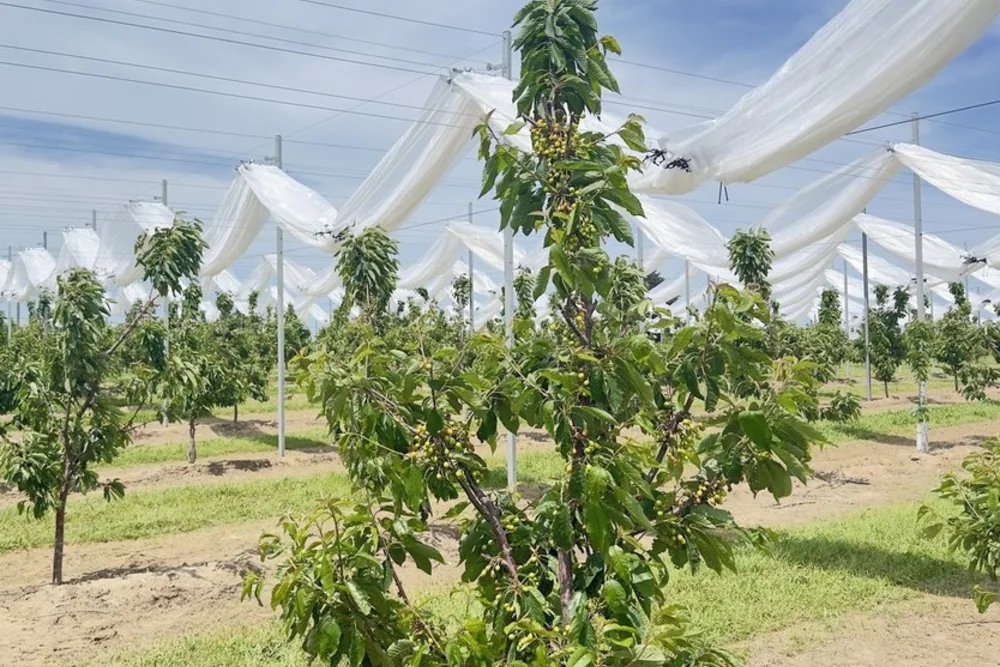
Orchards, vineyards and other high-value crops are becoming new areas of application for retractable roofs, solutions designed to keep plants exposed to the outdoor environment when conditions are favorable and protect them during the most critical periods.
This is the direction being taken by Cravo Equipment, a company specializing in retractable covering systems, which aims to broaden its scope through its Auto-Dry™ and Flat Roof technologies and, at the same time, through a network of local partners in new markets.
This development also coincides with Derek Vollebregt joining the family business as VP of Revenue, after spending around ten years working mainly in technology startups.
Derek is therefore joining his father, Richard Vollebregt, CEO of Cravo Equipment, as the company approaches the milestone of 50 years in business.
From greenhouse systems to orchard and vineyard protection
Historically, Cravo has focused much of its activity on the greenhouse sector. Today, however, the company sees new opportunities in permanent crops and open-field production.
According to Richard Vollebregt, the market shows a clear distinction between the greenhouse sector and open-field agriculture, orchards and vineyards.
With the Auto-Dry™ and Flat Roof systems, the aim is therefore to address more specifically the climate-related challenges affecting these crops.
Crop protection across larger areas
The requirements are in fact different from those of horticultural crops grown in greenhouses. Orchards and vineyards generally cover larger areas and require protection systems that are economically compatible with these dimensions, without necessarily turning production into a fully protected growing system.
The principle behind retractable roofs is precisely to keep the crop outdoors as much as possible, deploying a cover when weather conditions become unfavorable.
Yellow kiwifruit in New Zealand among the target markets
One of the sectors on which Cravo is focusing its attention is yellow kiwifruit production in New Zealand.
The high value of the crop and its exposure to risks such as frost, wind, sunburn and disease pressure make the sector an interesting market for the introduction of additional protection tools.
As Richard Vollebregt points out, this is a very different market from greenhouse tomato production. To develop this segment, Cravo has already identified a local partner in New Zealand.
The strategy is based on a broader consideration of the evolution of agriculture in response to increasing climate volatility.
Between open-field and protected environments
According to Derek Vollebregt, growers are no longer limited to choosing between fully outdoor cultivation and production in a completely artificial environment.
The development opportunity lies instead between these two extremes: continuing to benefit from natural outdoor conditions while adding systems capable of providing protection and greater climate management when necessary.
A network of local partners to install the systems
Expansion into new markets also involves a change in the commercial model of the company.
Traditionally, Cravo has operated mainly through a direct sales force. This model will remain in place, but it will gradually be complemented by local partners capable of also taking responsibility for system installation.
Derek Vollebregt will be involved specifically in defining these partnerships and identifying the markets where a local network could effectively complement the commercial activities already managed directly by Cravo.
For Richard Vollebregt, this development represents a new phase in the history of the family business. The company was founded by his father on the principle of listening to growers' needs and developing solutions built around their challenges.
A new phase for the family business
Later, Richard expanded the original retractable roof concept, turning it into a broader product portfolio and bringing Cravo technologies to international markets.
Today, the priority is shifting toward making these solutions more easily available and purchasable according to the needs of growers.
From technology startups to agriculture
For Derek, joining the company marks his return to Cravo after a long professional career outside the business.
He had already worked briefly in the family business at the age of 25, but later chose to build his own independent professional experience.
Over the following decade, he worked for companies active in educational technology, clean technology and manufacturing technology, gaining experience in businesses at different stages of growth.
Making research and data more accessible to growers
The goal now is to combine this experience with the technical and agricultural expertise developed by Cravo over several decades.
One of the priorities will be to make research, data and trial results more easily accessible to growers.
Rather than communicating simultaneously across a large number of crops, Derek aims to progressively organize information around specific crops and geographical areas.
Cherries and kiwifruit toward more specialized communication
Cherries are one of the examples cited by Cravo for this new approach. The company has a range of data that could be organized into more crop-specific content, while kiwifruit represents another market where development activities are already underway.
The main challenge will be selecting priorities. The potential applications of retractable roofs can in fact involve numerous crops, countries and climatic conditions, making greater segmentation of information and commercial strategies necessary.
As weather variability increases, crop protection could therefore evolve toward models that increasingly occupy the space between open-field production and protected environments.
For high-value orchards and vineyards, retractable systems are designed to fit precisely into this space: retaining the benefits of outdoor cultivation while providing an additional tool to deal with the most critical weather events.
Source: freshplaza.com
Image source: CRAVO
Cherry Times - All rights reserved