New genetics, field trials and technical support throughout the entire production cycle. These are the pillars on which Viveros Ebro is building its approach to the 2026 cherry season, which in the Ribera d’Ebre is marked by a particularly early harvest calendar and positive expectations in terms of fruit quality.
Interviewed by Óscar Ortega for Valencia Fruits, Jacob Marsal, the company’s research director, outlined the main varietal innovations and expectations for the harvest.
His analysis draws on the experience gained by Viveros Ebro over more than half a century of activity, spanning widely differing seasons, agronomic research and direct engagement with growers.
Nipama: first assessments of fruit grown in Europe
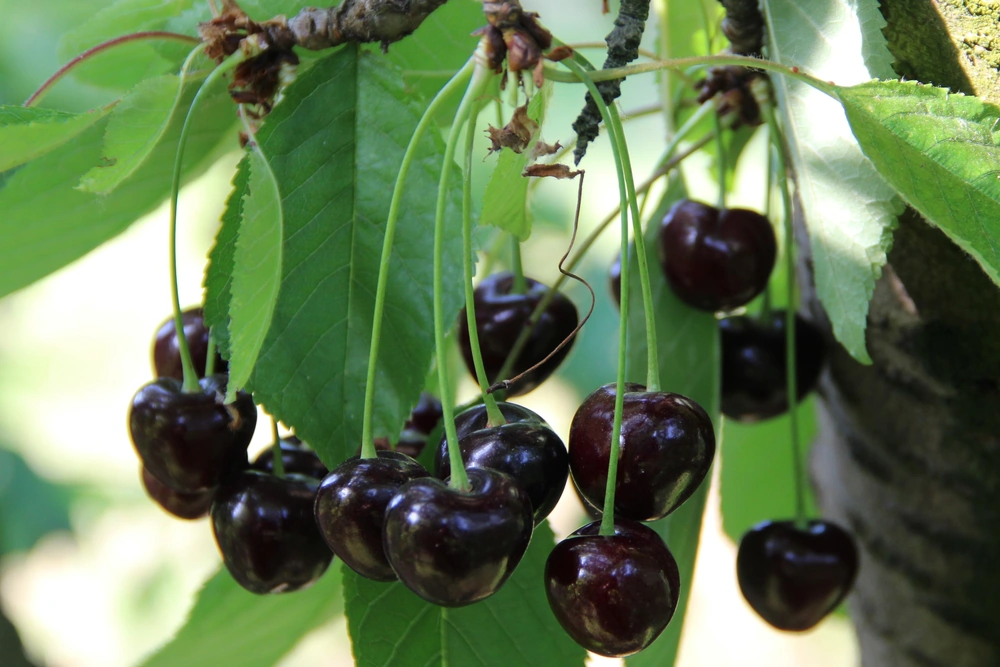
Among the most significant innovations is Nipama. In fact, 2026 is the first year in which Viveros Ebro has been able to assess the first fruit produced in Europe from this cherry variety.
Although it is not self-fertile, Nipama stands out for its very high productivity. Initial observations have highlighted promising characteristics in several respects, including colour, size, firmness, earliness and sugar content.
Particular attention was also paid to its postharvest performance. Fruit harvested around 20 April and stored under refrigerated conditions remained firm and in optimal condition for more than 30 days.
According to Marsal, this result reinforces the commercial potential of the variety.
Nipama also has a low chilling requirement, a characteristic that favours its adaptation to areas with mild winters. Its flowering period coincides with that of Royal Tioga, which the company identifies as one of the most suitable options for ensuring effective pollination.
SPC-108: productivity and large fruit size
Viveros Ebro is also preparing to begin the commercialisation of SPC-108, a variety marketed under the Sanaqueta brand.
This Canadian genetic selection was recently registered in Spain, and its distribution is expected to be subsequently extended to other European markets. Its main strengths include high production capacity and a low chilling requirement.
Flowering occurs during the same period as Lapins. SPC-108 is also self-fertile and shows good resistance to cracking, a particularly important characteristic in areas subject to rainfall during the stages close to harvest.
According to the assessments presented by Marsal, the variety can achieve large fruit sizes even under heavy crop loads, without compromising the fruit’s organoleptic characteristics.
New options for low-chill growing environments
The company’s varietal development work also includes Royal Apache and SMS-416. Both have shown good adaptation to conditions characterised by limited winter dormancy and ripen earlier than Santina.
The trials carried out to date have produced positive results, broadening the range of options available to growers operating in the early and intermediate stages of the season.
The objective is not merely to bring the harvest forward, but to identify genetics capable of combining productivity, climatic adaptation, fruit quality and agronomic reliability.
Ribera d’Ebre expects a regular, high-quality crop
For the current season, Viveros Ebro expects production in the Ribera d’Ebre to remain within normal levels, without particularly high crop loads per hectare.
This situation could favour the final quality of the cherries. A balanced crop load should allow growers to obtain fruit with good size, high firmness and an appropriate sugar content in the flesh.
The harvest calendar appears to be considerably earlier than in previous seasons. Provided that weather conditions remain favourable, Marsal believes that the area’s cherry orchards could produce fruit of particularly high quality.
Earliness and quality have long been two of the distinguishing features of cherry production in the Ribera d’Ebre.
Positive prices during the previous season
Looking back at the previous season, the research director of Viveros Ebro recalls favourable price trends.
The market did not experience any oversupply, and cherry prices generally remained strong. This trend may have been supported by the lower availability of fruit from countries such as Turkey and Greece, which were affected by severe spring frosts.
The reduction in international supply therefore helped maintain a more balanced market, supporting the value of the available production.
The search for genuinely improved varieties
Customer demand continues to focus on new varieties. However, for Viveros Ebro, innovation must be accompanied by tangible progress compared with the cultivars already available.
New selections must offer verifiable advantages, for example in terms of organoleptic quality, productivity or adaptation to agroclimatic conditions.
For this reason, the preliminary work carried out by breeders and nurseries plays an essential role.
Each new genetic selection must be tested in the field and compared with previous varieties under the same growing conditions, so that its actual improvements can be determined more accurately.
“The Collection”, Viveros Ebro’s experimental orchard
The company’s experimental orchard, known internally as “The Collection”, is the tool through which Viveros Ebro assesses the performance of new genetics.
All the factors that determine the agronomic and commercial management of a variety are monitored at the site, including flowering time, ripening period, winter chilling requirements and response to local conditions.
New introductions are compared with varieties already present in the orchard. Only through this assessment is it possible to establish whether a variety has sufficient characteristics to outperform previous selections and provide a tangible advantage to the grower.
Support from rootstock selection to orchard management
Viveros Ebro’s customers include a wide range of profiles, from private individuals interested in growing a plant on their balcony to companies developing large-scale fruit-growing projects covering numerous hectares.
In every case, the service begins by identifying the solution best suited to the customer’s specific requirements. Support may begin before planting, with the selection of the appropriate rootstock and variety, and continue throughout the entire productive life of the orchard.
The areas covered also include pruning, tree training and the overall management of the orchard. This ongoing assistance transforms nursery production into a technical and consultancy service.
More than 50 years of family experience and innovation
The history of Viveros Ebro now spans more than 50 years. During this period, the company has experienced widely differing seasons, building up a wealth of knowledge that is now shared with its customers.
While continuing to retain its identity as a family business, the company operates through a team of professionals engaged in research, experimentation and technical support.
The initial assessments of Nipama, the commercial launch of SPC-108 and the work on varieties suited to low-chill conditions indicate the direction for the future: developing a cherry industry capable of responding to climatic and production changes without compromising fruit size, firmness, sweetness and overall quality.
Text and image source: Valencia Fruits
Cherry Times - All rights reserved