In stone fruits, many of the characteristics that determine yield, fruit size, and quality at harvest are established well before ripening. Indeed, during the early stages following flowering — pollination, fertilization, fruit set, intensive cell division, and pit hardening — the ovary is directed either toward fruit development or toward growth arrest and abscission.
A recent review analyzed the most up-to-date evidence on the role of endogenous hormones in the early development of fruit in Prunus species, highlighting how auxins, gibberellins (GA), cytokinins (CTK), and abscisic acid (ABA) constitute the core of a dynamic regulatory network.
Development generally follows a double-sigmoid growth curve. During the first phase, cell division and expansion predominate, supported by auxins, gibberellins, and cytokinins; the second phase coincides with endocarp lignification and pit hardening, whereas the third is characterized by intensive mesocarp expansion and fruit ripening.
Auxin and fruit set
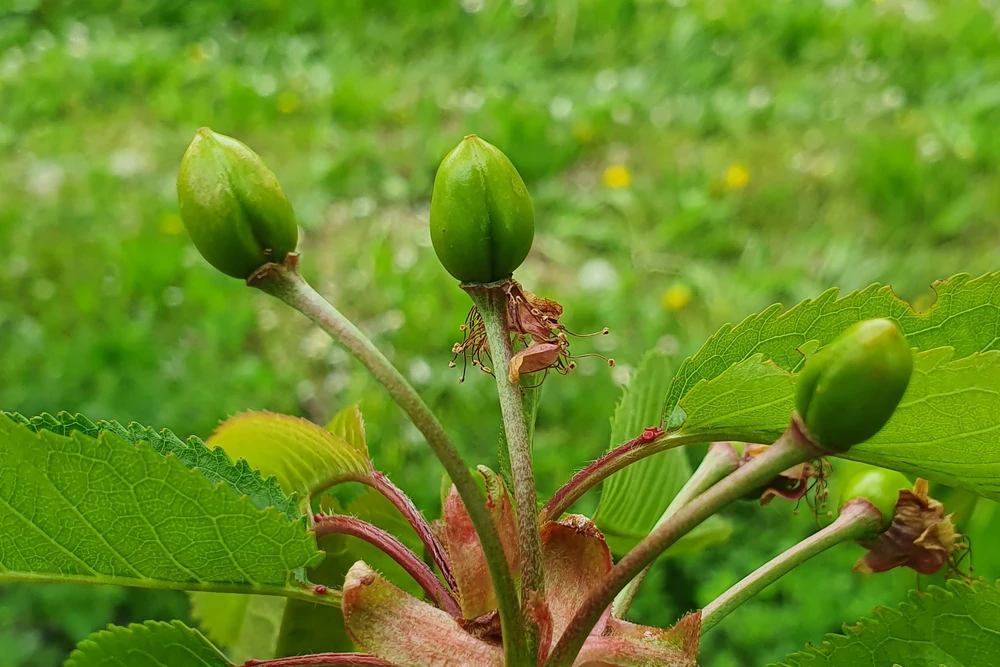
Among the regulators considered, auxin represents one of the main signals initiating fruit set. Following fertilization, increased indole-3-acetic acid (IAA) biosynthesis in the ovule and enhanced polar transport through the pedicel promote the activation of young fruit growth.
Insufficient auxin availability, in contrast, is associated with fruit abortion, whereas maintenance of auxin transport contributes to preserving the connection between the fruit and the plant. Gibberellins play a complementary role: in addition to supporting cell division and expansion, under certain conditions they can substitute for the signals normally generated by pollination and fertilization, thereby promoting fruit set and parthenocarpy.
The interaction between auxin and GA therefore appears to be particularly important: IAA contributes to initiating the developmental program, while GA sustains fruit growth. Cytokinins reinforce this system by promoting cell proliferation.
In peach, for example, CTK levels reach high values during the first weeks after full bloom, coinciding with the phase of intensive cell division; higher levels are also associated with large-fruited cultivars.
Role of ABA
At the opposite end of the regulatory spectrum is ABA, which acts predominantly as an inhibitory signal. Its accumulation can restrict growth and promote senescence and abscission, and it becomes particularly relevant under stress conditions or when fertilization fails.
The key message of the review is therefore that no hormone acts in isolation: the fate of the young fruit depends on the dynamic balance between growth-promoting and inhibitory signals.
This network is continuously reprogrammed according to developmental stage, tissue, and environmental conditions; drought, temperature, and other stresses can increase ABA levels and antagonize GA-, CTK-, and auxin-mediated pathways.
Cherry orchard management
For the management of cherry orchards and other stone fruit crops, this perspective therefore suggests that hormonal regulation should not be viewed simply as the application of individual plant growth regulators, but rather as an integrated system that can be modulated through appropriate orchard management.
The objective is to promote conditions that support fruit set and early fruit growth while limiting premature ABA accumulation. According to the researchers, a better understanding of these interactions could contribute to improving fruit set, reducing early fruit drop, and increasing yield consistency.
Source: Zhang, S., Sun, Y., Zhou, X., & Deng, Z. (2026). The Role of Endogenous Hormones in Regulating Early Development of Stone Fruit. Plants, 15(6), 890. https://doi.org/10.3390/plants15060890
Image source: Stefano Lugli
Andrea Giovannini
PhD in Agricultural, Environmental and Food Science and Technology - Arboriculture and Fruitculture, University of Bologna, IT
Cherry Times - All rights reserved