Cherry leaf roll virus (Nepovirus avii) is a plant virus that can cause decline and death in sweet cherry (Prunus avium), sour cherry (P. cerasus) and black cherry (P. serotina) trees. It has a wide host range among woody plants, although a specific host strain will typically not infect another plant genus under natural conditions. In cherry, the virus spreads primarily through infected propagative materials and can move locally through root grafts between neighbouring trees. It is unlikely to spread through fresh fruit and does not affect human or animal health.
How the virus spreads in cherry
Primary spread
Infected propagative materials
→
Local spread
Root grafts between neighbouring trees
Fresh fruit is an unlikely route of spread. The virus does not affect human or animal health.
Where it is
Cherry leaf roll virus occurs across several regions worldwide, including most of Europe, North America, Africa, Asia, South America and Australasia. In Canada, strains have been reported on golden elderberry (Sambucus nigra) in British Columbia and American elderberry (Sambucus canadensis) in New Brunswick. The virus is also known to occur throughout the natural range of elm trees (Ulmus spp.).
Only a few cases have been recorded in sweet cherry trees in Canada, and all infected trees were removed.
How to spot it
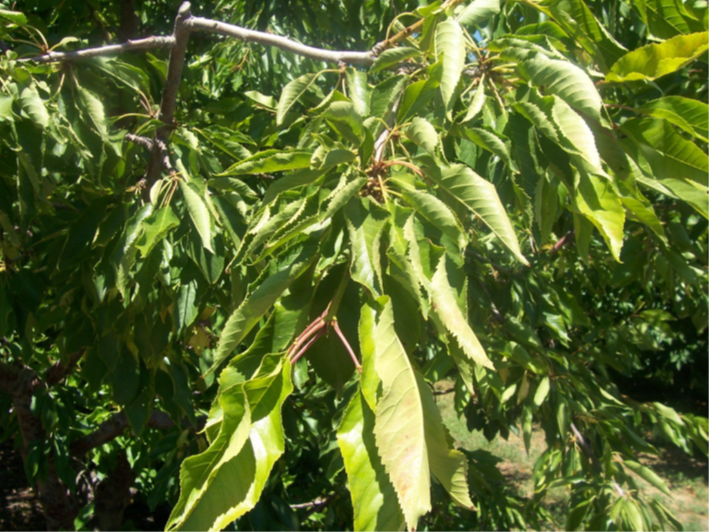
Healthy leaf (left) and infected leaf (right), showing yellowing and curling of the leaf margin caused by the virus. Image source: Rodoni et al. 2018; CC BY 3.0.Leaf rolling caused by the virus. Image source: Rodoni et al. 2018; CC BY 3.0.Healthy shoot (left) and infected shoot (right), showing the shorter internodes caused by the virus. Image source: Rodoni et al. 2018; CC BY 3.0.
In sweet cherry trees, the virus can delay and weaken leafing out and flowering. Infected leaves may develop yellow spots and margins that roll upwards. In some cultivars, leaves turn purple-red prematurely.
Other symptoms in susceptible cultivars include shortened internodes, branch dieback and bark splitting. Most trees show symptoms about five years after infection.
Symptoms and timing
Leaves and flowering
Delayed, weaker leafing out and flowering
Leaf symptoms
Yellow spots, upward-rolled margins and, in some cultivars, premature purple-red colour
Tree symptoms
Shortened internodes, branch dieback and bark splitting
Symptoms appear about five years after infection in most trees.
Use certified, virus-free propagative materials to help prevent the virus from being introduced and spreading.
If the Canadian Food Inspection Agency (CFIA) confirms the virus in an orchard, remove the infected trees and treat the stumps with a systemic herbicide. Trees that were root-grafted with the infected trees should also be removed.
Import only cherry trees produced under a CFIA-accepted virus certification program that certifies the material as free from cherry leaf roll virus.
What we are doing
Cherry leaf roll virus is a regulated pest in Canada. The CFIA has included regular testing for the virus in the requirements for cherry trees produced under the Canadian Fruit Tree Export Program. If the virus is detected, official control measures are put in place to prevent its spread.
Cheery Glow, Bloom Fresh’s early cherry, is expanding in Chile with 200 hectares. Low chill requirement, high quality and up to 60 days storage make it ideal for export to China, Europe and the United States, helping growers face climate challenges and competitive global markets.
In a two-year study, the nets reduced the damage caused by birds and SWD. Nets can be an effective way to protect crops and reduce dependence on pesticides.
Rain and hail in Chile have damaged crops, while a truckers’ strike in San Antonio threatens shipments. Cherry output could reach about 115 million boxes, below the 140 million estimate. Weather and logistics are clouding the 2026-2027 season and its export outlook.
Cherry leaf roll virus affects sweet, sour and black cherry trees. It is regulated in Canada, where symptoms may appear about five years after infection. The article outlines how it spreads and measures to prevent its introduction and contain the virus in orchards.