Accurate and timely detection of surface microcracks is crucial for monitoring sweet cherry quality. Cracking can compromise the commercial value of the fruit and facilitate the entry of microorganisms responsible for rots, negatively affecting storability and increasing losses along the supply chain.
In addition to requiring substantial labor, manual inspection can be inconsistent, while conventional computer vision systems struggle to distinguish the finest cracks from normal irregularities in the fruit skin.
How the YOLO-CY model works
A recent study proposes a deep learning-based solution, developing YOLO-CY, a visual detection model designed to identify cracks with high accuracy while maintaining low computational requirements and performance compatible with automated sorting lines. The system is based on the YOLO11 architecture, a neural network used for object recognition and localization in images, and introduces three structural modifications tailored to the characteristics of cherry cracks.
The first, called C3k2_AdditiveBlock, improves the extraction and combination of visual information at different scales, increasing sensitivity to small cracks. The second, C2PSA_CGLU, refines the selection of local features through a channel-attention mechanism, facilitating the distinction between discontinuities in the fruit surface, normal skin texture, and shadows cast by the stem.
The third modification introduces the Efficient Up-Convolution Block (EUCB), which improves the reconstruction of spatial information during image processing, preserving details along lesion boundaries and enabling more accurate localization.
Results on the tested samples
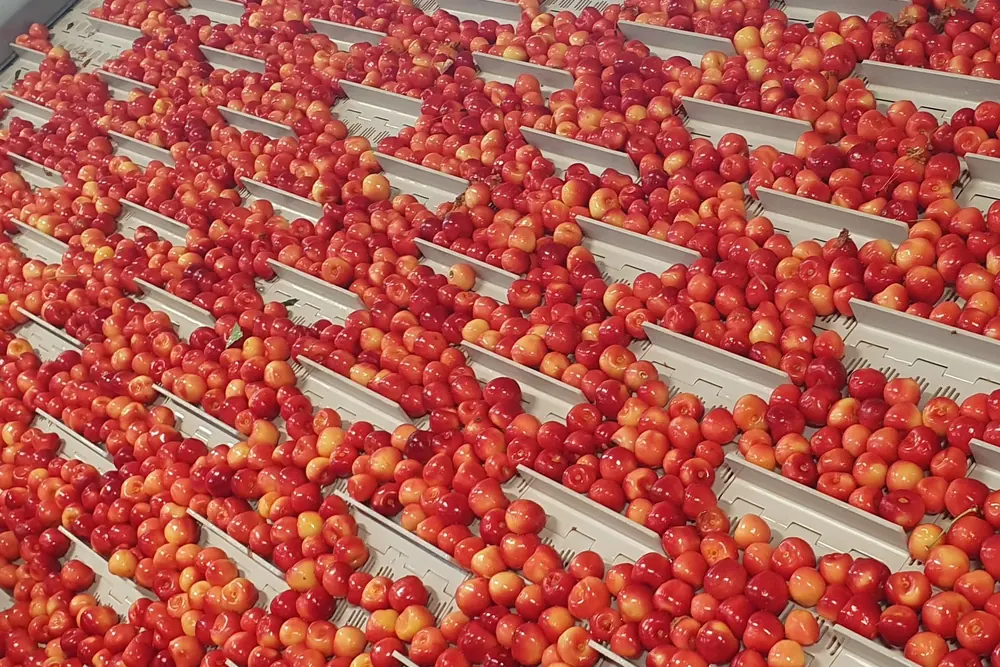
The model's effectiveness was evaluated using a dataset compiled by the researchers themselves, consisting of 3,662 cherry images acquired on an actual sorting line under natural ambient lighting conditions. The dataset included 1,878 intact fruit and 1,784 fruit with cracking, covering different defect configurations, from fine linear lesions to low-contrast cracks, those overlapping with the stem, and those occurring in closely spaced clusters.
The results demonstrate better performance than the reference models evaluated. YOLO-CY achieved a precision of 93.90% and a recall of 90.81%, while mean average precision (mAP50) reached 94.88%.
This metric summarizes the model's ability to correctly detect defects and localize them in images, using a 50% overlap threshold between the predicted and reference areas. The improvement was particularly relevant for more challenging samples: under these conditions, YOLO-CY achieved an mAP50 of 92.6%, a precision of 93.2%, and a recall of 90.0%, confirming its improved ability to detect fine, low-contrast, or partially concealed cracks.
In terms of processing speed, the model reached 160 images per second during inference alone and 125 frames per second when considering the entire pipeline, including preprocessing and postprocessing. Ablation experiments also confirmed that the improvement resulted from the complementary integration of the three modules.
YOLO-CY at a glancePerformance reported in the study
94.88%Overall mAP50
93.90%Overall precision
90.81%Overall recall
Metric comparison (%)
mAP50
94.88
Precision
93.90
Recall
90.81
Inference only160 images/s
Full pipeline125 frames/s
Prospects for automated sorting
Overall, the results show that YOLO-CY can make automated defect detection more reliable without compromising operational speed.
Its use could therefore help make commercial sorting more consistent, reducing the risk of cracked fruit escaping detection and proceeding to subsequent stages of the supply chain. However, experimental performance must be distinguished from full industrial validation.
This technology represents a promising solution for automated cherry quality control, but its adoption on a commercial scale will require further testing across different cultivars, sorting facilities, and operating conditions.
Source: Sun, Y., Miao, X., Zhang, Y., He, Z., Tao, X., Wang, Z., Hou, T., Ren, P., & Wang, W. (2026). Lightweight and High-Precision Visual Detection of Cherry Cracking Defects Based on Improved YOLO11 with Enhanced Feature Fusion. Agriculture, 16(10), 1110. https://doi.org/10.3390/agriculture16101110
Image source: Stefano Lugli
Andrea Giovannini PhD in Agricultural, Environmental and Food Science and Technology - Arboriculture and Fruitculture, University of Bologna, IT
In Canada, Vineland's sweet cherry breeding program presents five selections, including Prism®. Fruit up to 30 mm in diameter, early ripening, self-fertility and resistance to rain cracking highlight the key traits of these new cherry varieties for Canadian growers.
The high production of cherries in Chile requires new storage strategies. A study evaluates the use of controlled atmosphere on different varieties, analysing the impact on quality, physiological disorders and post-harvest damage while awaiting the packaging process.
YOLO-CY detects sweet cherry cracks with high accuracy and speed. Tested on 3,662 images, the model achieved 94.88% mAP50 and processed 125 frames per second. Further validation across varieties, sorting lines and operating conditions is still needed before rollout.
Chilean cherries in China are shifting from Lunar New Year gifts to everyday fruit. With prices falling and consumers focused on value, Ipsos outlines four strategies to reach new audiences, highlight quality and wellbeing, and build year-round demand in China and retail.