Cherries already leave little room for manoeuvre: they must be harvested, processed and sent to the market within an extremely short timeframe.
When the weather accelerates ripening and concentrates the supply into just a few days, management becomes a race against time.
This is the context in which the 2026 campaign should be viewed, complicated by high temperatures, disrupted production schedules and a sudden overlap between different growing areas.
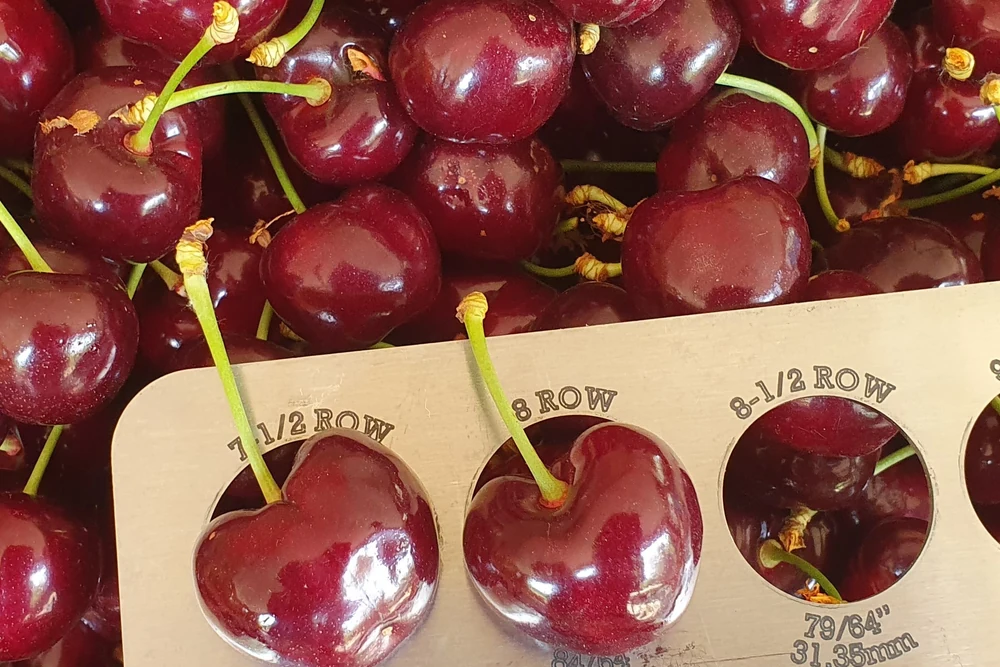
Extremely short timeframes
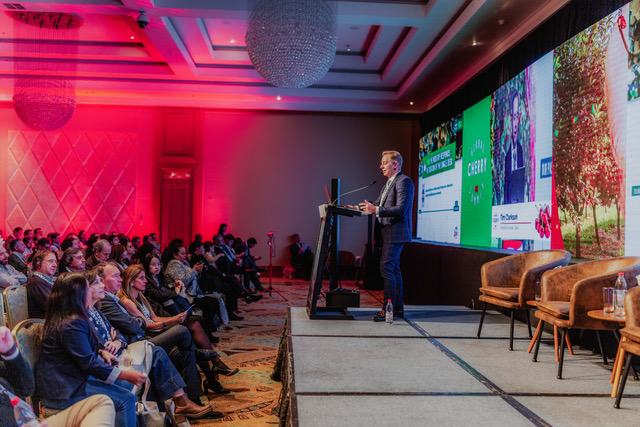
Enrico Bucchi, general manager of Valfrutta Fresco, provided an overview during the online meeting Forum Tutto l’Anno, organised by Impresa Persona Agroalimentare.
“When I talk about cherries, around two-thirds of the volume I am referring to is Vignola PGI Cherry,” Bucchi explained. “Under our management model, this product has a very limited holding time of no more than 36-48 hours.”
A comparison with last year is inevitable. “In 2025, we started with exceptionally high prices, supported by frost damage in Turkey and Greece and production difficulties in Apulia.
At that time, cherries from Northern Italy, between Emilia and Trentino, were practically the only ones available, allowing us to achieve a memorable campaign from every point of view.”
Weather conditions
This year, the situation was different. During the final weeks of May, particularly in the Vignola area, temperatures rose rapidly, reaching highs of 32-33°C, while night-time temperatures also remained elevated.
“We experienced an unusual weather pattern, with very high temperatures as early as the end of May. This triggered accelerated ripening,” Bucchi observed.
Meanwhile, in Apulia, initially milder conditions delayed the start of the harvest, altering the usual balance of the production calendar.
Overlapping production schedules
“In practice, there was a reversal. Apulia arrived later, Vignola accelerated and we found ourselves facing a significant overlap.
As if that were not enough, the Trentino season also began early, once again because of the high temperatures. Last but not least, Turkish and Greek competitors returned to full production.
The result was an oversupply concentrated into just a few days.”
From a production perspective, therefore, it was a generous season, and the Alegra Group, of which Valfrutta Fresco is a member, had to manage very high daily peaks, placing considerable pressure on product intake, sorting and sales.
Record production
“Agrintesa recorded an all-time production high of more than 3,000 tonnes, of which 60-65% was PGI-certified. Given the circumstances, operational management represented a major challenge for our entire supply chain, from product intake and sorting to packaging and commercial planning, but one that we successfully overcame.
Field yields were higher, while the Vignola PGI Cherry maintained a significant price premium. The distinctive nature of both the brand and the product was also crucial in this respect, with the cherries achieving an exceptionally high quality level.”
According to Bucchi, these factors helped limit the effects of commercial pressure. “Despite the challenging circumstances, we still managed to achieve a satisfactory result for our members, as the higher yields offset the decline in prices.
This outcome could not be taken for granted, because when supply becomes concentrated so rapidly, the market comes under considerable pressure.
Strong demand
Our performance was also supported by very strong market demand from the outset, which remains high even now. As shown by the Nielsen research we presented last year, cherries remain extremely popular among consumers.
We are also satisfied with the performance of production from Agrintesa members in the Romagna growing area. This is a growing, high-quality segment that we now promote under the Valfrutta Fresco brand and which has been selected for some of the leading national premium private labels.”
Looking ahead, the key issue remains the weather. “It will increasingly act as both referee and judge of our campaigns,” Bucchi emphasised.
“We try to limit the risk by covering our cherry orchards, but further investigation will be necessary. Covers help protect against rain and hail, but excessive heat is becoming an increasingly serious problem.”
Agronomic research
This highlights the need to strengthen research, not only into new varieties but also into the agronomic management of orchards.
“The Vignola PGI Cherry Consortium is also working through its experimental orchard. The objective is to improve the ability of cherry orchards to adapt to new climatic conditions, because what we witnessed this year could happen again.”
From a commercial perspective, Bucchi’s assessment is equally clear. “The success of the PGI demonstrates that distinctive projects based on quality and territorial identity can deliver results even during challenging campaigns.
Commercial vision
However, this requires an organised supply, the concentration of production and effective promotional and communication activities.
Solid commercial planning is also essential: projects such as the PGI are built one brick at a time, over the years and with vision and foresight.
That same vision and foresight distinguished people such as Andrea Bernardi, first and foremost, who devoted an entire lifetime to creating a successful model for the cherry growers in our area.”
In other words, the PGI did not eliminate the difficulties of a campaign shaped by high temperatures and overlapping production periods. However, it made it possible to protect value in a market that was more crowded than expected.
Source: www.italiafruit.net
Image source: Stefano Lugli
Cherry Times - All rights reserved