Plant grafting with dwarfing rootstocks is one of the most important management practices in the sweet cherry sector. Various hypotheses have explained the differences in cultivar vigour induced by dwarfing rootstocks, including that rootstocks can regulate scion growth by influencing water and solute supply, hormone synthesis and transport, and the anatomy of the graft union.
At the molecular level, however, the mechanism of action is still unclear. Currently, an increasing number of studies have shown that DNA methylation is involved in rootstock-scion interactions and that grafting causes alterations in scion DNA methylation.
DNA methylation is a vital epigenetic (i.e. phenotypic) modification and influences a variety of physiological processes in plants through the regulation of gene expression. The study conducted at the University of Guizhou (China) aimed to investigate the impact of the dwarfing rootstock ‘Pd1’ (Prunus tomentosa) on sweet cherry ‘Shuguang2’ shoots.
To achieve this goal, morphological observations were conducted, gibberellin and auxin contents were detected using high-performance liquid chromatography, and epigenome and transcriptome integration analyses were implemented.
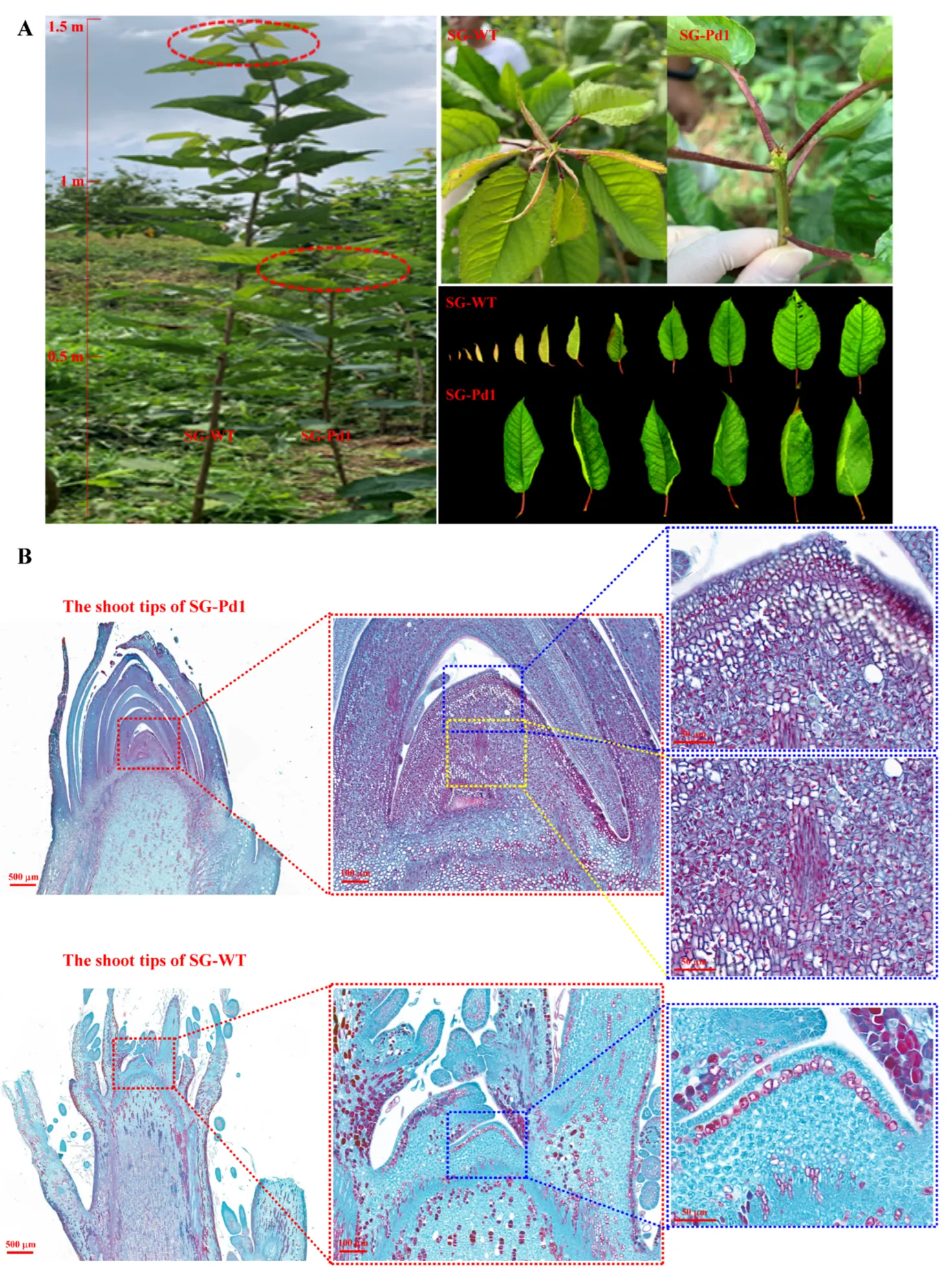 Immagine 1: Crescita e osservazione anatomica dei germogli. (A) Piante innestate allo stadio di ristagno della crescita (195 giorni dopo l'innesto). I cerchi rossi indicano gli apici dei germogli. (B) Osservazione anatomica degli apici dei germogli. SG-Pd1: Ciliegio dolce “Shuguang2” innestato su portainnesto Pd1 (nano); SG-WT: Ciliegio dolce “Shuguang2” innestato su portainnesto wild-type (vigoroso).
Shoot length growth was strongly reduced by the dwarfing rootstock ‘Pd1’, as indicated by anatomical analysis. The activity of the shoot apical meristem allows the vertical growth of the plant and thus also its growth in height. Plants grafted onto dwarfing rootstock showed a smaller apical meristem surrounded by lignified scales.
Furthermore, the cells in the outermost area of the bud were densely arranged, suggesting that the cell division capacity of the apical meristem in plants on dwarfing rootstock was reduced. The diameter and length of internodes are the most direct growth indicators to assess the degree of vigour of trees. In this investigation, the data showed that the growth vigour of sweet cherry rootstocks was significantly reduced by dwarfing ‘Pd1’ rootstocks.
Also gibberellin and auxin levels were significantly reduced by the ‘Pd1’ rootstock. An increasing number of studies have shown that grafting induces DNA methylation alterations in cultivars. In contrast to sweet cherry rootstocks grafted onto wild-type (vigorous) rootstocks, the overall level of genomic methylation of sweet cherry rootstocks grafted onto ‘Pd1’ (dwarfing) rootstocks was higher. However, the mechanisms by which the rootstock induces methylation changes in the rootstock are not yet fully understood.
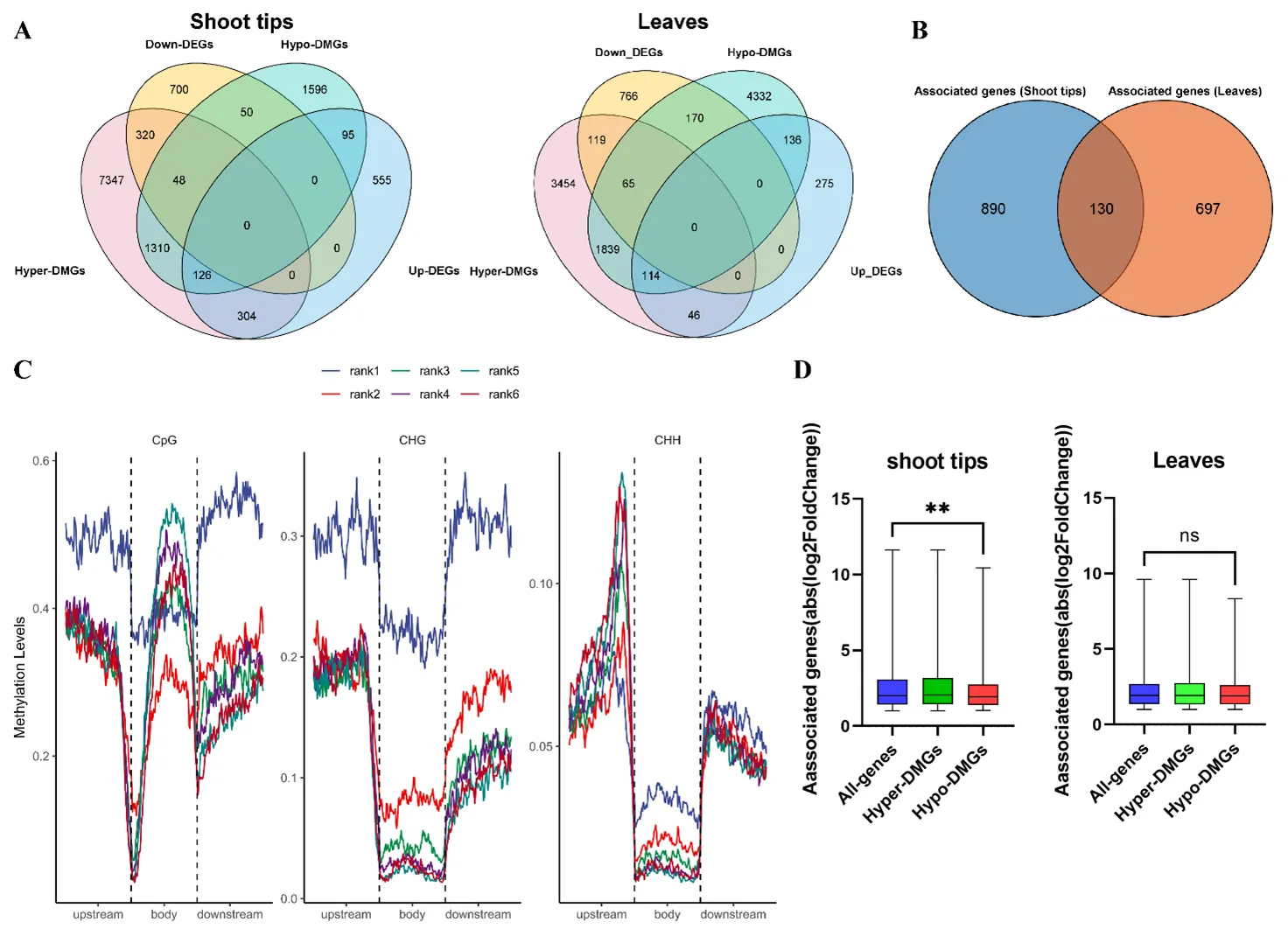 Immagine 2: Analisi della correlazione tra metilazione del DNA ed espressione genica. (A) Analisi del diagramma di Venn dei DEG e dei DMG negli apici dei germogli e nelle foglie. (B) Analisi del diagramma di Venn dei geni sovrapposti negli apici dei germogli e nelle foglie. (C) Distribuzione dei livelli di metilazione all'interno dei geni suddivisi per livelli di espressione: il rango 1 è il più basso e il rango 6 è il più alto. (D) Livelli di espressione differenziale di tutti i geni, geni ipermetilati e geni ipometilati, visualizzati come boxplot. I valori di Wilcoxon p sono indicati con ** (valore p < 0,005). Inoltre, ns indica “non significativo”.
This investigation provides a methylome map of the sweet cherry genome, reveals the extensive DNA methylation alterations in rootstocks caused by dwarfing rootstock, and identifies a significant number of genes with methylation and transcriptional alterations that could be involved in rootstock-induced growth changes in sweet cherry rootstocks.
Our results may serve as a solid basis for further epigenetic investigations of dwarfing rootstocks used on cherry and offer valuable new insights into the understanding of rootstock-graft interactions.
Source: Hong, Y.; Wen, Z.; Qiao, G.; Tian, T.; Wen, X. Single-Base Methylome Analysis of Sweet Cherry (Prunus avium L.) on Dwarfing Rootstocks Reveals Epigenomic Differences Associated with Scion Dwarfing Conferred by Grafting. Int. J. Mol. Sci. 2024, 25, 11100. https://doi.org/10.3390/ijms252011100.
Images: Yi Hong et al., 2024
Melissa Venturi
University of Bologna (IT)
Cherry Times - All rights reserved