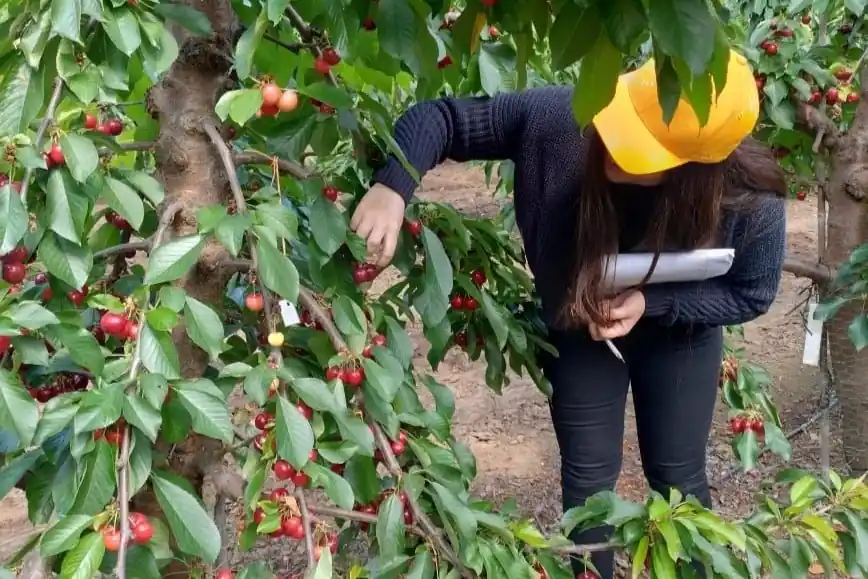
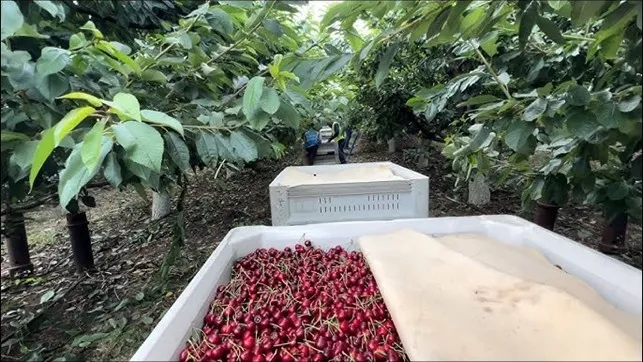
Five varieties of cherries are harvested in Chile Chico for sale in Chile and abroad, three decades after the Agricultural Research Institute, through the INIA Tamel Aike Regional Center, promoted the creation of orchards in this municipality in the General Carrera Lake basin.
According to Camila Reyes, director of the INIA Tamel Aike Regional Center, on the Frutas de Chile website, “at the time, the Ministry of Agriculture sought to diversify regional forestry and livestock activities, which were primarily focused on livestock and horticulture. Therefore, in 1995, INIA Tamel Aike began evaluating the fruit growing sector in the area, which became an interesting regional initiative.”
“Preliminary results indicated that there were two species of great technical and commercial interest: apricot and cherry,” recalled INIA Tamel Aike agronomist Diego Arribillaga García.
Due to the harvest period (January),” he added, “the locality was the only supplier of fresh fruit. This led, in 1998, with the support of a Regional Government project, to the creation of the first 40 hectares of commercial cherry orchards, managed by small producers in the localities of Bahía Jara, Chile Chico, and Puerto Ingeniero Ibáñez.”
Currently, the region has 244 hectares dedicated to cherry production (INE 2022) in the Chile Chico valley, reflecting the interest in the fruit growing sector in the region.
Esteban Milovic, from Agrícola Chile Chico Cherry Limitada, is one of the entrepreneurs who have invested in this sector. A dentist by profession, Milovic was motivated to embark on this family project in the early 2000s, driven by the knowledge of the work developed by INIA. He recounts that they realized the comparative advantage they had over the central zone, as the cherry harvest was significantly later, allowing them to enter the international market at a time of low production in other regions.
“We entered the market at a key moment for Europe and the United States, the main markets at the time. Together with INIA, we developed a collaboration strategy, formed a Technology Transfer Group (GTT) with small producers receiving state support, and we, also small in terms of land area, formed an alliance to channel our fruits and bring them to Europe,” commented Milovic.
Since 2007, Javier Cereceda of Agrícola Austral Cherry, in the Bahía Jara area, has followed a similar path. He began planting in 2011 and consolidated his production in 2015 with varieties such as Kordia, Regina, Sweetheart, and Lapins. Cereceda highlights the contribution of research developed by INIA, which paved the way for his company.
“Agriculture in Patagonia is not easy; fruit growing is even more challenging, and we see very positively the entrepreneurial ideas developed that allow us to move forward and find new opportunities for products in this area,” concluded Cereceda.
Differentiation and technological improvements in production to advance
Chile has consolidated its position as the world's leading cherry exporter, with forecasts of 131,587,007 boxes to be sold abroad by the 2024-2025 season, according to the Chilean Cherry Committee. This represents an increase of approximately 59% compared to the previous season.
In this context, the challenge for regional production is to stand out in the international market through quality, as late production is no longer a differentiating factor.
According to Diego Arribillaga, “between 2002 and 2003, thanks to a project funded by the AFI, INIA introduced the Kordia variety for the first time. It delivered excellent results, with a very good size, and today it has established itself in the market.” INIA handled the technical aspects, demonstrating that this variety and its rootstock work quite well. The rest was the gradual push from fruit-growing companies.”
Javier Cereceda agrees on the importance of “creating a competitive advantage, because the market prefers it, whether it is early, mid-season, or late.” Producing Kordia in Chile’s central valley is more challenging due to the amount of cold during winter, which is below the variety’s requirements. Here, however, it can be produced as a main variety, giving us the opportunity to offer the market a cherry it demands, desires, and recognizes.”
Esteban Milovic reiterated that the challenge lies in achieving this differentiation, both with the Kordia variety and with new varieties to be implemented: “This is now the challenge, to see if after so many years we can awaken this interest, producing quality fruits recognized worldwide, and maintaining our position as cherry producers, given that the rules of the game have changed.”
Continuing research and opening markets
One of the characteristics of the fruit industry is its dynamism and the climatic challenges that necessitate continuous research into new varieties that allow for deeper differentiation of niche cherry production.
For this reason, since 2022, with the support of fruit-growing entrepreneurs from the municipality, such as Ramón Jorge Vega (Las Parámelas), Javier Cereceda (Agrícola Austral Cherries), and Soc. Agrícola Copequen Ltda., together with ANA Chile, INIA has developed a line of research focused on evaluating four new cherry varieties recently introduced to Chile: Areko, Pisue 177, Sweet Stephany, and Sweet Saretta.
In addition, it is essential to continue advancing in productive diversification, represented by viticulture, which already has positive experiences in the vineyards of the General Carrera Lake basin. However, like cherry production, it requires long periods of experimentation and research to create protocols and technological packages.
In the far south, these packages must include strategies for frost management and mitigation of losses caused by birds. INIA is working on the development of a protocol that will provide effective tools for growers, ensuring a promising future for the region’s fruit growing. “We, as INIA, handle the technical side, but it is the producers and entrepreneurs who position the fruit in the market,” summarized Diego Arribillaga G.
Source: Smartcherry
Image: INIA
Cherry Times - All rights reserved