The Cherry & Kiwi Conference, jointly organized by Abud & Cía. and the Centro de Innovación Montefrutal (CIM), brought together key leaders and experts in the fruit sector to discuss the future of these two crops. With the participation of over 300 people, 26 sponsors, and five collaborators, the event stood out for its comprehensive approach to commercial and technical aspects.
The event offered a comprehensive analysis of the market and sustainable practices for managing cherries and kiwis, addressing economic, social, and environmental aspects. The commercial block highlighted the experience of industry leaders, who presented the challenges, opportunities, and threats facing these two fruit crops.
Among the attendees were the Undersecretary of Agriculture Ignacia Fernández, the Seremi of the Maule Region Claudia Ramos, and agricultural sector authorities, including Iván Marambio, President of Frutas de Chile; Carolina Dosal, President of FruSéptima; Carlos Cruzat, President of the Kiwi Committee; Claudia Soler, Secretary General of the Cherry Committee; Carolina Torres, Director of Amagro; and Laureano Goycoa, President of the Kiwi Producers Chamber of Mar del Plata, Argentina.
In the commercial block, we had significant industry references with extensive experience and background, both speakers and presenters, who provided insights into the challenges, opportunities, and threats of these two iconic fruit trees.
The experts who participated in this block included Claudia Soler, Executive Director of the Cherry Committee; Orieta Ramirez, General Director of Exportadora Frusan; Ivan Marambio, President of Frutas de Chile; Claudio Vial, General Director of Exportadora Rancagua (Ranco Cherries); Carlos Cruzat, President of the Kiwi Committee; and Camilo Alvarado, Representative of Dalian Yidu Group.
After his presentation, Iván Marambio assured that "as Frutas de Chile, it is very important to participate in this type of event, as we can share the work we do to promote the development and growth of the sector, as well as analyze the positive aspects and the challenging ones that drive us to work together."
"This work has led to positive results in this 2023-2024 season, where, from January to June, we have grown in exported volumes by about 6% and in value by 15%."
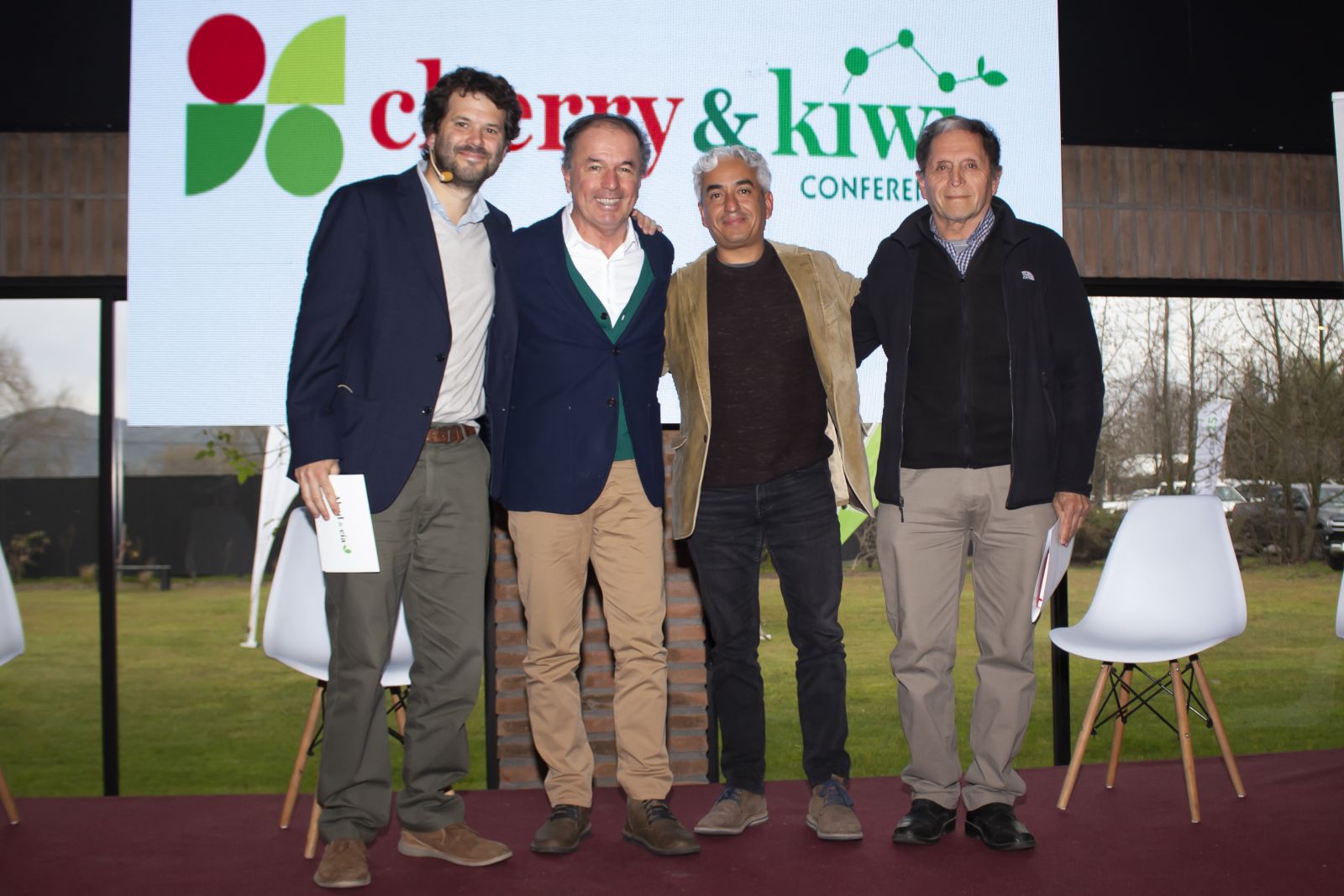
The seminar continued with the technical block on cherries, with contributions from Walter Masman, technical consultant and specialist in cherries and stone fruits; Christian Abud, Executive Director of Abud & Cía.; and Óscar Carrasco, Professor of Fruit Growing at the University of Chile and fruit consultant, specialist in pome and stone fruits.
Masman spoke about the new varieties of cherry trees, and Christian Abud delved into the productive equation of this season (high productive potential) and how to handle weather conditions well, as this season is very different from the previous one and offers different challenges.
Christian Abud, organizer of the Cherry & Kiwi Conference and speaker in the technical block on cherries, explained that "the sector greatly appreciated the focus of the seminar, the quality of the presentations, and the complementary nature of production of kiwis and cherries in the same field."
"We are proud of the work of our Centro de Innovación de Montefrutal (CIM), led by Dr. Luis Ahumada, which allows us to carry out applied research with great impact in orchards and to disseminate it to the fruit industry." The Executive Director of Abud also added that "over the years, we have demonstrated that addressing sustainability is imperative because it allows us to improve the profitability of orchards."
Matías Vallo, for his part, commented that "the invitation was very good, to be able to come, to learn a bit from the experience they have here in Chile and also to be able to tell them what we are doing in kiwis. It was very nice to participate in the panel of experts, where we could share some experience and the vision we have for kiwis in Argentina. We are in a renaissance of kiwis and have established a foundation to feed the experience of both Chile and Argentina."
Regarding the event, Christian Abud stated that "this event has become a valuable platform for sharing knowledge and strategies that can be directly applied to the reality of cherry and kiwi production."
The Cherry & Kiwi Conference 2024 stood out for its ability to bring together two important fruit crops, showcase their complementarity, and offer a valuable exchange of knowledge, meeting the expectations of over 300 participants.
Source: Diario Frutícola
Image: Diario Frutícola
Cherry Times - All rights reserved