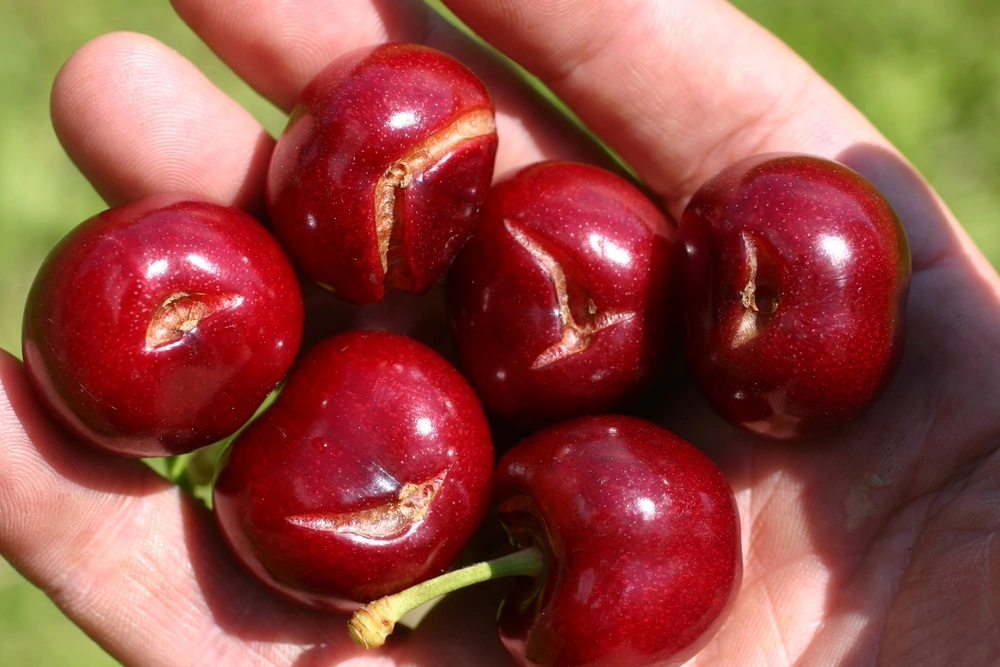
Extreme weather events are an increasing challenge for sweet cherry production, particularly during the period close to harvest, when intense rainfall can cause substantial fruit losses due to cracking, simultaneously compromising yield and commercial quality.
A recent study evaluated for the first time the effectiveness of preharvest foliar applications of 24-epibrassinolide (24-BL), a brassinosteroid belonging to a new class of biologically safe hormones, on two sweet cherry cultivars, ‘Sunburst’ and ‘Skeena’, during the 2022 and 2023 seasons. In the first year, plants were treated with 24-BL at concentrations of 0.01, 0.1 and 1 μM, whereas in the second year the two most promising doses, 0.01 and 0.1 μM, were used.
Applications were performed at three key stages of fruit development: pit hardening, the onset of colour development and three days before harvest.
Fruit growth
The results showed a positive effect of the treatment on fruit growth. The 0.1 μM dose produced significant increases in equatorial diameter, reaching approximately 9% in ‘Sunburst’ and 15% in ‘Skeena’ compared with the controls during the later stages of development.
In 2022, the increase in fruit size also resulted in greater fruit weight and commercial yield. In particular, the 0.1 μM treatment achieved 22.01 kg tree−1 in ‘Sunburst’ and 30.22 kg tree−1 in ‘Skeena’, making it the most effective dose for both cultivars.
The 2023 season was characterised by exceptionally high rainfall: in the experimental area of Alicante, May recorded 156 L m−2, the highest value since 1950. Under these conditions, cracking affected more than 60% of the fruit on control ‘Sunburst’ trees and approximately 20% of the fruit on ‘Skeena’ trees.
Preharvest applications of 24-BL at 0.01 and 0.1 μM significantly reduced the disorder, with a decrease of more than 30% in ‘Sunburst’ and up to 50% in ‘Skeena’.
Fruit quality
The treatment also improved several quality parameters. Fruit firmness was higher in 24-BL-treated fruit in both seasons, together with a more intense red coloration. In parallel, anthocyanin and total phenolic concentrations increased, particularly at the 0.01 and 0.1 μM doses.
In ‘Skeena’, for example, the 0.1 μM treatment increased anthocyanin content by 69% in 2022 and 64% in 2023 compared with the control. The researchers attribute these effects to the ability of brassinosteroids to modulate physiological processes involved in fruit growth, cell wall integrity, and the biosynthesis of pigments and phenolic compounds.
The response was dose-dependent: the highest concentration, 1 μM, provided no additional yield benefits, confirming that lower doses may be more effective.
Preharvest strategy
Overall, the study demonstrates that the use of 24-BL represents a promising preharvest strategy to enhance sweet cherry resilience to extreme rainfall events, reduce losses caused by cracking, and improve fruit size, firmness, colour and bioactive compound content.
The researchers nevertheless emphasise the need for further studies to determine whether these effects persist during storage and whether the treatment can potentially extend fruit shelf life.
Source: Garrido-Auñón, F., Puente-Moreno, J., García-Pastor, M. E., Agulló, V., Valero, D., & Serrano, M. (2026). Preharvest Treatment with 24-Epibrassinolide Enhances Resilience to Fruit Cracking, Yield and Quality Traits in Two Sweet Cherry Cultivars. International Journal of Molecular Sciences, 27(6), 2793. https://doi.org/10.3390/ijms27062793
Image source: Stefano Lugli
Andrea Giovannini
PhD in Agricultural, Environmental and Food Science and Technology - Arboriculture and Fruitculture, University of Bologna, IT
Cherry Times – All rights reserved