A few years after a bacterial canker outbreak in Northwest cherry trees revealed increasing resistance to common treatments, researchers and growers have hope for new solutions. Fortunately, one of them also works on cherry powdery mildew, which saw its own surge last year.
Washington State University’s Frank Zhao has been testing lime sulfur and clove oil on the ooze-inducing bacterial disease. At least in his Prosser laboratory, they work, sometimes killing the pathogen in a matter of minutes with low concentrations.
 Frank Zhao of Washington State University discusses alternative treatments for bacterial canker at the 83rd Annual Cherry Institute in January in Yakima. (TJ Mullinax/Good Fruit Grower)
In 2023, bacterial canker surged in Washington and Northern Oregon in the wake of weather conditions favorable to the disease and a rise in susceptible cultivars. What’s more, the pathogen populations have been showing resistance to typical treatments of copper.
The industry also is wary of emerging resistance to the antibiotic kasugamycin. In Zhao’s lab, a 2 percent concentration of lime sulfur inhibited or killed two strains of Pseudomonas syringae, the pathogen that causes bacterial canker, within 24 to 48 hours.
At 5 percent, it took only six hours. At 10 percent, one of the strains died in 30 minutes. Growers are generally familiar with lime sulfur, sometimes used for blossom thinning and pest and fungus control, but little is known about how it works on bacteria, Zhao said.
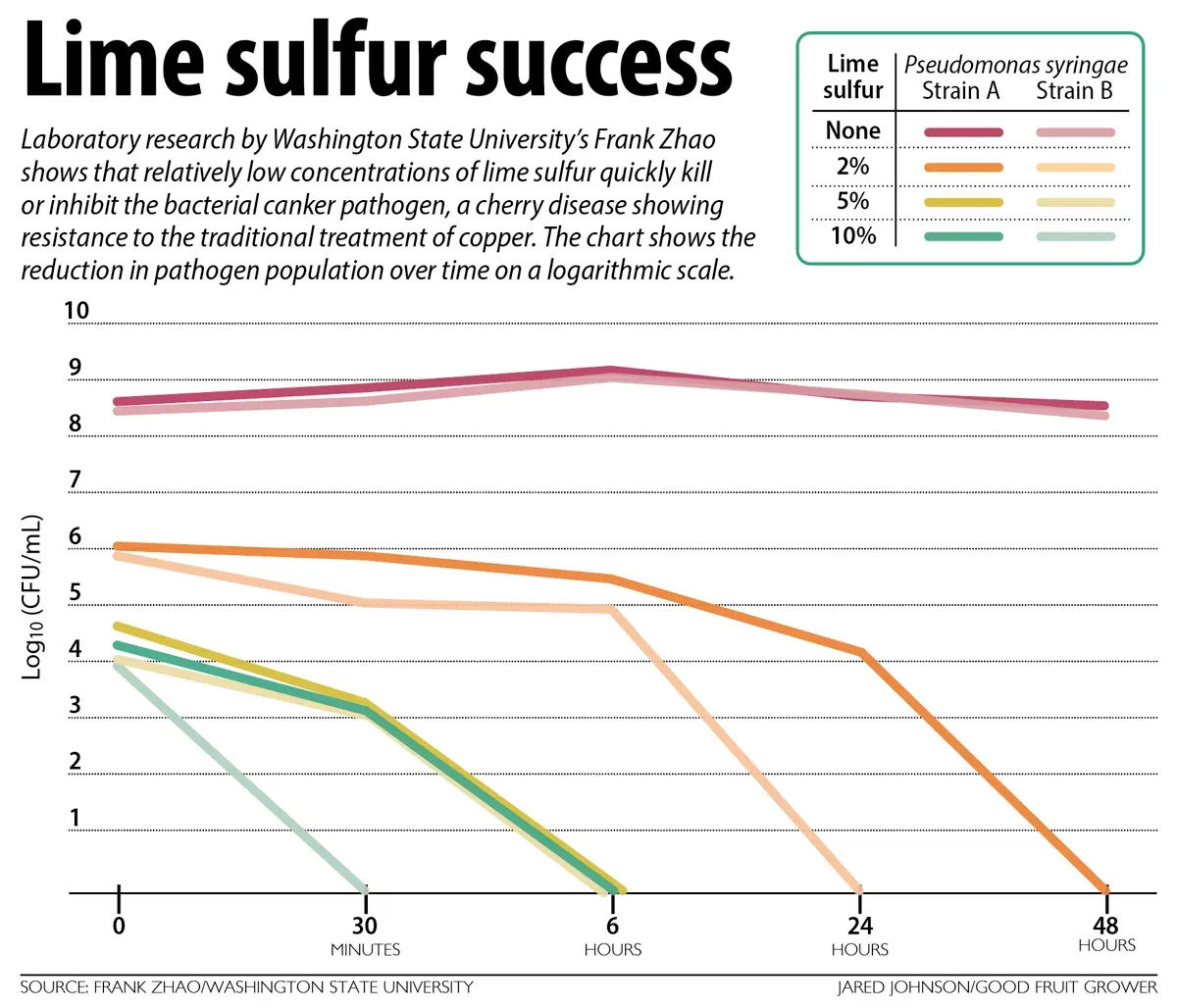 This chart shows results of Washington State University research into using lime sulfur against a bacterial canker pathogen. (Source: Frank Zhao/Washington State University; Graphic : Jared Johnson/Good Fruit Grower)
Cherry growers
Cherry growers have been using lime sulfur on powdery mildew for about 10 years, said Leroy Groeneweg, a crop consultant for G.S. Long Co. Over the past three years, they have started aiming it at bacterial canker, as well.
“It kind of fits in,” he said. Growers typically spray lime sulfur with oil in the spring, at side green bud stage, to knock back powdery mildew and any insect pests that may have overwintered.
Then, in early October as leaves begin to senesce, they use it again to minimize mildew going into winter. That’s the application that helps with bacterial canker, he said. The irony is that powdery mildew is on a surge, too; 2025 was a high-pressure year, he said. Growers aiming for large fruit irrigate and fertilize more, prompting more vigor, which means less airflow and sun penetration. Combine that with an increase in overhead netting, and conditions start to favor mildew.
“Greenhouse conditions,” Groeneweg called them. In the lab, clove oil worked even faster than lime sulfur against bacterial canker. “What we found is that it can easily kill bacteria at a very, very low concentration,” Zhao said. Clove oil killed the two strains, sometimes in less than a minute, at a 0.125 percent concentration.
That would be only 16 ounces (circa 473 milliliters) in a 100-gallon tank (circa 378.5 liters). However, getting clove oil to work in the field has been a challenge so far. In Zhao’s 2025 trials, inoculated trees treated with clove oil showed no statistically significant improvement compared to untreated inoculated trees.
Essential oils
Essential oils are sometimes used in orchards as a pest and disease deterrent, and growers have reported success in some use cases. Clove oil, which qualifies for organic use, is light-sensitive and usually stored in dark glass bottles.
Zhao uses a special formulation from Louisiana State University that will fully mix in water, despite being an oil. He plans to test some clove oil products from Kemin, a maker of oil-based pesticides and plant nutrition supplements.
While research continues, Zhao reminded growers to mind the timing of pruning and heading cuts, namely avoiding wet weather. The bacterial canker pathogen enters through wounds, such as winter injury or pruning cuts, often splashed by rain or irrigation.
Opening image source: Obstbauberatung LK Steiermark
Ross Courtney
Associate Editor, Good Fruit Grower
Cherry Times - All rights reserved