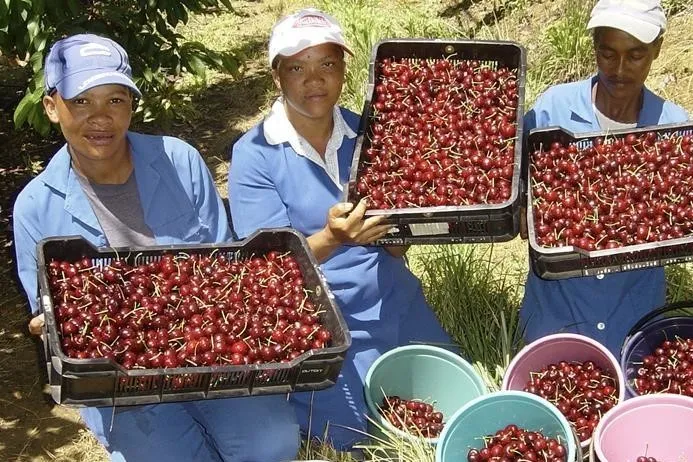
The 2025/26 cherry harvest has begun in the Western Cape, South Africa’s largest cherry-growing region. This season sees several new cultivars reaching local markets for the first time. Cheery Nebula, Cheery Cupid, and Cheery Burst are new cultivars being harvested coming into production this season, although volumes might not be sufficient to satisfy the requirements of overseas supermarkets.
Production for the 2025/26 cherry season is predicted to reach 267 000 5kg-equivalent cartons, up by 16% from the previous season. According to Hortgro CherriesZA’s harvest forecast, yields of the large, dark-red Lapins cultivar are set to rise by 42%, while the late-ripening Royal Helen is expected to increase by 32%.
With the northern regions nearly finished harvesting, the bulk of the country’s cherry crop is now being picked in Ceres. The Western Cape accounts for 61% of national plantings, followed by North West (15%) and a smaller, declining share in the Free State.
Early start and export advantage
This year, the Western Cape’s season started about seven to 10 days earlier than usual, allowing South African cherries to reach UK and European supermarket shelves sooner, which is an advantage over key Southern Hemisphere exporters like Chile. The earlier season and an expected bumper crop are attributed to excellent growing conditions.
“We had good rain before flowering and sunny weather during bloom. That meant excellent pollination and strong fruit set,” Calla du Toit, Tru-Cape’s procurement director, said in a media statement. The warmer spring boosted natural sugar levels, with early sugar readings exceeding 25° Brix, indicating superior eating quality.
Larger cherries and market trends
South Africa’s export markets prefer larger cherries. “International buyers increasingly prefer cherries of 24mm and larger. In the past, 22mm was fine, but now we’re adapting our orchards and thinning practices to meet that demand,” Nico Verhoef, financial director at Witzenberg Properties, one of Tru-Cape’s leading cherry producers in the region, explained.
Apart from new cultivars, another emerging trend is a potential shift in exports to the East, with local producers eyeing the Chinese market. Competing with Chile, South African cherries reach China up to three weeks earlier, which is a valuable advantage for growers.
“Negotiations for full market access to China are advancing, with a key technical inspection underway during the 2025 harvest. Approval could potentially [come] as early as the 2026/27 season,” Clive Garrett, marketing manager at ZZ2, said.
“Our cherries are exported to a mix of markets: the UK [33%], the Middle East [24%], Southeast Asia [23%], the EU [19%], and Far East Asia [1%].”
Cold chain innovations and quality control
According to Karien Bezuidenhout, manager of Hortgro CherriesZA, Hortgro is looking into the effect of cold treatment on fruit quality in order to access the Chinese market. “The first year’s data looked promising, but we are waiting for the second season’s data to confirm this.
“Other research is testing which farm practices contribute most to ‘pitting’, a bruising condition that only appears several days after harvest and processing,” she explained. New cultivars are tested, and improved rootstock combinations are designed to produce larger and more uniform fruit.
Producers are also focusing on quicker pre-cooling and cold-chain precision. “We use smaller trucks to move cherries more frequently from orchard to packhouse. The faster we cool the fruit, the longer it lasts,” Verhoef added.
Processing and weather challenges
Around 40% of South African cherries are exported, and 3% of the total harvest is processed into juice and canned products. Wet weather during harvesting can lead to splitting, which diverts more fruit to the local market, as was the case in the northern regions.
“We received more rain during the harvesting period than last year. However, we managed to dry the fruit with the use of helicopters to minimise the damage, and waited 24 hours after harvesting before packing the cherries. This allowed excess moisture to evaporate, preventing splitting and maintaining fruit quality,” Garrett explained.
Source: www.farmersweekly.co.za
Image source: Fruitnet
Marinda Louw Coetzee
Cherry Times - All rights reserved