Pseudomonas syringae is a bacterial pathogen responsible for the bacterial canker in cherry trees. This bacterial species complex includes several groups (pathovars) capable of infecting plants belonging to the genus Prunus as well as more than 180 other plant species, including apple, barley, hazelnut, kiwifruit, tobacco, tomato, and wheat. Infections caused by P. syringae can be particularly destructive in young cherry orchards, where yield losses of up to 75% have been reported.
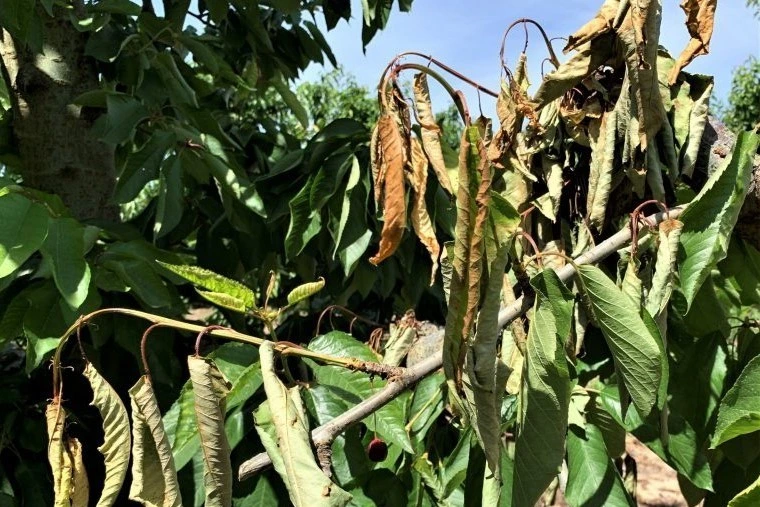 Source: B. Sallato, WSU
Disease symptoms are highly variable because the different pathovars within the P. syringae complex can colonize a variety of ecological niches both on the surface and inside the cherry tree.
The most common symptoms include fruit spotting, shoot necrosis, blossom blight, necrotic cankers on woody tissues, branch dieback, and gummosis, all of which significantly reduce crop productivity and fruit quality.
Bacteriophages as a biological control strategy
In the absence of effective control measures, bacteriophages represent a promising biological control strategy. Bacteriophages, or phages, are viruses that infect and kill bacteria and therefore provide a potential alternative approach for managing bacterial canker.
Their widespread presence in nature, ability to persist in environmental conditions, lytic life cycle which results in the destruction of the bacterial cell, and their high host specificity make them particularly attractive candidates for controlling bacterial diseases.
For these reasons, phage-based approaches are increasingly considered innovative solutions not only in agriculture but also in livestock production and human medicine for the management of bacterial infections.
However, the development of effective phage-based treatments requires a detailed understanding of bacterial antiviral defence systems (ADS) and their influence on phage infection dynamics.
This knowledge is essential for the rational design of an effective phage cocktail, which is essentially a mixture of different bacteriophages selected to target the pathogen. Research conducted at the University of Warwick in collaboration with the University of Birmingham (United Kingdom) analyzed 250 Pseudomonas strains and revealed that the P. syringae complex contains a wide diversity of antiviral defence systems, whose distribution appears to be strongly influenced by the phylogenetic relationships among bacterial strains.
 Source: Cooney-Nutley et al., 2025
Phage infection dynamics
The study is based on the hypothesis that the success of phage therapy largely depends on two main factors: the antiviral defence systems of bacteria and the compatibility between bacteriophages and bacterial receptors, which determines the virus’s ability to infect the host cell.
In parallel, the researchers performed host-range experiments using five lytic bacteriophages with distinct genotypes. These phages demonstrated strong lytic activity against several pathovars responsible for bacterial canker in cherry, including P. syringae pv. syringae and P. syringae pv. morsprunorum (race 1 and 2).
Role of bacterial receptors
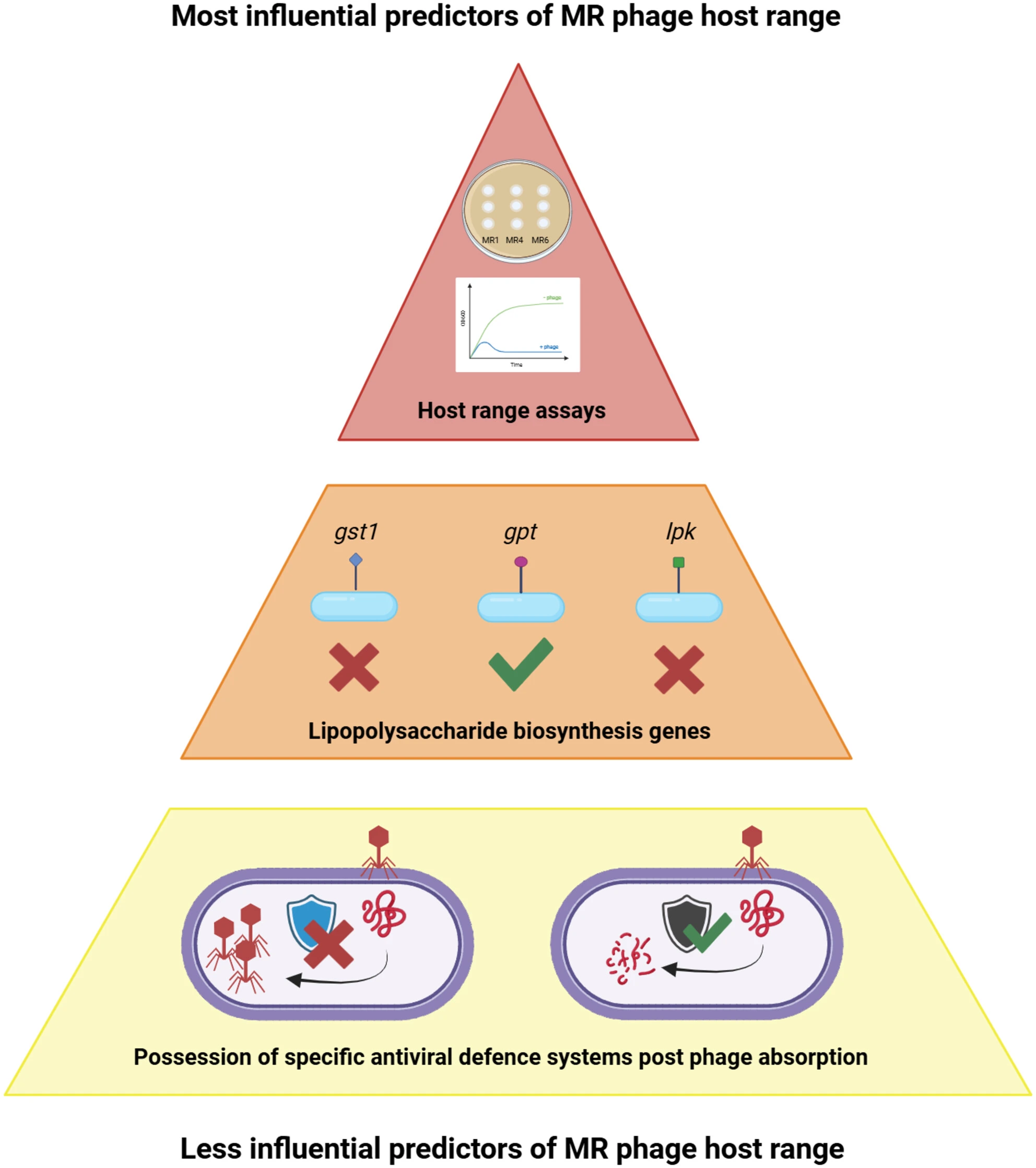
Interestingly, bacterial susceptibility to phage infection was not directly correlated with the total number of antiviral defence systems present in the genome, but rather with specific individual defence mechanisms, suggesting that some systems play a more critical role than others.
Another key aspect of the study involved identifying the bacterial receptors used by phages during infection.
The authors analyzed several genes involved in the biosynthesis of lipopolysaccharides (LPS), which are components of the outer membrane of Gram-negative bacteria and often serve as attachment sites for bacteriophages.
The importance of the gpt gene
Among these, three genes were examined in detail and phylogenetic analysis showed that these genes are highly conserved across different phylogroups of Pseudomonas syringae. However, the gpt gene emerged as the primary determinant of susceptibility to the tested bacteriophages.
The authors suggest that this gene may influence the structure of the lipopolysaccharide layer and therefore affect the ability of phages to adsorb to the bacterial surface. Despite these findings, the authors emphasize that empirical phage screening remains essential, as interactions between bacteriophages and bacterial hosts are extremely complex and cannot be fully predicted solely from genomic data.
Source: Cooney-Nutley, K., S.Chakravorty, I.Nix, Z.Zeng, S. F.Greer, and M.Rabiey. 2025. “Understanding Bacterial Antiviral Defence Systems and Phage Receptors to Better Inform Rational Phage Cocktail Design to Treat Bacterial Canker.” Microbial Biotechnology18, no. 9: e70232. https://doi.org/10.1111/1751-7915.70232
Melissa Venturi
University of Bologna (IT)
Cherry Times - a