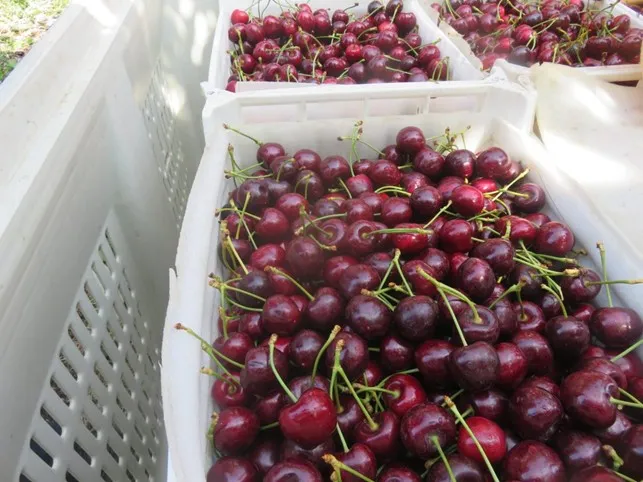
In the Asian giant, people no longer “pay any price for the best.” Today, buyers want the best, but only if it truly meets the expected standards. This is stated by Felipe Henríquez, a fruit trader active on the Chinese market and South America representative for the importer Golden Frutas Import, who in this interview analyzes the progress of the 2025/26 cherry season in China.
Characterized by a high volume of early fruit, a rapid price decline, and a more demanding and cautious Chinese market, the season is interpreted by Felipe Henríquez through his direct experience in the destination market.
The analysis goes into detail on varietal performance, logistical pressure, and end-of-season projections, which according to his estimates should settle at around 112 million boxes.
“It is a significant figure that set very high expectations from the outset, especially regarding the response of the Chinese market,” he says.

Sales and price decline
— However, difficulties in commercialization were discussed from the very first stages. What happened?
— Sales were complex from the start. At this point, it is estimated that about 50–60% of the fruit has been sold in China, but at prices far lower than expected.
Standard early fruit (not ultra-early) stopped moving at levels of 5–6 USD/kg (4.60–5.50 €/kg) and quickly dropped to values around 3–3.5 USD/kg (2.75–3.20 €/kg), marking a sharp change compared to previous seasons.
— What explains such a rapid price drop?
— Mainly a very early oversupply. Chile began exporting fruit before the second half of October, with very early shipments from El Huique, followed by part of the Brooks crop from Ovalle.
Subsequently, other varieties entered the market. All of this generated a very high volume concentrated in October, an unusual amount of fruit that created immediate pressure on prices, especially in the airfreight channel.
— Did the quality of this early fruit affect market response?
— Absolutely. Very early fruit tends to have lower firmness, sweetness, and color, and this was immediately perceived by buyers.
In the air market, especially in China, customers are extremely demanding: they want firm, sweet, well-colored fruit with a fresh appearance. When these factors are missing, complaints arise immediately and prices adjust downward.
Speaking of so-called “second-tier” products, such as whisky, consumers have become more conservative in their consumption of this type of good.
In other words, the logic of “paying any price for the best” no longer exists. Today, buyers want the best, but only if it truly meets expected standards.
In addition, we are facing an economy weakened by the post-Covid period, with more cautious consumption and a greater propensity for price negotiation.
Demand and alternative strategies
— Does the time of year when this fruit arrives also play a role?
— Very much so. During that period, there is no strong natural demand for cherries in China, as the Canada and United States seasons are still coming to an end.
What happened this year is that a large volume of early Chilean fruit arrived at a time when the market was not yet ready to absorb it strongly.
Early fruit to new markets
EARLY FRUIT TO SPAIN, THAILAND AND OTHER ASIAN MARKETS
— Faced with the rejection of some varieties in China, what strategy did you adopt?
— When we saw that China was not accepting some varieties well, we began shipping them to other markets, such as Spain, Thailand, and several Asian countries.
In these markets, the fruit moved, but a similar situation occurred, as it was also criticized for lack of color and firmness.
Prices were acceptable, but clearly lower than what had been expected for that type of product.
— What prices were achieved with these alternative shipments?
— Air-shipped fruit generated returns to growers between 4 and 4.5 USD/kg (3.65–4.10 €/kg).
These values allowed sales, but were far from the 7–8 USD/kg (6.40–7.30 €/kg) that could have been obtained in normal seasons during the same period.
In Europe, although selling prices are lower than in Asia, transport costs are also lower, which in some cases allowed specific operations to be sustained.
However, it was not possible to ship large volumes by air, because overall margins did not allow it.
Transport costs and the maritime season
— Did transport costs further worsen the situation?
— Yes, significantly. Air freight became extremely expensive, reaching levels close to 6 USD/kg (5.50 €/kg), whereas three or four years ago it ranged between 4.8 and 5.1 USD/kg (4.40–4.70 €/kg).
This represents an increase of more than 20%, precisely at a time when selling prices were falling, further squeezing margins and limiting exporters’ ability to react.
— Then the maritime season began. What happened at that stage?
— Practically the same phenomenon was repeated. As the air channel collapsed rapidly, the decision was made to load large volumes of early fruit by sea.
This was compounded by the fact that several areas were under quarantine, forcing fruit that would normally have gone by air to be shipped by sea.
The result was an unusually high volume: the first vessel, which in a normal season carries 150–200 containers, departed with about 480 containers and, within a few days, around 1,000 containers had accumulated in China by the second week of December.
Market response and outlook
— How did the Chinese market respond to these volumes?
— China is practically the only market capable of absorbing such high volumes without completely collapsing, but despite this, prices fell rapidly.
A sharp decline occurred from mid-December, followed by a small low point at the beginning of January and then a slight recovery when a gap emerged in the arrival of large vessels.
However, prices are now falling again.
— What is expected for the rest of the season?
— Today we see a more complex scenario than initially expected. Prices continue to decline and market movement has slowed.
Until January 15, we expected a more positive trend, supported mainly by late fruit, particularly from the Chimbarongo area southwards, which developed more regularly and managed to clearly differentiate itself from early fruit.
Instead, prices stabilized and were followed by a slow, gradual decline.
At this moment, we are at one of the lowest price levels seen in the industry in recent years, with high volumes and limited movement.
There is a lot of fruit available and, in practice, product is being stored in China while waiting for a possible market reactivation.
Although it is believed that the market is close to its “minimum price,” there is no certainty that this point has already been reached or when a trend reversal will occur.
Chilean producers and exporters are waiting precisely for the moment when sales velocity will increase, leading to an improvement in prices.
Even if volumes are slightly lower, the difference from final estimates is not that significant: the season could close between 112 and 115 million boxes, or even increase further.
In this context, the current scenario is more pessimistic than initially expected.
Southern producers and future prospects
“INDIAN SUMMER” FOR SOUTHERN PRODUCERS
— How are producers in late areas performing?
— Initially, it was thought that something similar to an “Indian summer” could occur for them.
There were purchases of fruit at fixed prices, even by exporters with Chinese capital, in a range between 2.5 and 3.5 USD/kg (2.30–3.20 €/kg), and some specific lots close to 4 USD/kg (3.65 €/kg), values that the south had not seen in seven or eight years.
However, this scenario remained linked to an expectation that did not materialize, because the anticipated trend reversal around January 15 did not occur.
Today, the landscape remains characterized by low prices across all three phases of the season, increasing uncertainty about the future.
This raises a key question for the next season: what will happen with the advance payment policy?
Chinese buyers are operating with increasingly restrictive criteria, and it is unclear whether there will be sufficient capital to launch the season as in the past, or whether only larger players with greater liquidity will be able to sustain operations, leaving small and medium importers in a more complex position, with weaker financial solidity and stricter conditions compared to large exporters.
— Returning to new varieties, why do they struggle so much to establish themselves in China?
— Because they must meet three fundamental conditions: firmness, sweetness, and good size, with firmness as the most decisive factor.
The problem is that many new varieties have a shorter fruit development cycle, and climatic conditions in some areas do not allow all three requirements to be achieved.
These varieties are necessary to remain competitive, but the real issue is the commercial model.
— Finally, what can be expected from the settlements that will arrive in April?
— They will be difficult, especially for early fruit. There was a lower yield per hectare and prices significantly lower than in previous seasons.
As mentioned earlier, in weeks when returns of 6–7 USD/kg (5.50–6.40 €/kg) were historically achieved, values of around 3–3.5 USD/kg (2.75–3.20 €/kg) are now estimated, with almost half the volume.
For medium-sized producers, the situation appears slightly more stable, thanks to a good size distribution, especially 2J and 3J, which helps support returns.
However, overall, the initial expectations of the season were not met, and it cannot be ruled out that settlements may end up being even lower than those of the previous season.
Text and image source: redagricola.com
Miguel Patiño and Melanie Maxwell
Redagricola
Cherry Times – All rights reserved