As the Postharvest team at Paclife, each season we aim to go beyond trials at origin. Part of our approach is to observe what happens where the fruit is truly put to the test: at destination.
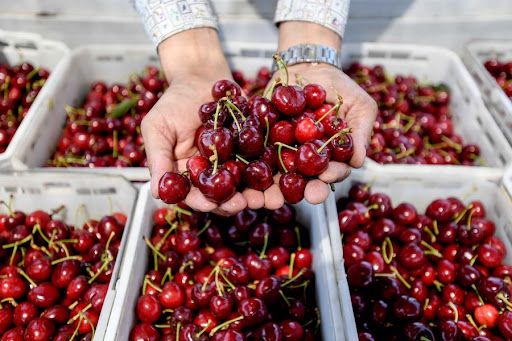
For this reason, during the last cherry season we traveled to China to closely monitor the arrival of different shipments and evaluate on site how the fruit behaves after its long journey from Chile. The first thing we confirmed is something that is becoming increasingly evident for the industry: storage time at destination is a critical variable. We monitored several arrivals in the Chinese market and realized that the longer the storage time, the more essential it becomes to use technological packaging capable of protecting fruit quality. And this highly demanding market is already taking notice.
In the field, we also observed how waiting times at destination — often unavoidable — can affect attributes such as freshness and firmness. In this context, having solutions capable of ensuring stability over extended periods is no longer an advantage, but a necessity.
During the monitoring
During the monitoring, we also analyzed several strategies adopted by the industry to manage more sensitive varieties during long-distance transport. A clear example is the Regina variety. As with many other delicate varieties, special low-atmosphere or high-humidity bags are used. However, in practice, we found that these types of solutions are not always sufficient to adequately protect the product.
This reinforces a line of work we have been pursuing for several years: developing a solid and consistent packaging solution for all cherry varieties, capable of maintaining gas and humidity stability even in complex logistics scenarios.
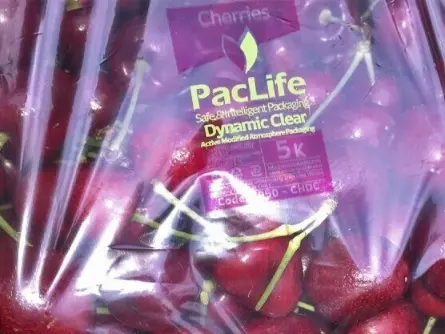
During this latest trip, we were also able to confirm the good performance of these solutions. We observed that the packaging generates high relative humidity, helping to prevent dehydration and keeping weight loss below 1%, while gas behavior remains stable even under challenging destination conditions.
But it is not just
But it is not just about a modified atmosphere packaging (MAP) bag. In practice, there is a clear difference between companies that rely solely on MAP and those that work with an integrated set of technologies designed for each stage of the process, protecting the fruit from packaging through to market arrival.
What we observed in China also confirms that the development of postharvest solutions must address the real challenges the industry faces today. Market saturation in China, long sea transport times, overproduction, and quality losses make it increasingly necessary to have tools capable of ensuring greater product safety and stability throughout the export process.
The fieldwork was intense, in a port that never stops. But it was also an experience that reinforces a key point: when fruit has to travel thousands of kilometers to reach consumers, observing what happens at destination is essential to continuously improve solutions and provide increasingly effective tools to the industry.
Image source: Paclife
Gonzalo Quitral
Research and Development Coordinator, Paclife Chile
Cherry Times - All rights reserved