Understanding how irrigation management interacts with organic soil amendments in orchards is essential to improve resource-use efficiency and enhance the resilience of sweet cherry systems under climate change.
A recent multi-year study conducted in Canada from 2014 to 2020 investigated the interaction between two irrigation systems: drip and micro-sprinkler, and different soil management strategies, including compost, woodchip mulch, their combination, and fumigation. Non-nutritional effects were isolated by applying a standardized fertilization regime.
The findings provide useful technical insights for optimizing sweet cherry production under water-limited conditions. Overall, drip irrigation maintained higher soil moisture levels in the root zone during the growing season compared to micro-sprinklers, demonstrating greater water-use efficiency. However, the effects of soil amendments were strongly dependent on the irrigation system.
The combination of compost and mulch increased soil moisture under drip irrigation, whereas under micro-sprinkler systems it sometimes reduced soil moisture during hotter periods, likely due to increased evaporation losses and surface water redistribution.
This highlights the non-linear nature of interactions between water and soil management and the need for integrated approaches. Vegetative growth, measured as trunk cross-sectional area (TCSA), was primarily influenced by the irrigation system.
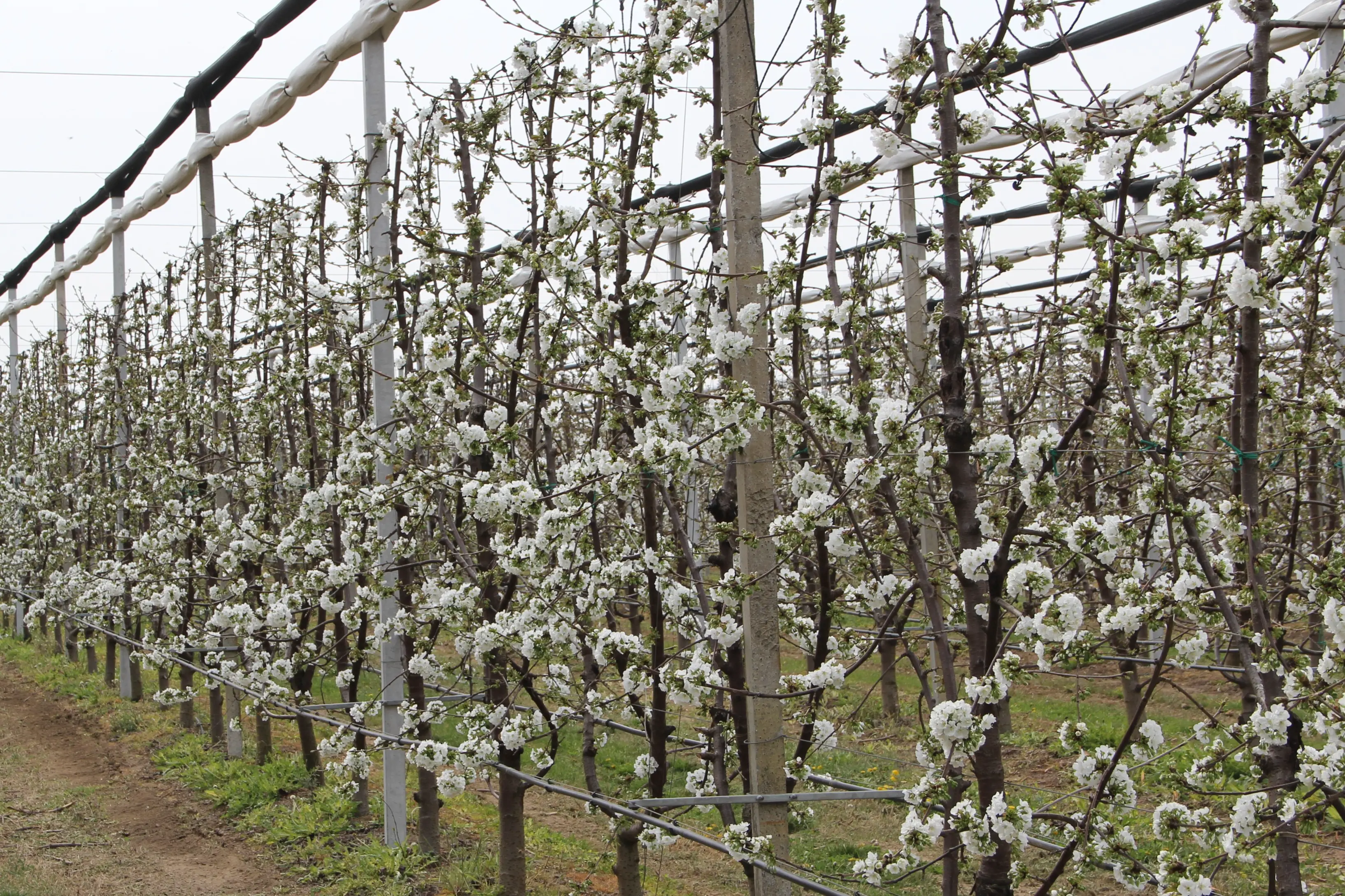
Drip irrigation
Drip irrigation promoted greater growth, up to 20% higher in several years, confirming its effectiveness in maintaining more stable water conditions in the rhizosphere. In contrast, the effects of soil amendments were more evident during the early establishment phase, suggesting a key role in improving tree establishment and early development, with diminishing influence over time.
Yield response was more complex and strongly affected by annual climatic conditions. In a hot and dry year (2017), drip irrigation resulted in higher yields than micro-sprinklers, whereas in a cooler and wetter year (2020) the opposite trend was observed.
Overall, cumulative yield did not differ significantly between irrigation systems, reflecting high interannual variability. The impact of soil amendments on yield was more pronounced in the years of reapplication, indicating “pulse” responses, temporary effects linked to the addition of organic matter.
Productive efficiency showed a clear interaction between irrigation and soil management. The combination of drip irrigation with compost and mulch emerged as one of the most effective strategies, particularly under high water stress conditions.
Conversely, treatments with high woody material content may induce short-term negative effects, such as nitrogen immobilization, potentially reducing yield immediately after application.
Conclusions
Overall, the study demonstrates that drip irrigation is a robust strategy to improve water-use efficiency and support sweet cherry growth, especially in water-limited environments.
Its integration with organic amendments, particularly compost combined with mulch, can further enhance productive efficiency, provided that application timing and methods are properly managed.
These findings support an adaptive management model in which technical choices are tailored to annual climatic conditions and soil characteristics, with the goal of balancing productivity, sustainability, and resilience in modern orchard systems.
Source: M. Sharifi, T. Forge, K. Hannam, S. Kuchta, D. Neilsen, K. Asefpour Vakilian, E. Yasari (2026). Multi-year effects of irrigation method and organic amendments on soil moisture dynamics, tree growth and productivity in sweet cherry under a standardized nutrient input. Scientia Horticulturae, 358, 114715. https://doi.org/10.1016/j.scienta.2026.114715
Image source: Stefano Lugli
Andrea Giovannini
PhD in Agricultural, Environmental and Food Science and Technology - Arboriculture and Fruitculture, University of Bologna, IT
Cherry Times - All rights reserved