Despite declining planted areas, climate pressure and phytosanitary challenges, sweet cherry cultivation in Apulia can still represent a profitable and sustainable choice. Especially when supported by targeted technical decisions and a new generation of rootstocks.
After a promising phase of expansion and strong market returns, driven by numerous varietal introductions and innovation in orchard systems and protective structures, sweet cherry cultivation in Apulia has experienced a slowdown, particularly in terms of planted surface.
This trend runs counter to what is observed internationally and in northern Italian regions, where sweet cherry production continues to expand and renew itself.
The causes of this crisis, which has particularly affected southern cherry production, are multiple: orchard ageing, declining yields, rising management costs, increasing pressure from biotic and abiotic stresses (such as root rots, Drosophila suzukii and fruit cracking), the limited availability of effective plant protection tools, and the impact of climate change.
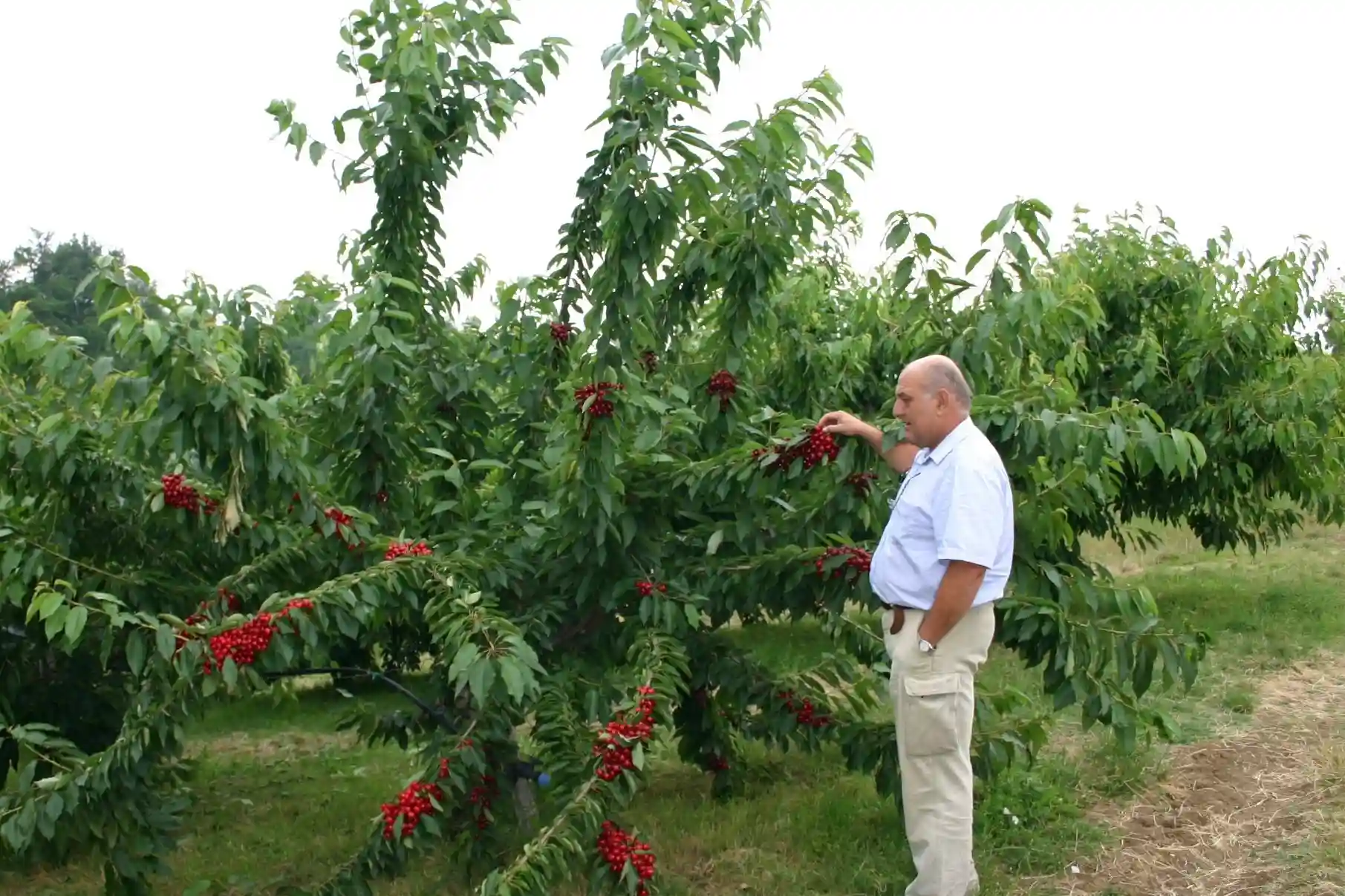
The rootstock issue in sweet cherry cultivation
Yet, despite these difficulties, sweet cherry profitability remains high. The crop therefore continues to represent a strategic agronomic choice, thanks to the species’ rusticity and its adaptability to conditions of limited production inputs, especially water.
In southern areas, rootstock choice is currently almost mandatory and falls on mahaleb (Prunus mahaleb), both seedling-derived and micropropagated.
This rootstock has shown the best adaptation to high-pH soils, high levels of active limestone, stony soils and limited water availability. However, it is characterised by high vigour, the opposite of that of the new rootstocks introduced to the market (such as the Gisela series), which are designed to combine low vigour with high productive efficiency.
Several private initiatives promoted by specialised nurseries are assessing the adaptability of these new rootstocks to southern pedoclimatic conditions. While awaiting results, managing the vigour of mahaleb in order to maintain high productivity currently represents the main technical challenge for growers and advisors.
Canopy management and the role of spurs
Among the key factors for successful cultivation is canopy management, which must remain balanced with crop load and root system development.
The main fruiting organs of sweet cherry are spurs, small perennial structures that remain productive over time if well exposed to light and properly managed. To promote early bearing, it is essential to encourage rapid spur formation, reducing practices that excessively stimulate vegetative growth and instead favouring the maturation and ageing of formed structures.
The multi-axis vase: a pathway to revitalisation
To revitalise a crop that still retains high productive and economic potential, a training system capable of containing vigour and anticipating production is proposed: the multi-axis vase.
This system is based on long pruning, where scaffolds are not headed back, combined with moderate bending of main branches. This approach allows earlier fruiting, thanks to faster spur differentiation.
The scaffolds, never topped, remain flexible and easy to manage, enabling harvesting from the ground or with the aid of small ladders.
Depending on varietal growth habit, it is possible to establish from the first or second year 15–20 axes per tree, to be reduced or renewed over time according to vigour and desired productivity.
Training phases: from planting to first production
In the first year after planting, the grafted tree should be headed back to 40–50 cm, ensuring an adequate number of vegetative buds. During the growing season, shoot growth of at least 50–70 cm is desirable.
During summer pruning, the developed shoots should be tipped at 20–25 cm to stimulate the emission of sylleptic shoots and thus obtain a good number of vegetative axes. In the case of grafting at planting, preferably at 30–40 cm above ground, the shoot should be cut back to 3–5 buds once partially lignified.
If the desired number of shoots is not reached in the first year, in the second year those formed should be shortened in winter to 10–15 cm, cutting back the more vigorous ones more severely and removing weak or poorly developed shoots.
In this way, by the end of the second growing season, a minimum of 15 productive axes is obtained.
In the third year, axes should no longer be tipped, allowing lateral buds to transform into spurs.
During summer, it is possible to remove the tips of the main axes, leaving only the central extension shoot. This operation weakens the apices and stimulates floral differentiation of the buds. This is the stage when the tree begins to enter production.
Management from the fourth year onwards
From the fourth year, management focuses on balancing light interception and production.
If yellowing leaves appear at the base of the axes, a sign of insufficient light, it is advisable to remove 2–4 central axes to improve light penetration.
At maturity, the number of axes to be maintained ranges between 12 and 20, depending on varietal vigour, rootstock and soil fertility.
The ideal tree height should not exceed 2.7–3 metres. Beyond this threshold, axes should be diverted onto horizontal branches to limit further growth.
Sylleptic shoots and lateral branchlets are removed, leaving 5–7 cm spurs, productive for only one season in “non-spur” varieties with a more spreading growth habit.
Axis renewal should be carried out when axes lose flexibility or no longer bear an adequate number of productive spurs, heading them back to 15–20 cm to encourage the formation of new axes.
In cases of excessive crop load at the expense of fruit quality, targeted pruning should be applied, removing or shortening surplus fruiting branchlets.
In specific situations, artificial spur extinction may be used to eliminate excess spurs, a costly practice that does not always guarantee satisfactory results.
Branch bending must be calibrated according to varietal and rootstock vigour: the more vigorous the tree or the more delayed fruiting is, the wider the bending angle should be.
However, excessive inclination can reduce vegetative growth and disrupt the balance between vegetative and productive activity, promoting excessive flower bud formation or the emission of water sprouts, especially in upright-growing varieties.
Outlook and new trials
In intensive and specialised cherry orchards managed mainly from the ground, the multi-axis vase finds its best application in combination with semi-dwarfing rootstocks (such as MaxMa 14) or, in the case of mahaleb, in poor soils with limited vegetative stimulation.
Thanks to its limited height, this training system is also well suited to the use of rain and hail protection covers, now essential to ensure fruit quality.
At the same time, the expansion of cherry growing into non-traditional areas and more fertile soils is opening the way to high-density orchards (700–1,200 trees/ha), with permanent protections and training systems borrowed from other fruit species.
These systems make it possible to obtain small-sized trees, early bearing and high productivity. However, rootstock choice remains a critical aspect, given the limited adaptation shown by weak rootstocks (such as Gisela 5 and Gisela 6) to southern pedoclimatic conditions.
In this context, the trials initiated by Vivai Fortunato deserve attention. The nursery is testing more than 50 rootstocks to evaluate their adaptability and performance under the typical conditions of the north-eastern Bari cherry-growing area, in collaboration with leading scientific institutions and breeders.
An initiative that could represent a decisive step towards the renewal of the Apulian sweet cherry sector, restoring competitiveness and growth prospects within the national fruit-growing landscape.
Image source: SL Fruit Service
Source: © fruitjournal.com
Lorenzo Laghezza
Agronomist, Agrimeca Grape and Fruit Consulting
Cherry Times – All rights reserved