With the 2026/27 season just around the corner, the Chilean cherry industry is preparing for a campaign characterized by higher volumes, following a 2025/26 season marked by an early harvest, oversupply in destination markets and price adjustments.
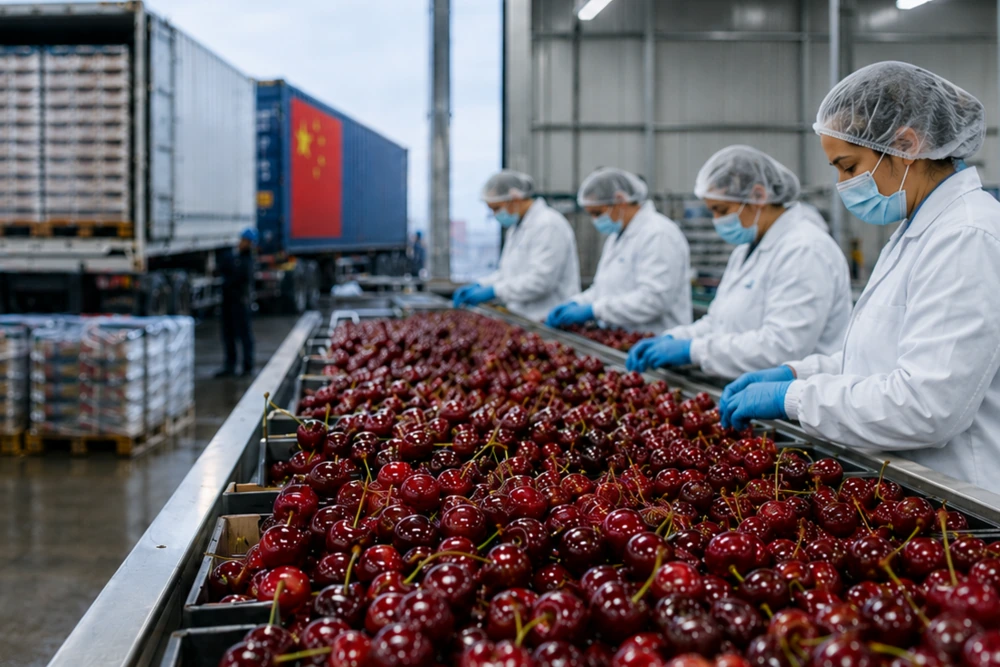
In this scenario, Interborders, a freight forwarder and logistics operator with a presence in six countries, analyzes how refrigerated transport and the cold chain are becoming decisive factors in ensuring that fruit reaches the Asian market on time and in the expected condition.
A market growing in volume and requiring greater precision
According to ODEPA's April 2026 Fruit Bulletin, fresh cherry exports closed the 2025/26 season at 569 thousand metric tons, down 8.9% from the previous season, with a value of USD 2.59 billion FOB (approximately EUR 2.29 billion), 8.8% lower than the USD 2.84 billion recorded in the previous season (approximately EUR 2.51 billion).
The main destination remains clearly defined.
According to the preliminary report by the Frutas de Chile Cherry Committee, 113.8 million boxes were shipped, of which 98.9 million were destined for China. However, China's share fell from 92% to 87%, indicating progress in the diversification of destination markets for Chilean cherries.
For the new campaign, expectations are rising again. Frutas de Chile has presented a preliminary forecast of 132 million boxes for the 2026/27 season, which will be revised in mid-October and would represent an approximately 16% increase in volumes compared with the previous season.
The logistics challenge: timing, temperature and arrival windows
Reefer transport leaves no room for improvisation.
The industry described last season as particularly challenging because weather conditions brought the harvest forward by around 10 days and concentrated supply in the first few weeks, while a later Chinese New Year extended the marketing period from October 15 to February 15.
This mismatch has a direct impact on international logistics: more refrigerated containers concentrated within a limited number of weeks, greater pressure on the availability of equipment, vessel capacity and port coordination, as well as the need for each shipment to reach its destination at the most commercially advantageous time.
For a perishable product, every day of delay in the cold chain affects quality and, consequently, the economic return for the producer.
Interborders' approach: planning before the harvest
For Interborders, the work involved in fresh fruit exports begins well before the first shipment.
Its approach as a logistics partner is based on anticipating bookings for space and reefer equipment, coordinating the different players across the supply chain, and constantly monitoring the goods from the packing facility to the destination port.
The company's experience in ocean freight and operations with Asia allows it to support exporters in planning their operations by assessing routes, transit times and alternatives in the event of unforeseen circumstances.
This is complemented by digital tools that provide traceability and visibility for every shipment, a crucial aspect when temperature and timing determine the fruit's final value.
Competitiveness and sustainable results
With volumes expected to increase and an increasingly demanding Chinese market, the competitiveness of Chilean cherries will depend as much on the quality achieved in the orchard as on the efficiency of reefer logistics.
Advance planning, real-time information and integrated coordination between exporters and freight forwarders will be key to ensuring that the 2026/27 season delivers sustainable results.
Source: www.portalagrochile.cl
Image source: Agroconectados
Cherry Times - All rights reserved