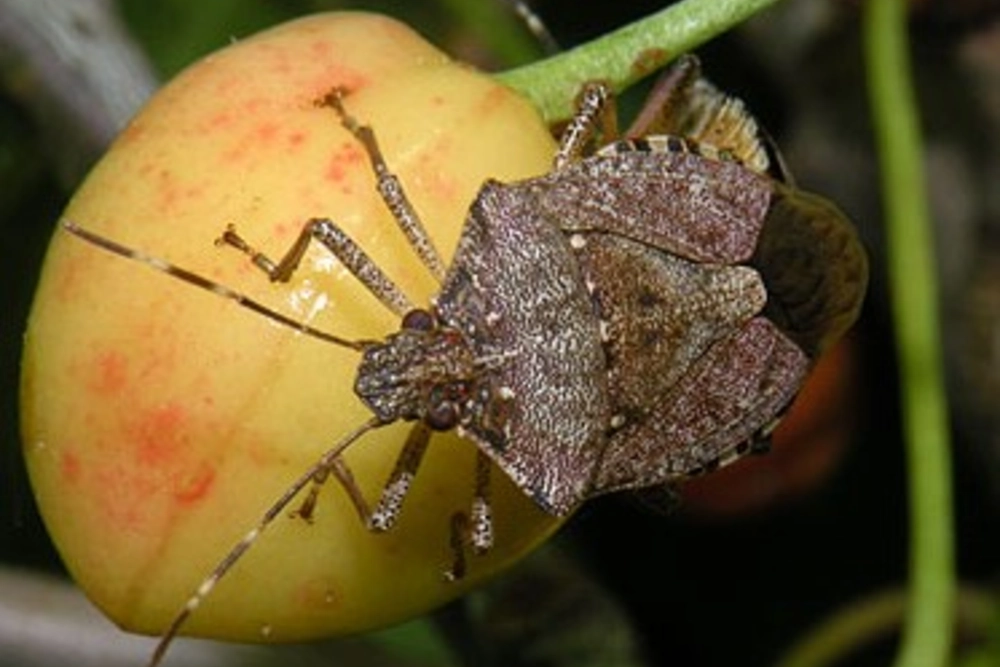
The Asian stink bug has now spread throughout Germany. Researchers at the Julius Kühn Institute (JKI) have developed a natural method to control it without using pesticides.
Damage caused by the Asian stink bug
In 2019, the pest caused losses of more than €500 million in fruit production in northern Italy, according to the Bavarian State Research Center for Agriculture (LfL). Native to Asia, the Asian stink bug poses a particular threat to apples and pears. Other host plants include cherries, plums, peaches, apricots, soft fruit, hazelnuts and grapes.
Losses in fruit production in northern Italy
More than €500 million
Damage caused by the Asian stink bug in 2019. Source: Bavarian State Research Center for Agriculture (LfL).
In Germany, the Asian stink bug is no longer a local problem. Since it was first sighted in the country, in Konstanz in 2011, it has gradually spread from the southwest to other regions. According to the Agricultural Technology Centre Augustenberg (LTZ), by 2025 it was present across Germany. Recent observations indicate further expansion in central Germany, particularly in Saxony. In 2026, the European and Mediterranean Plant Protection Organization (EPPO) considers the species to be widespread in Germany.
The spread of the Asian stink bug in Germany
2011
First sighting in Germany, in Konstanz.
2025
The LTZ reported its presence throughout Germany.
2026
The EPPO considers the species widespread in Germany; observations indicate further expansion in central Germany, particularly in Saxony.
The Asian stink bug is lured with scent compounds
According to the Federal Office for Agriculture and Food (BLE), the method combines “push-and-pull” and “attract-and-kill” strategies: the insects are repelled from fruit or vegetable crops using scent compounds, then lured to a specific location and killed with a natural pyrethrum extract. The scent compounds are distributed throughout the crop using special capsules.
How the method works
1. Repel
Scent compounds drive the insects away from fruit and vegetable crops.
2. Attract
Other compounds lure them to a specific location.
3. Eliminate
The bugs pierce capsules containing natural pyrethrum extract and an oil-and-sugar solution.
The capsules distribute the scent compounds throughout the crop and contain the formulation used for contact action.
Further research is needed
The research team, together with Bielefeld University of Applied Sciences and Biocare Biologische Schutzmittel GmbH, identified effective compounds for each of the three stages. The insects respond only to specific concentrations of the scent compounds: if concentrations are too high or too low, the desired effect is lost.
Combined with an oil-and-sugar solution, the natural pyrethrum extract proved highly effective at killing the insects. The capsules are filled with this formulation and then pierced by the bugs. The contact insecticide acts selectively on the harmful insects while sparing beneficial ones.
Further work will aim to optimise the concentrations of the scent compounds, making the method suitable for practical use.
The four-year BIOBUG project was funded under the Federal Organic Farming Scheme (BÖL).
Source: gvf.de
Image source: Tim Haye - CABI
Cherry Times - All rights reserved