The high volume of fruit harvested annually in recent seasons has led to its accumulation in raw material storage rooms, in some packing facilities exceeding 10 days of waiting before processing, with a consequent deterioration in product quality.
In response to this issue, the use of postharvest storage technologies has been proposed to maintain the initial quality of the fruit while awaiting processing.
Cultivated area and markets
According to unofficial data, the area planted with cherry trees in Chile is currently estimated to exceed 80,000 hectares, well above the 62,000 hectares recorded in 2022.
Interest in this crop remains high, supported by the prices recorded in previous seasons, with the exception of the most recent one.
During the 2024/25 season, exports reached a volume exceeding 625,000 tons of fresh fruit, with China as the main destination market, absorbing more than 91% of exports, followed by the United States with 3.2% (IQonsulting, 2025).
Storage and product quality
The high volume of fruit harvested annually in recent seasons has resulted in its accumulation in raw material storage rooms, in some packing facilities exceeding 10 days of waiting before processing, to the detriment of fruit quality.
To address this issue, the use of storage technologies aimed at maintaining the initial quality of the fruit while awaiting the packing process was therefore proposed.
One of the systems tested on a small scale is the use of controlled atmosphere (CA) under different combinations, considering that the reduction of O₂ and the increase of CO₂ play a key role in fruit metabolism through the respiratory process.
Numerous studies have evaluated different concentrations of these gases, such as 2/0, 2/10, 5/10, 5/15, 10/10 and 10/15 of O₂ and CO₂ respectively, on different cultivars, highlighting positive effects on key quality parameters, such as firmness retention, maintenance of green pedicel color, and reduction of certain skin disorders and rots.
Experimental study on five cultivars
Based on the above and in response to concerns raised by some technicians, a study was conducted on the effect of this storage system on five cherry cultivars, harvested during the normal commercial harvest of each orchard.
Experimental trial at the Pome Fruit Center
As a first approach to the use of this technology on cherries and to at least partially address concerns regarding its effects on fruit, the Pome Fruit Center, through the Postharvest Unit and the Cherry Unit, developed a study aimed at determining the effect of controlled atmosphere on flesh firmness, soluble solids content, titratable acidity (previously published), and postharvest disorders in cherries of the cultivars Lapins, Regina, Sentennial, Staccato and Sweetheart.
Harvest and cold storage
The fruit was harvested in orchards in the Maule Region, following export standards required by the industry.
The fruit was immediately subjected to low temperatures through hydrocooling; once a pulp temperature of 2 °C was reached, the bins were wrapped in bags with 0.3% perforations and stored in 0.3 m³ stainless steel controlled atmosphere minicells (Photo 1) available at the Pome Fruit Center.
In these chambers, gas concentrations were adjusted to reach 10% O₂ and 8% CO₂, at a storage temperature between -0.5 and 0.0 °C.
In addition, a control sample (bagged) was stored under modified atmosphere (MA) at the same temperature.
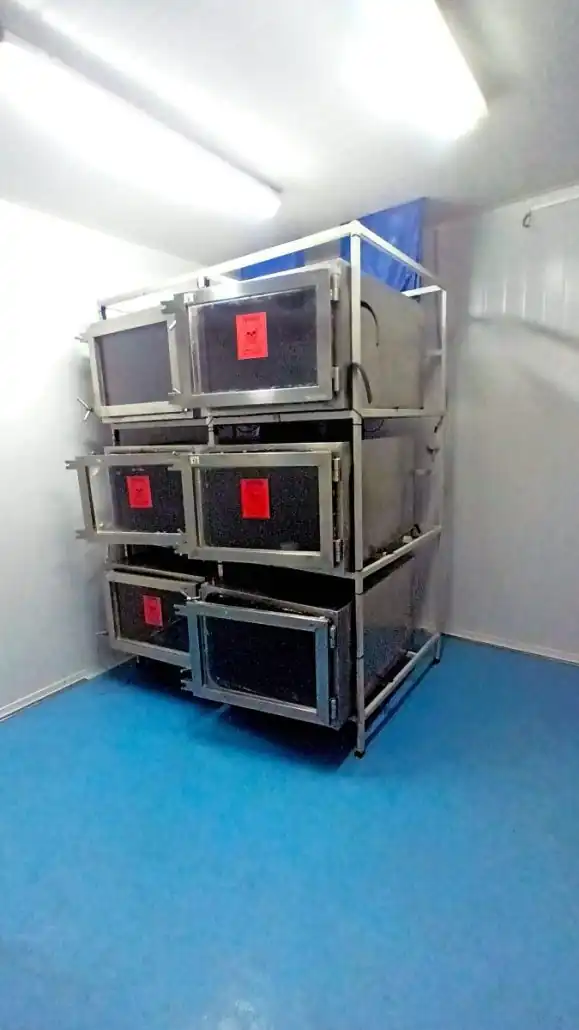 Photo 1. Controlled atmosphere minicells at the Pome Fruit Center.
Treatments
The treatments involved the use of batches of stored fruit under two storage systems: modified atmosphere and controlled atmosphere, for periods of 7 and 15 days.
Subsequently, in some cases, the fruit was evaluated immediately or subjected to the packing process and then stored in modified atmosphere for an additional 30 days (Table 1).
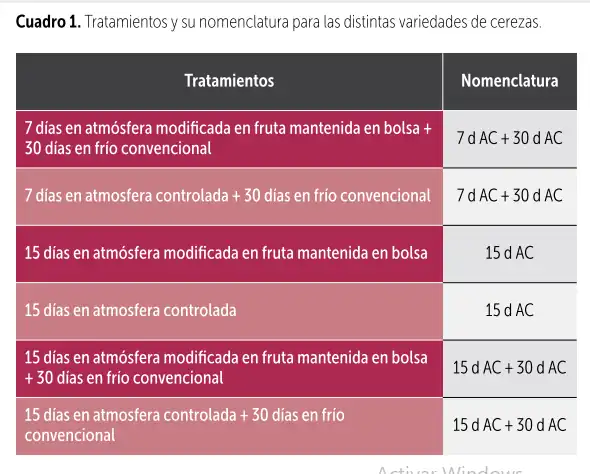 Table 1. Treatments and their nomenclature for the different cherry cultivars.
Fruit evaluations
Physiological disorders, alterations and defects
After each opening of the CA chambers, an external evaluation of fruit condition was carried out, including pedicel coloration and other damage.
After opening the modified atmosphere packaging (MAP) bags and 30 days of cold storage, a detailed evaluation of physiological disorders, alterations and defects was conducted.
Results are expressed as damage incidence (%; Figure 1). For this evaluation, 1,500 ± 700 fruits per cultivar were analyzed, distributed across six replicates.
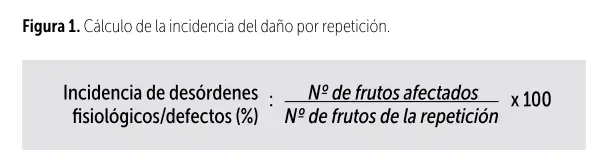 Figure 1. Calculation of damage incidence per replicate.
Results
Physiological disorders and other alterations
In general, physiological disorders were observed in all cultivars evaluated, across all treatments and at the different times of removal from cold storage.
The main disorders observed were lizard skin, pitting and pedicel browning. The main results for each cultivar are described below.
CV. Lapins
When comparing fruit stored under MA versus CA at each removal time from cold storage, a lower incidence of damage was observed in fruit maintained under CA from 15 days onward; however, in some cases the differences were not marked.
Lizard skin and pitting are examples of this, with values close to 100% for both disorders and under both storage conditions when fruit was maintained for 7 days under MA or CA, followed by packing and evaluation after 30 days.
Pedicel browning was lower in fruit maintained for 7 days under CA, with an incidence of approximately 44% compared to 60% in fruit stored under MA for the same period.
At the 15-day evaluation, fruit under MA showed double the incidence compared to CA for lizard skin (97% vs 54%) and pitting (57% vs 23%), and triple for pedicel browning (25% vs 8%).
After 15 days of storage under both conditions, followed by packing and an additional 30 days under MA, fruit from CA showed a lower incidence of lizard skin (100% vs 93%) and pitting (100% vs 83%) (Figure 2).
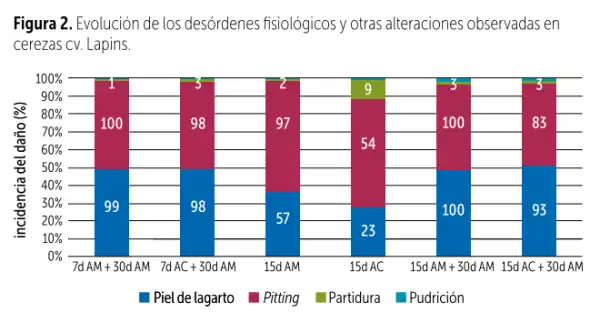 Figure 2. Evolution of physiological disorders and other alterations observed in cv. Lapins cherries.
CV. Regina
For this cultivar, an additional evaluation was carried out after 7 days of storage under MA and CA.
Observed values of lizard skin and pitting reached 30% and 90%, respectively, after 7 days under CA, tripling after packing and an additional 30 days of storage under MA with MAP bags.
Storage of this cultivar under CA for 7 or 15 days prior to processing does not appear to be a favorable solution (Figure 3).
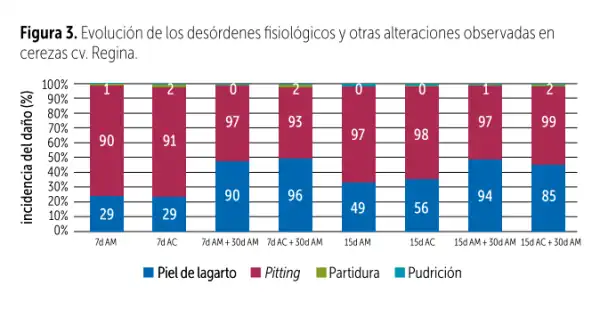 Figure 3. Evolution of physiological disorders and other alterations observed in cv. Regina cherries.
In this case, no treatment effect was observed on internal browning in Regina.
CV. Sentennial
In most evaluations of this cultivar, a high incidence of damage was observed.
In the final evaluation, corresponding to 15 days under MA or CA, followed by packing and 30 days of storage under MA, a lower incidence of damage was observed in fruit maintained under CA; however, the differences were not particularly marked.
Pitting was the parameter showing the greatest difference (86% vs 71%) (Figure 4).
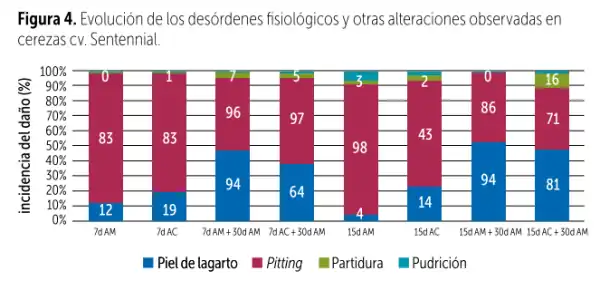 Figure 4. Evolution of physiological disorders and other alterations observed in cv. Sentennial cherries.
CV. Staccato
At the end of the storage period, a high incidence of damage was observed for most evaluated parameters, with pitting exceeding 66% in fruit maintained under MA and 74% in fruit stored under CA.
The latter system maintained 55% of fruit with lizard skin, while fruit stored from the beginning under MA reached an incidence of 73% (Figure 5).
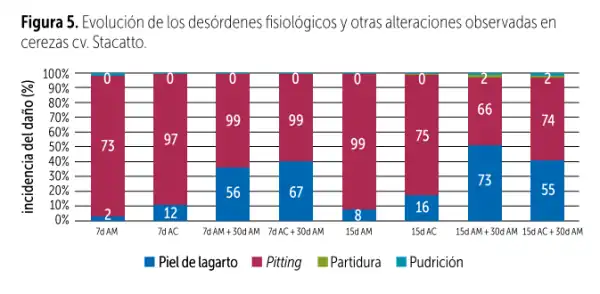 Figure 5. Evolution of physiological disorders and other alterations observed in cv. Staccato cherries.
CV. Sweetheart
For this cultivar, as for Lapins, the 7-day evaluation under MA and CA was not conducted.
After this period, fruit was subjected to packing, stored for an additional 30 days under MA, and only then evaluated.
A strong positive effect of CA on lizard skin was observed, with an incidence of 47% in CA fruit compared to 100% in fruit stored under MA.
This trend was also maintained after 15 days under CA, followed by packing and an additional 30 days under MA, with an incidence of 71% in fruit from CA compared to 97% in fruit stored under MA (Figure 6).
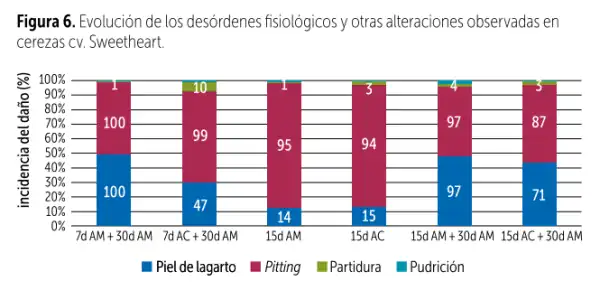 Figure 6. Evolution of physiological disorders and other alterations observed in cv. Sweetheart cherries.
Pedicel browning
This parameter was evaluated only after 15 days of storage (under MA or CA), followed by packing and 30 days of storage under MA.
In general, fruit maintained under CA showed a higher incidence of mildly browned pedicels compared to fruit under MA.
These effects were more evident in the cultivars Lapins, Sweetheart, Regina and Sentennial.
In the Staccato cultivar, however, results did not meet expectations, as no differences were observed in mild, moderate or severe browning levels (Figure 7).
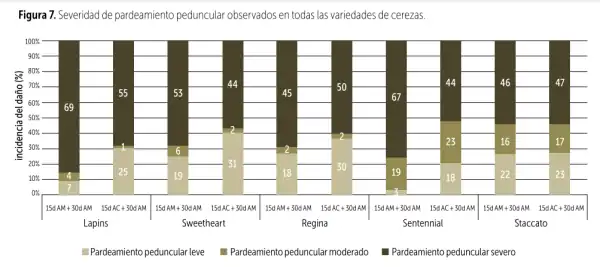 Figure 7. Severity of pedicel browning observed across all cherry cultivars.
Final remarks
In Lapins and Sentennial, a slight positive effect of controlled atmosphere compared to modified atmosphere was observed.
The physiological disorders with the highest incidence were lizard skin, pitting and pedicel browning.
Fruit stored under controlled atmosphere showed a higher number of pedicels with mild browning, while fruit under modified atmosphere showed a higher incidence of severe browning.
Mauricio Fuentes and Daniela Simeone, Pome Fruit Center, University of Talca, Chile
Text and internal image source: Redagricola
Opening image source: SL Fruit Service
Cherry Times - All rights reserved