


It was a golden New Year for cherries in Vietnam, in particular for Australia and New Zealand
17 Feb 2025
Despite the significant price increase, demand remained high, especially for premium varieties from New Zealand and Australia.


Research with little cherry disease-sniffing dogs has moved to a new phase — nurseries — after the results of a previous research project surprised even its proponents. “It exceeds my expectations in a sense,” said Jessica Kohntopp, owner of Ruff Country K9 in Idaho.
Kohntopp and her research collaborators have begun a new project to test her trained canines’ ability to sniff out the infection in the warehouses, mother blocks and crowded beds of finished trees in nurseries. They hope the dogs do as well there as they did in production orchard trials.
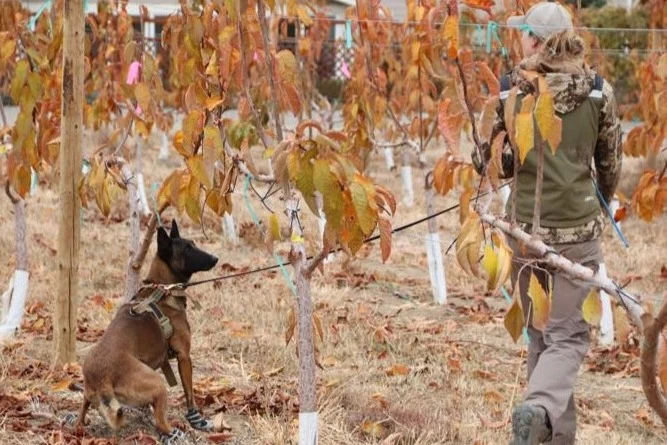
One of the biggest challenges with little cherry disease detection is finding it before symptoms are severe and spreading. The telltale small underdeveloped fruit sometimes takes years to show up. If a tree has recently been infected with one of the pathogens that cause little cherry disease pathogens, including the X-disease phytoplasma or one of the little cherry viruses, it may only be in one small branch. That makes sampling for genetic screens unreliable early in the stages of the disease.
In fall 2024, in a Zillah, Washington, commercial orchard, Kohntopp’s dogs, Aika and Humma, alerted on many Rainier trees suspected infected with little cherry disease. But, in numerous cases, traditional testing methods failed to confirm the dogs’ findings, which raised a key question: Were the dogs wrong, or did the tests miss the mark?
To settle the debate, researchers at Washington State University dug up five of those trees, dissected them into hundreds of 4-inch pieces (10.16 cm) and ran polymerase chain reaction (PCR) tests for each segment. Sure enough, every tree had some X-disease phytoplasma present, but only in an average of 2.8 percent of those sample sections.
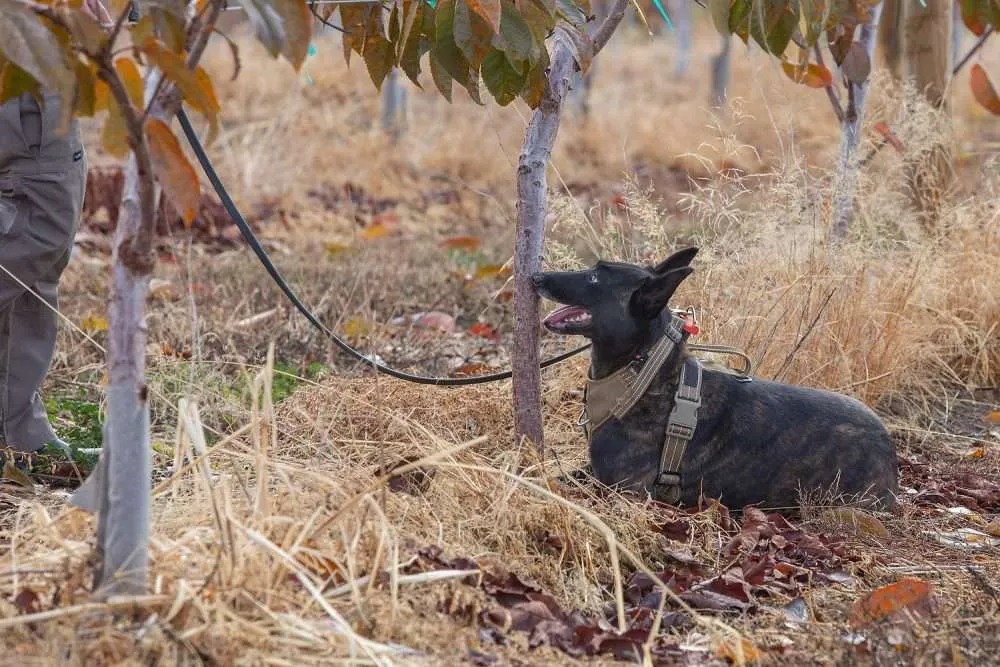 Image 1. Humma of Ruff Country K9 alerts on a Rainier cherry tree she detected as positive for little cherry disease in 2024 in Zillah, Washington. (Ross Courtney/Good Fruit Grower)
That means the odds of random sample success for a scientist taking a random sample were less than 3 in 100 — and proving the testing required an expensive time-consuming laboratory process that no orchardist would dream of. “The dogs were right,” said Scott Harper, pathologist at Washington State University. “It took a lot of work to show that, but they were right.”
The project also included diluting sap extractions from infected trees to lower and lower concentrations to see how little pathogen the dogs can detect. The answer is very small pathogen concentrations. That information will help Kohntopp and scientists develop improved training substances. If research continues to go favorably, the industry will want to scale up commercial use.
Training new dogs only on potted plants used previously, as Aika and Humma were, would be inefficient, Harper said. The Washington Tree Fruit Research Commission funded the research, which ended last year, at a total of $190,000 (€175,000), and agreed to the new two-year project focused on introducing dogs into nurseries. If fully funded, it will total $135,000 (€124,000). The Northwest Nursery Improvement Institute and the Oregon Sweet Cherry Commission contributed.
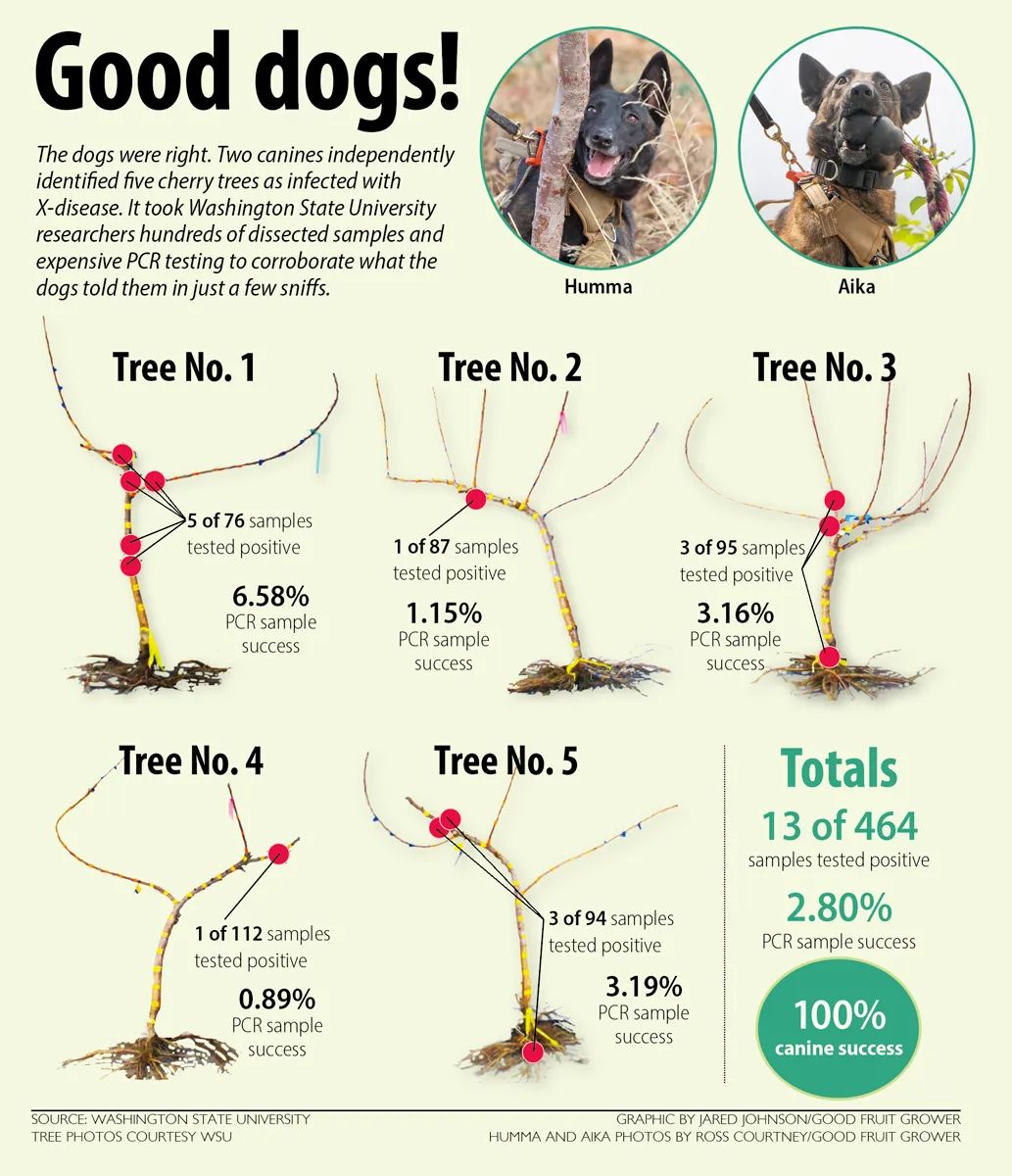 Image 2. This graphic illustrates the results of canine detection and traditional laboratory testing for little cherry disease. (Source: Washington State University; Graphic: Jared Johnson/Good Fruit Grower. Tree photos courtesy WSU; Humma and Aika photos by Ross Courtney/Good Fruit Grower)
The pathogen scent won’t change in a nursery, but dogs also rely on visual cues, Kohntopp said. Altering those cues can create confusion during detection. She tried her dogs once, informally, on some bareroot nursery trees. She and Harper knew a few that were positive but did not know the status of the remaining trees.
The dogs first alerted everywhere then nowhere. Further PCR testing showed that the disease was more prevalent in the trees than they realized, and the dogs became overwhelmed. “We honestly set the dogs up for failure,” she said.
For the newly funded nursery project, Kohntopp will train the dogs on known positive and negative samples in the new environment before running trials on unknown samples. Nurseries expressed strong enthusiasm. “I’m bullish on the dogs,” said Bennett Mayo, president of Mike and Brian’s Nursery in the Yakima Valley.
Aika and Humma have visited Mike and Brian’s mother blocks and alerted on two trees that had previously tested negative with PCR. Mayo trusted the dogs and removed the suspected trees. At Cameron Nursery in the Columbia Basin, owner Todd Cameron can’t wait to have dogs sniffing through nursery rows.
“The real risk is those mother trees in nurseries,” he said. “They need to be walked by detection dogs every year, in my opinion.” He would even support adding such a safeguard to state regulations.
Detecting X-disease in tightly spaced nursery beds or in nursery warehouses with packed bins, when dozens of trees are grouped together, will be more complicated, they said. And even if canine detection becomes common practice at nurseries, production orchards will still need monitoring.
That’s because leafhoppers transmit the phytoplasma and live among root suckers and weeds. “One infected tree with suckers inside a block will spread if not stopped,” Cameron said.
Text and internal images source: goodfruit.com:
Opening image source: Corina Serban, WSU
Ross Courtney
Associate editor for Good Fruit Grower

17 Feb 2025
Despite the significant price increase, demand remained high, especially for premium varieties from New Zealand and Australia.
19 Jun 2025
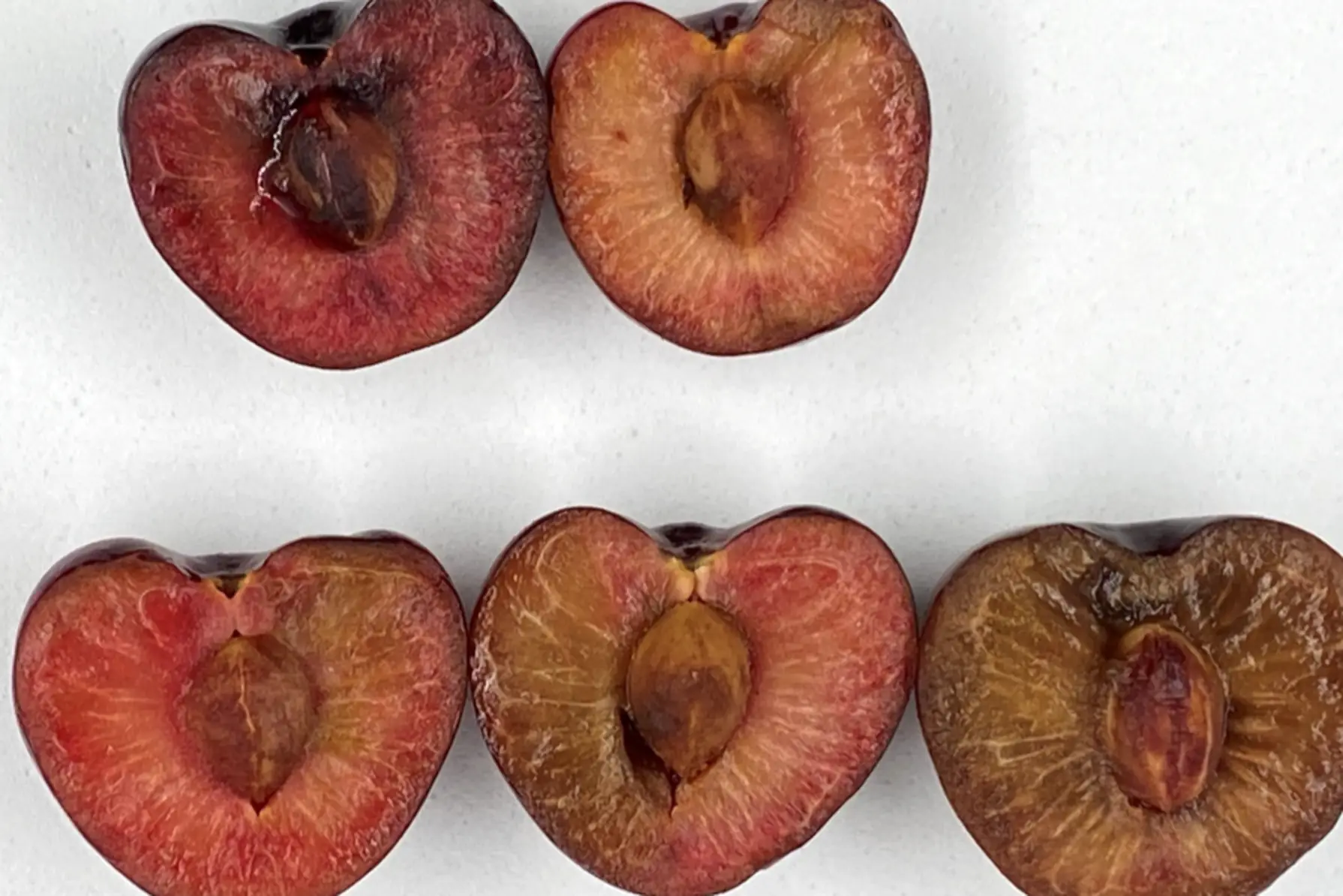
Regina cherries for export to China need targeted postharvest treatments to retain premium quality. This Chilean study explores the use of natural elicitors to reduce internal browning and improve firmness and flavor throughout cold storage and long-distance transport.




21 Oct 2026
A study of greenhouse-grown Sunburst sweet cherries in Beijing, China, compares hand pollination, growth regulators and honey bees. Hand pollination raises fruit set to 71.68% while maintaining good fruit firmness. Costs and results across seasons still need assessment.

21 Oct 2026
Cherry irrigation and fertilization: practical guidance on water, nutrients and root growth. Learn how irrigation frequency, calcium and nitrogen applications, soil inspections and compaction management can support fruit quality, healthy roots and productive orchards.