A spatial decision support system for estimating fruit cracking intensity at single-tree, plot and regional level. Fruit cracking is one of the main issues affecting the quality and yield of many fruit crops.
The CrackSense project has developed a spatial decision support system (SDSS) that integrates data from different sources and artificial intelligence models to estimate cracking intensity at single-tree, plot and regional level. The system provides growers, advisors and policymakers with useful information for timely interventions and for reducing crop losses.
Fruit cracking
Fruit cracking is a complex physiological disorder influenced by multiple interacting factors, including environmental conditions, irrigation practices, fruit growth dynamics and varietal characteristics.
In crops such as pomegranate, cherry, citrus and table grapes, cracking can lead to significant yield losses and a reduction in market value, with reported losses ranging from 10 to 40% in pomegranate, from 20 to 50% in cherry, from 10 to 35% in citrus and up to 30% in table grapes, depending on weather conditions, varietal susceptibility and orchard management practices.
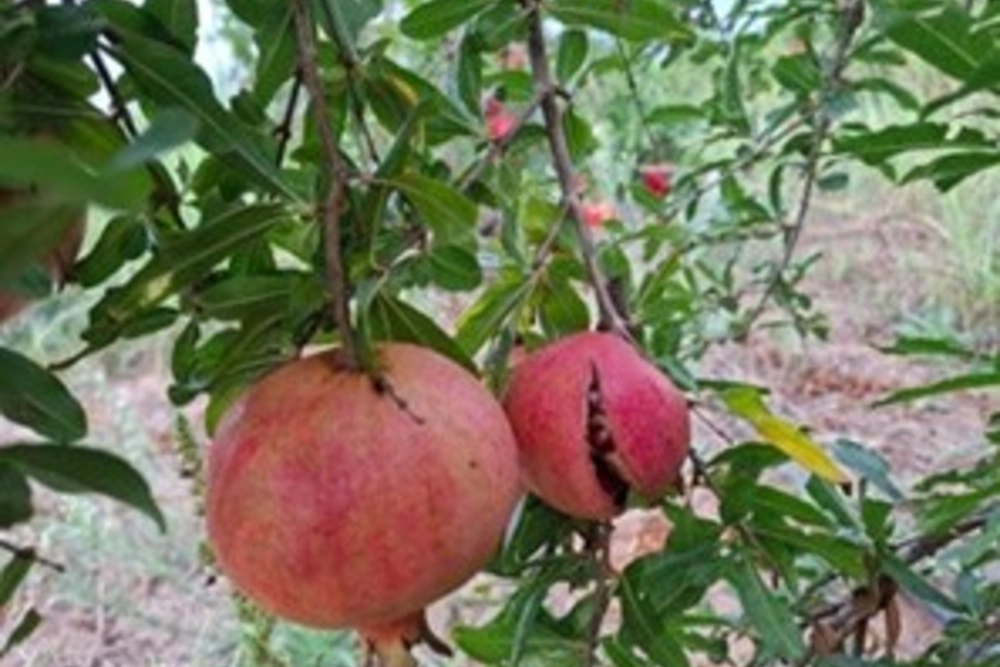 Figure 1: Example of pomegranate fruit cracking, illustrating the type of physiological damage that can lead to significant yield and quality losses in fruit production systems.
Traditional monitoring methods are based on field observations and historical experience, which often fail to capture the dynamic and spatially heterogeneous nature of cracking risk within orchards and across different regions.
Data-driven tools
With increasing climate variability and the greater frequency of extreme weather events, growers need data-driven tools capable of predicting cracking risk and supporting proactive management decisions.
Recent advances in remote sensing, proximity sensing and artificial intelligence offer new opportunities to address this challenge.
By integrating environmental data, plant physiological measurements and Earth observation datasets, predictive models can estimate cracking risk at different spatial scales.
As part of the CrackSense project, a spatial decision support system (SDSS) will be developed to combine these technologies into an operational framework capable of supporting decision-making by growers, advisors and agricultural stakeholders.
Multiscale decision support framework
The CrackSense SDSS is designed to estimate fruit cracking intensity across three spatial levels.
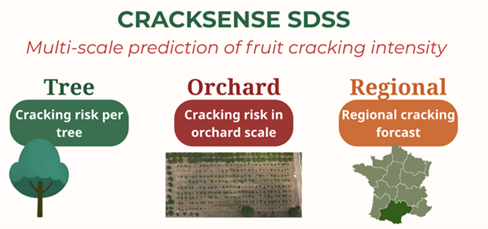 Figure 2: Conceptual overview of the CrackSense SDSS, showing the multiscale prediction framework used to estimate fruit cracking intensity at single-tree, orchard and regional level.
Tree level
At single-tree level, the system integrates high-resolution measurements collected from sensors, drone imagery and physiological field observations.
Key variables include:
- Stem water potential (SWP)
- Fruit growth dynamics
- Trunk diameter growth
- Soil moisture
- Vegetation indices (NDVI, MSAVI, NDRE, etc.)
- Canopy temperature and heat stress indicators
These variables are processed using machine learning models to estimate tree-specific cracking probability and fruit stress levels.
This detailed analysis allows growers to identify individual trees or rows that may require targeted management interventions.
Plot/orchard level
At plot level, the SDSS aggregates single-tree predictions to assess spatial patterns of cracking risk within orchards.
Using geospatial analysis and remote sensing data, the system can:
- Detect zones with greater susceptibility to cracking
- Identify management factors, such as irrigation variability
- Monitor canopy vigour and water stress across the orchard
- Provide maps of predicted cracking intensity
This spatial information enables growers to apply precision management strategies, such as adjusting irrigation schedules or applying plant growth regulators in a targeted way.
Regional level
At regional level, the SDSS integrates datasets from multiple orchards across different climatic zones.
Regional datasets include:
- Meteorological data (temperature, humidity, rainfall, VPD)
- Remote sensing observations via satellite and UAV
- Historical records of cracking events
- Crop management practices
- Soil and environmental characteristics
Artificial intelligence models analyse these datasets to generate regional assessments of cracking risk, allowing stakeholders to monitor large-scale patterns and forecast potential cracking outbreaks under specific climatic conditions.
Regional forecasts can support early warning systems for growers, advisory services and extension programmes, as well as policy planning and climate adaptation strategies.
AI-based predictive models
The SDSS system is based on machine learning algorithms, mainly Random Forest models, trained using multi-season datasets collected at pilot sites in Europe and Israel.
The models integrate environmental variables, including temperature, humidity and VPD, plant physiological indicators, remote sensing indices, management practices, and soil and climatic conditions. By combining these heterogeneous data sources, the system can capture the complex interactions between environmental stress and fruit development.
The artificial intelligence models generate predictions for:
- Fruit cracking probability
- Tree water stress indicators
- Yield and productivity losses
These predictions are continuously refined as new data are collected and integrated into the system database.
Web platform for decision support
The CrackSense decision support system is implemented through a web platform designed to provide easy access to cracking risk assessments and related agronomic information for growers, advisors and other stakeholders.
The platform integrates datasets from different sources and model outputs to support the monitoring and analysis of orchard conditions across different spatial scales. Its development follows a user-oriented approach to ensure that the system is practical, accessible and adaptable to different crops and production environments.
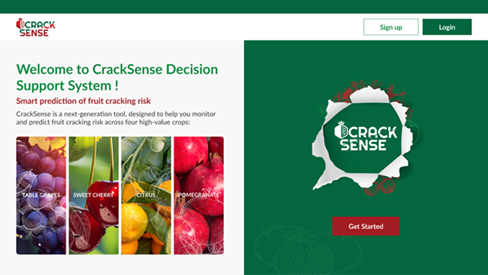 Figure 3: Prototype interface of the CrackSense web-based decision support system, designed to provide users with access to fruit cracking risk forecasts for four crops and three spatial scales.
Benefits of the system
Fruit cracking remains one of the main causes of yield and quality loss in many fruit crops.
Addressing this challenge requires integrated monitoring systems capable of combining environmental, physiological and remote sensing data.
The CrackSense spatial decision support system represents an innovative approach that enables cracking risk assessment across multiple scales, from individual trees to regional production systems.
The main benefits of the system include:
- Early identification of cracking risk factors
- Precision orchard management
- Improved yield and fruit quality
- Data-driven advisory services
- Greater resilience to climate variability.
Resilience and economic sustainability
By providing useful information at single-tree, orchard and regional level, the SDSS system allows growers and agricultural stakeholders to forecast cracking risk, optimise management practices and reduce yield and quality losses.
This supports a more efficient use of water, inputs and labour, while improving the resilience and economic sustainability of orchards.
Future developments will focus on expanding datasets, refining predictive models and integrating additional sensing technologies to further improve the reliability, scalability and practical adoption of the system in different production contexts.
Acknowledgement
This work was developed as part of the CRACKSENSE project (GA No.: 101086300), funded by the European Union’s Horizon Europe programme.
Source: Medium / Foodscale Hub, Trg Dositeja Obradovića 8 / Agricultural University of Athens AUA OFC.
Opening image source: Stefano Lugli
Cherry Times - All rights reserved