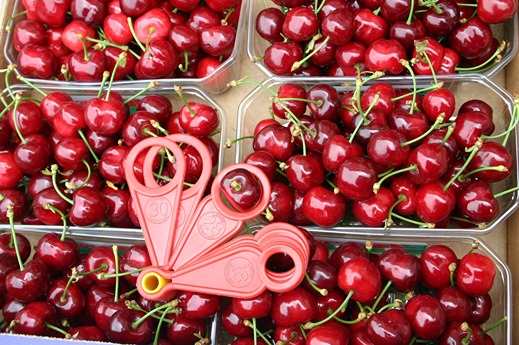
The early cherry window represents one of the most interesting opportunities within the fresh fruit industry. Early-season cherries can capture strong market demand, higher prices, and significant consumer interest at a time when supply is still limited.
For growers and commercial operators, this window can represent exceptional value.
However, this opportunity also involves a higher level of risk. Producing early cherries means operating within a narrow and vulnerable climatic window, where frosts, rainfall, sudden temperature fluctuations, or other adverse weather events can compromise fruit quality, the exportable percentage, and the final value of production.
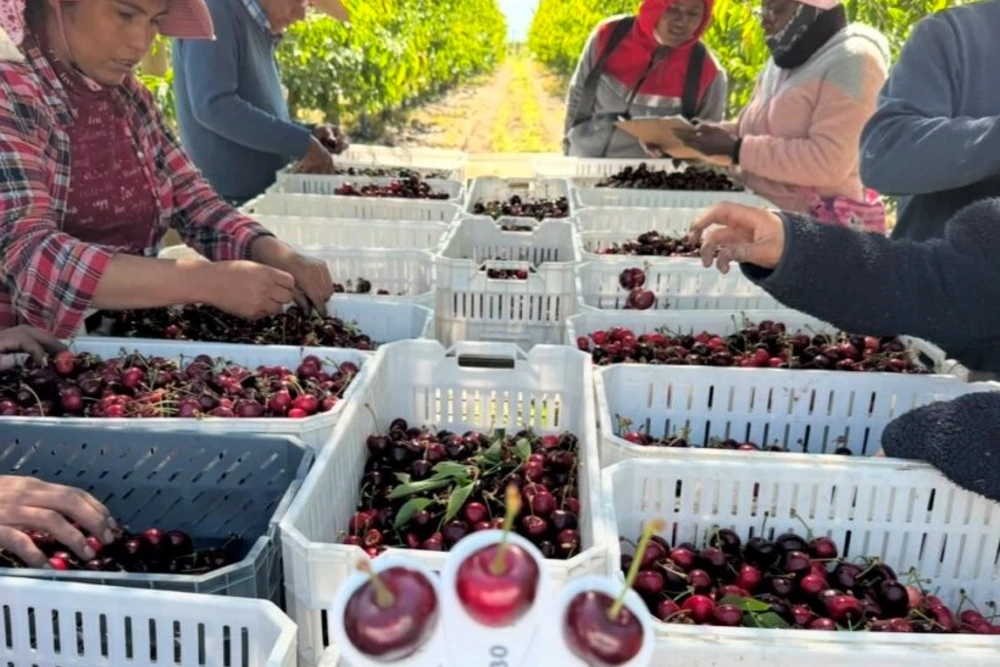
When climate determines the season
In cherries, where harvest timing and quality are critical factors, a single weather event can significantly affect the outcome of a season.
In this context, climate risk management becomes just as important as production potential. Genetics represents the first tool for addressing this challenge.
The ability of a variety to adapt to different climatic conditions, maintain fruit quality, and perform consistently across different production systems is a determining factor for the success of early cherry projects.
Genetics and field results
In the case of Bloom Fresh cherries, the 2026 season showed that good results can be achieved in different production systems. In California, for example, on April 20, some open-field growers in the far south of the San Joaquin Valley achieved positive results with Cheery Cupid, reaching 11.5 tons/ha, with 50% of the fruit above 26 mm.
This shows that Bloom Fresh cherry varieties have high commercial value and can deliver excellent performance under the right conditions. The result was supported by a combination of strong genetics, proper site selection, and solid technical management.
However, protected agriculture has proved to be a valuable tool for many projects exposed to greater climate risks. Rain covers, tunnels, and other protection systems can help reduce vulnerability during sensitive stages such as flowering, fruit development, and harvest.
Protecting the crop at critical moments
Another grower in California reported that their block grown under plastic covers produced 3.8 times more than the open-field block, mainly thanks to the improved conditions created under cover during the pollination period.
When frosts or rainfall occur, protected orchards can have an important advantage in preserving fruit quality and safeguarding production potential.
The value of protection structures should not be understood as a mandatory requirement, but rather as a strategic risk management tool. In areas where weather events are frequent or unpredictable, these systems can provide an additional level of security and help protect the grower’s investment.
Quality, earliness, and margin for error
This aspect is particularly relevant in the early cherry window, where the commercial return can be high, but the margin for error is limited. Early fruit must not only reach the market first: it must also meet expectations in terms of size, flavor, firmness, appearance, and postharvest shelf life.
A well-designed and well-managed protection system, accompanied by adjustments in nutrition, canopy management, irrigation, and other technical practices, can help maintain these quality parameters when climatic conditions become challenging.
As global climate patterns become more variable and growers face increasing uncertainty linked to climate change, the industry is being pushed to think more strategically about resilience.
Resilience in modern fruit growing
Protected agriculture is one of several solutions available to growers, alongside varietal selection, site assessment, rootstock choice, irrigation management, pruning strategy, and harvest timing.
At Bloom Fresh, the focus remains on developing and evaluating cherry varieties with high commercial potential, excellent fruit quality, and adaptability to real production conditions.
Understanding how each variety performs in different climates and management systems is essential to help growers make informed decisions and build more resilient projects. In some areas, open-field production may be fully suitable.
Earliness looking to the future
In others, protected agriculture can help reduce risk and improve the consistency of results.
Ultimately, the early cherry opportunity is as promising as it is demanding. As climate variability increases, success will depend less and less on pursuing maximum yield and increasingly on the ability to build systems capable of delivering quality and consistency year after year.
The right combination of genetics, technical knowledge, site-specific decisions, and risk mitigation tools will be fundamental to capturing the value of this commercial window.
Producing earlier, producing better
The early cherry opportunity continues to be one of the most interesting in modern fruit growing. However, capturing this value will increasingly require an integrated approach, capable of combining genetic innovation, technical excellence, and intelligent risk management.
In an increasingly uncertain climatic context, the question is no longer only how to produce earlier, but how to do so consistently, sustainably, and profitably year after year.
Antonia Sánchez-Labbé, MSc
Technical Director, Cherries, Bloom Fresh
Source: Portal Fruticola
Image source: Portal Fruticola
Cherry Times - All rights reserved