Over time, breeders and fruit growers have developed numerous agronomic techniques to improve the appearance and quality of fruits, particularly color, which represents one of the main criteria guiding consumer choice.
Among these techniques, fruit bagging is widely used because it allows modification of the microenvironment surrounding the fruit, regulating factors such as light exposure, temperature, and humidity.
In addition to improving aesthetic appearance, this practice also provides effective protection against pests and pathogens, thereby contributing to overall better fruit quality at harvest.
Fruit bagging and its effects
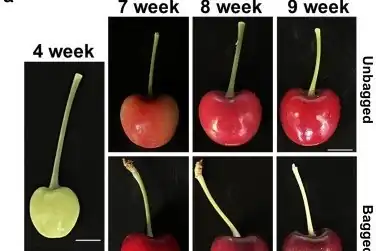
Numerous studies have shown that fruit bagging can significantly influence fruit coloration, although its effects vary depending on the species, cultivar, and type of bag used.
For example, in some red-skinned apple cultivars, the use of yellow–red double-layered bags have resulted in increased anthocyanin content—the pigments responsible for red and purple hues—accompanied by a reduction in chlorophylls and carotenoids.
Conversely, in other cultivars such as ‘Jonagold’, yellow–black double-layered bags have been found to inhibit anthocyanin accumulation.
In cultivars like ‘Granny Smith’ and ‘Golden Delicious’, early application of paper bags promoted higher anthocyanin levels in mature fruits.
Focus on sweet cherries
Despite the widespread use of this technique, the specific effects of fruit bagging on sweet cherry coloration have not yet been fully clarified.
The study described here was conducted by researchers from four research institutes in Beijing (China) in collaboration with Michigan State University (USA) and focused on the red sweet cherry cultivar ‘Lapins’.
The aim was to evaluate the impact of fruit bagging on anthocyanin accumulation and to elucidate the molecular mechanisms underlying color changes.
Using an integrated approach that combined transcriptomic and metabolomic analyses, the researchers were able to examine in detail the genes and metabolites involved in this process.
Findings and implications
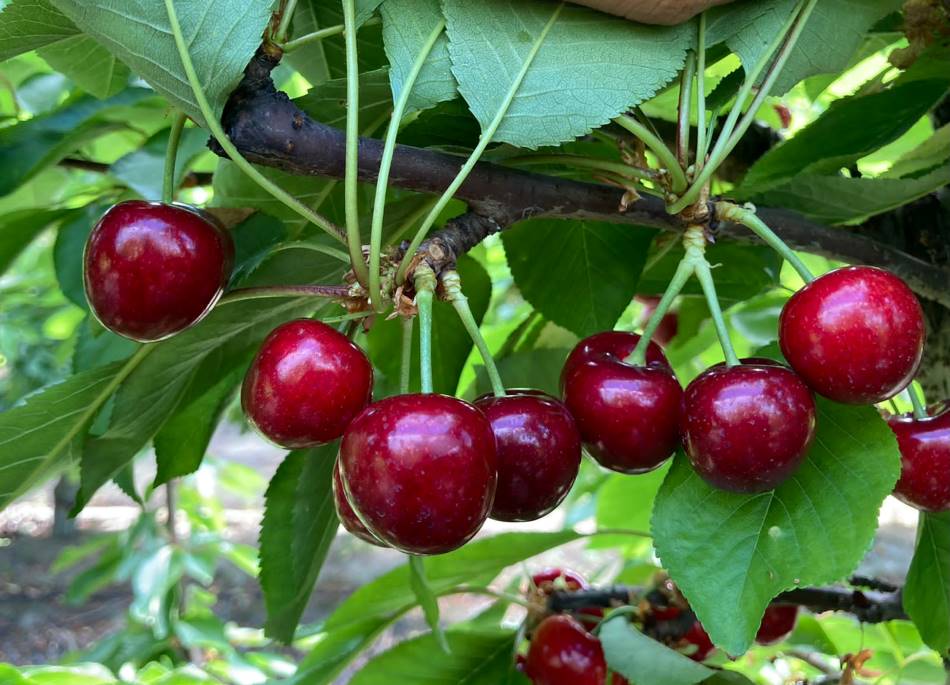
The results showed that bagging with yellow–black double-layered bags visibly improved the coloration of ‘Lapins’ cherries.
This effect was associated with a significant increase in several key anthocyanins, such as cyanidin-3-O-glucoside and peonidin-3-O-rutinoside.
At the same time, bagged fruits exhibited higher accumulation of sugars including glucose, fructose, and sorbitol, which may provide the energy and precursors required for anthocyanin synthesis.
Plant hormones also played an important role: certain auxins, one abscisic acid derivative, and one jasmonic acid derivative showed positive correlations with anthocyanin accumulation, while some cytokinins appeared to have the opposite effect.
Gene expression insights
At the genetic level, gene expression analysis revealed that specific transcription factors, such as PavMYB10.1 and PavNAC02, promote anthocyanin biosynthesis, whereas PavBBX24 acts as a negative regulator, preventing excessive accumulation under normal light conditions.
Overall, this work demonstrates that fruit bagging is an effective strategy for improving the coloration and quality of sweet cherries, providing new insights into the metabolic and molecular mechanisms involved.
These findings open up promising perspectives for optimizing cultivation practices and enhancing fruit quality in sweet cherry production.
Source: Chen Feng, Qingqing Guo, Chuanbao Wu, Xiaoming Zhang, Jing Wang, Guoqing Song, Guohua Yan, Yu Zhou, Wei Wang, Kaichun Zhang, Xuwei Duan, Effect of bagging treatment on fruit anthocyanin biosynthesis in sweet cherry, Agriculture Communications, Volume 3, Issue 4, 2025, 100103, ISSN 2949-7981, https://doi.org/10.1016/j.agrcom.2025.100103
Image source: Feng et al 2026
Melissa Venturi
University of Bologna (IT)
Cherry Times - All rights reserved