There is a word that is still used by many people, although it is gradually falling out of use. It is often pronounced with a certain emphasis, almost accompanied by a rhetorical gesture of the hand: marchiano. A glaring mistake. A colossal blunder. Something enormous, excessive and impossible to ignore.
Yet very few people know that behind this common word lies a story of extraordinary fruit, ancient geographies and an Italy in which the reputation of an agricultural product had the power to transform it into language.
As documented by the Treccani dictionary, the adjective marchiano derives directly from marca, an ancient term referring to the March of Ancona, the medieval territory that roughly corresponded to the modern-day Marche region. Its original meaning was simply “from the Marche”, or belonging to that land.
From the 14th century onwards, the term appeared as a noun in contemporary texts with a geographical meaning. Then something changed. The ciliegie marchiane, a variety of exceptionally large cherries renowned throughout Italy, became so iconic that they carried the adjective into the realm of figurative language: since the cherries from the Marche were the largest of all, marchiano became, by antonomasia, a synonym for enormous, excessive and colossal.
This is confirmed by the website Una parola al giorno, whose newsletter we recommend and which is regarded as one of the most authoritative online resources on the Italian language: “The word marchiano probably acquired the meaning of ‘large’ thanks to the outstanding qualities of a product from the Marche: saragie, namely cherries.”
Even Gabriele D’Annunzio wrote about them, mentioning firm-fleshed and marchiane cherries in his Prose di ricerca, almost granting them literary consecration.
From Ancona to Vignola: Durone della Marca is still here
The thread connecting the Marche region to Vignola is long and slender, but it exists and is still alive today. In Vignola, the European capital of cherries, located in the foothill area between Modena and Bologna, the Durone della Marca is still one of the cultivars officially recognised by the production specifications of the Ciliegia di Vignola PGI, the European certification obtained in 2012.
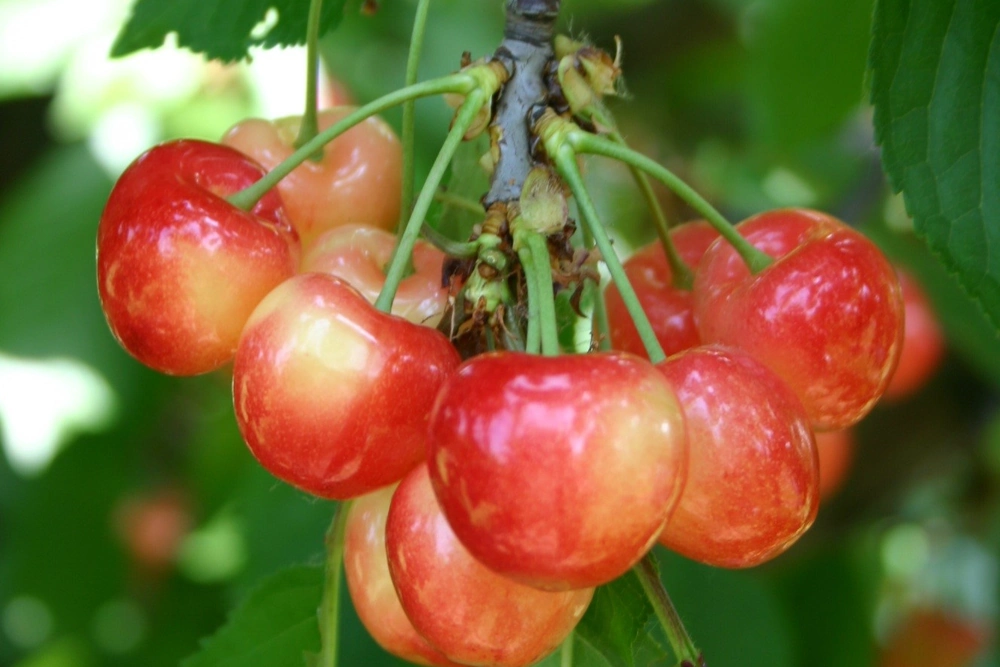
It is immediately recognisable: unlike its scarlet or almost black relatives, the Durone della Marca has a whitish-yellow skin, slightly blushed by exposure to the sun, and firm, compact flesh. Locally, it is also known simply as Marchigiana.
The minimum size established by the production specifications ranges from 20 to 23 mm, depending on the variety, while the largest cherries exceed 28 mm. These are certainly respectable dimensions, but they are far removed from the legend of the colossal fruit that once amazed half the Italian peninsula.
In other words, the same cherries that were once large enough to enter the Italian vocabulary as a metaphor for excess would now be considered perfectly normal according to current market standards. Varietal development, genetic selection and the general increase in fruit sizes across the sector have reduced the historical magnitude of those marchiane cherries.
When food becomes language
This story reminds us of something important: food has always represented culture, identity and reputation. Long before brands, certifications and production specifications existed, the fame of a product could spread, shape the collective imagination and even alter everyday language.
The ciliegie marchiane had no logo, no dedicated shelf space and no communication campaign, yet they were so good and so large that they became a figure of speech.
Today, the Ciliegia di Vignola PGI encompasses a broad range of varieties, including early, mid-season and late cultivars that cover the season from May to July. All the cherries are strictly hand-picked with their stems attached.
The Durone della Marca remains there, included in the production specifications as a small witness to a linguistic history that most people do not know. The next time someone makes an errore marchiano, a glaring mistake, you will know where that expression comes from.
Source: www.fruitgourmet.it
Image source: Stefano Lugli
Cherry Times - All rights reserved