In the fruit-growing corridors of many countries with a strong vocation for cherry cultivation, such as Chile, from the central valleys with high UV radiation to the humid lake regions, small and medium-sized orchards, known as “family-run”, are undergoing a technological evolution. Small growers (1–10 hectares) face the same climate instability as large-scale operations, but without the same protection against crop losses.
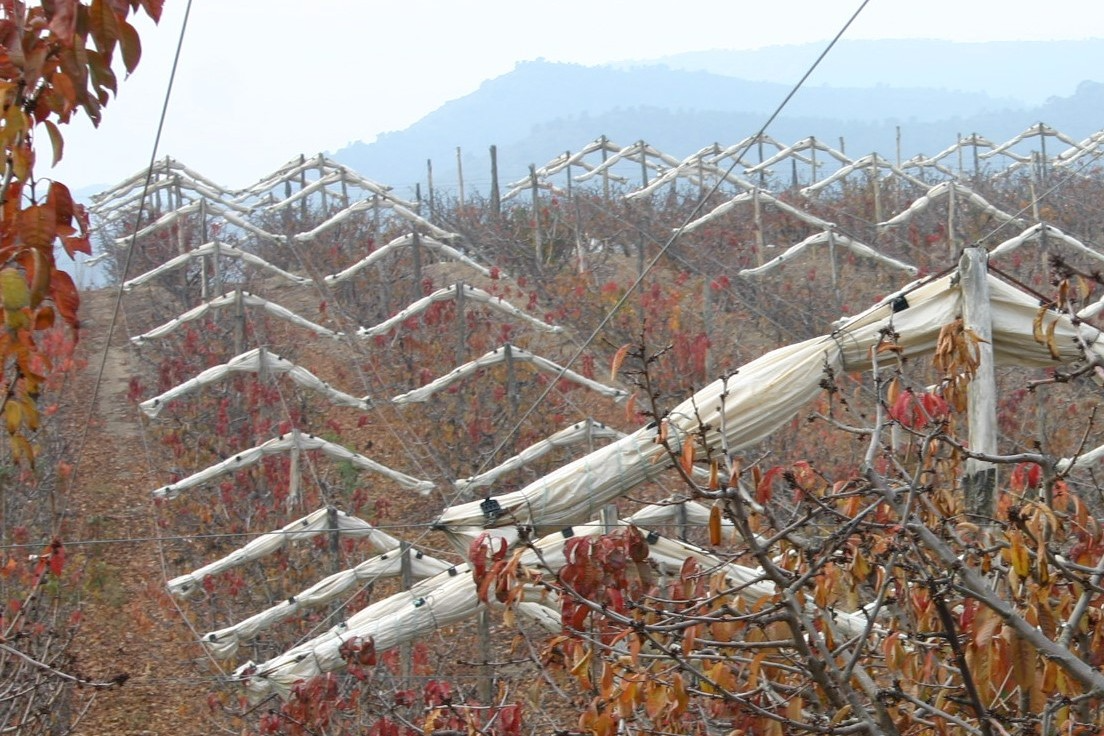
For these growers, a fixed greenhouse is often a “static trap”: expensive to build and rigid in climate management, whereas retractable rain covers represent an evolution toward agile infrastructure, a system that provides greenhouse protection with the physiological benefits of open-field conditions.
1. The agronomic advantage: optimizing the “photosynthetic window”
The main disadvantage of traditional fixed covers is “light limitation.” Even high-transparency films filter specific light spectra. For a small orchard, where fruit color and Brix (sugar content) are key factors for export price, every hour spent under cover represents a trade-off.
- Dynamic light accumulation: retractable systems allow the orchard to remain open for 90% of the growing season. This ensures maximum photosynthetically active radiation (PAR), resulting in firmer fruit and more uniform ripening compared to fixed-cover environments.
- Vapor Pressure Deficit (VPD) management: fixed covers often trap a layer of stagnant, humid air (low VPD). This blocks transpiration, which in turn prevents calcium movement into the fruit. By retracting the covers, growers “flush” the canopy, maintaining the transpiration flow required for high-density cell walls and extended shelf life.
2. Engineering for the reality of “family labor”
In Chile, small orchards often operate with very limited labor margins. The shift from “manual emergency management” to a “systemic response” is crucial for operational survival.
The gap in “implementation speed”
| Management task | Traditional manual shelter | Shengtao retractable system |
|---|
| Reaction time (1 ha) | Over 120 minutes (4 people) | < 10 minutes (1 person) |
| Midnight storm risk | High (requires on-site intervention) | Low (remote/automatic activation) |
| Operational fatigue | High (manual pulling/tying) | Low (mechanical crank/motor) |
For a family-run farm, this 110-minute difference represents the “failure window”, the time required for rain to cause osmotic cracking in cherries or blueberries.
3. Financial engineering: phased capital investment and asset return
Small growers often see protection systems as an “all-or-nothing” expense. Retractable systems offer a modular investment pathway.
- Scale efficiency: by using 6–8 meter spans, these systems require 30% less steel per hectare compared to traditional tunnels. This reduces initial material costs and the environmental impact of structural shading.
- Phased implementation: a family farm can install the support structure (posts and cables) in year one and add retractable membranes in year two, when the orchard reaches peak production. This aligns investment with cash flow.
4. Technical specifications for the Chilean environment
In windy regions such as San Fernando or Osorno, retractable covers provide a significant advantage: they can be retracted during extreme wind events (Beaufort 9+) to prevent sail-effect damage to the steel structure.
- Anchoring standard: we use 1.2 m spiral anchors with high-torque helix. This ensures the cable network remains tensioned even when soil is saturated by winter rainfall.
Material longevity
Our high-tenacity woven HDPE covers are designed to withstand the UV profile of the southern hemisphere.
- Service life: 5–7 years for the membrane; over 20 years for the hot-dip galvanized frame.
- Anti-drip coating: prevents the formation of large droplets on the underside, which can act as “magnifying lenses” and burn young leaves.
5. Decision matrix: which system best fits your farm?
| Farm profile | Recommended system | Strategic advantage |
|---|
| Niche export (1–2 hectares) | High-torque manual crank | Minimal maintenance; 100% reliability. |
| Growth phase (3–7 hectares) | Semi-automatic (motorized) | Balance between labor savings and capital costs. |
| Precision Tech (over 8 hectares) | Fully automatic with integrated sensors | 24/7 protection with no human intervention. |
Source: Shaanxi Shengtao Agricultural Technology Co
Image source: Stefano Lugli
Cherry Times - All rights reserved