The management of postharvest diseases is a critical issue for the sweet cherry supply chain, as the fruit is particularly susceptible to deterioration due to its high water content, delicate epidermis, and intense metabolic activity. Among the most important pathogens, Botrytis cinerea is responsible for gray mold and can cause substantial commercial losses.
In this context, a study conducted on sweet cherries of the cultivar ‘Xianfeng’ evaluated the potential of strigolactones (SLs), carotenoid-derived phytohormones, as elicitors of postharvest defense responses. The fruit were treated with different concentrations of strigolactones, ranging from 0 to 2 μM, and subsequently inoculated with Botrytis cinerea.
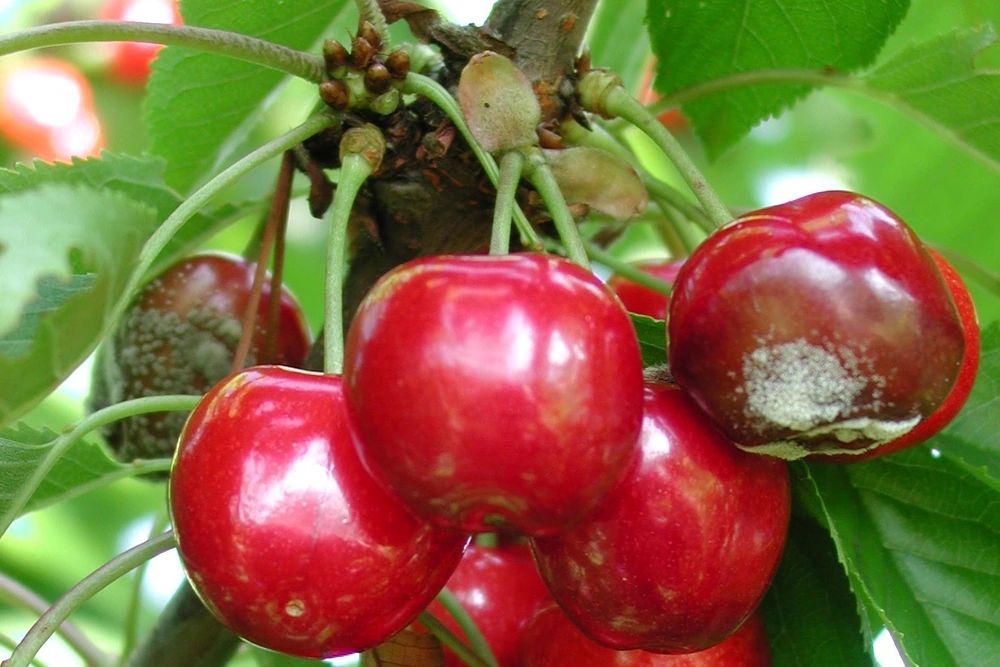
The results showed a strongly dose-dependent response: low or moderate concentrations exerted a protective effect, whereas higher concentrations paradoxically accelerated lesion development. The concentration of 0.1 μM proved to be the most effective, reducing disease incidence, lesion diameter, and fungal biomass compared with the control.
At 48 hours after inoculation, untreated fruit had reached 100% disease incidence and lesions exceeding 20 mm, whereas cherries treated with 0.1 μM SL showed significantly more limited disease progression. Further evidence supporting the role of strigolactones came from the use of Tis-108, an inhibitor of strigolactone biosynthesis, which produced the opposite effects, increasing fruit susceptibility and accelerating the growth of B. cinerea.
The mechanism underlying the enhanced resistance
The mechanism underlying the enhanced resistance was investigated through an integrated transcriptomic and metabolomic approach. Application of 0.1 μM SL markedly activated metabolic pathways associated with phenylalanine metabolism, phenylpropanoid biosynthesis, and flavonoid biosynthesis.
In particular, the enzymes PAL, C4H, and 4CL, which are considered key components of the phenylpropanoid pathway, showed increases in both gene expression and enzymatic activity. In parallel, the production of defense-related secondary metabolites increased, including phenolic compounds and flavonoids. The compounds most strongly affected included catechin, epicatechin, rutin, and chlorogenic acid, while increases were also observed in proanthocyanidins, lignin, phloridzin, and ferulic acid.
The activation of the defense response was not limited to phenylpropanoid metabolism. Cherries treated with strigolactones also showed increased activity of pathogenesis-related proteins, particularly chitinase and β-1,3-glucanase, enzymes involved in the degradation of fungal cell walls. The corresponding genes, PaCHI and PaGLU, together with PaPR4, were also more highly expressed than in the control and Tis-108 treatments.
Overall
Overall, the data indicate that strigolactones do not simply act as compounds with direct antifungal activity, but rather appear to function primarily as inducers or “primers” of the cherry’s defense response, preparing fruit tissues to respond more effectively to infection. The coordinated enhancement of phenylpropanoid pathways, phenolic metabolites, flavonoids, and lignification contributes to strengthening the fruit’s biochemical and structural defenses.
From an applied perspective, the findings are of interest because they demonstrate the potential of hormonal elicitors as a complementary tool for more sustainable management of postharvest diseases. However, the marked dose-dependent response is a crucial consideration: the protective effect observed at 0.1 μM cannot automatically be extended to higher concentrations, which instead promoted disease development in the study.
The researchers therefore identify SLs as promising candidates for new strategies to control gray mold, while emphasizing the need for further studies to clarify the signaling mechanisms involved and to verify their efficacy under practical application conditions.
Source: Wang, H., Zhu, Y., Li, Z., Li, X., Xu, H., Hao, S., Abbas, A., Guo, Y., & Ji, N. Strigolactone-mediated resistance to gray mold in postharvest cherry fruit revealed by physiological and omics analyses. Available at SSRN 6464558. PRE-PRINT https://dx.doi.org/10.2139/ssrn.6464558
Image source: Stefano Lugli
Andrea Giovannini
PhD in Agricultural, Environmental and Food Science and Technology - Arboriculture and Fruitculture, University of Bologna, IT
Cherry Times - All rights reserved