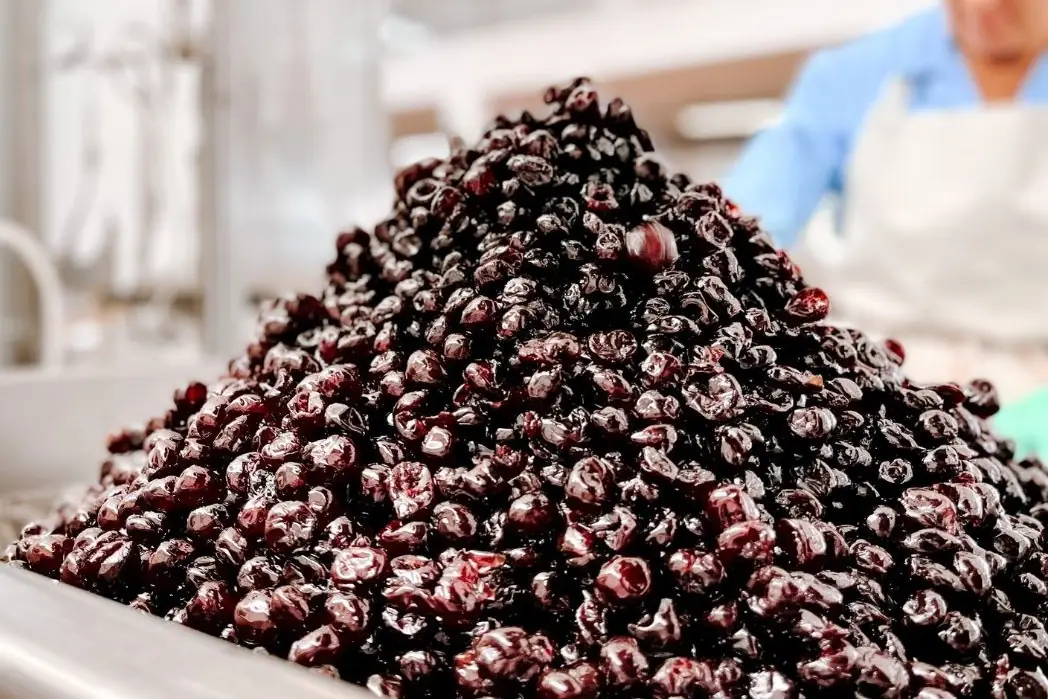
Managing the postharvest quality of sweet cherries requires precise control of conditions throughout the cold chain, as temperature fluctuations can accelerate the proliferation of microorganisms responsible for fruit rots.
The thin epidermis, relatively soft texture, and high water content make this fruit particularly susceptible to mechanical damage and subsequent microbial colonization.
Penicillium, Monilinia, Rhizopus, Mucor, and Alternaria are among the main fungal genera associated with postharvest deterioration and, once infection is established, can rapidly lead to a loss of commercial quality.
In this context, a recent study developed a dynamic predictive model capable of describing fungal growth under fluctuating temperature conditions, with the aim of supporting storage management and the estimation of sweet cherry shelf life.
Experiment and fungal growth
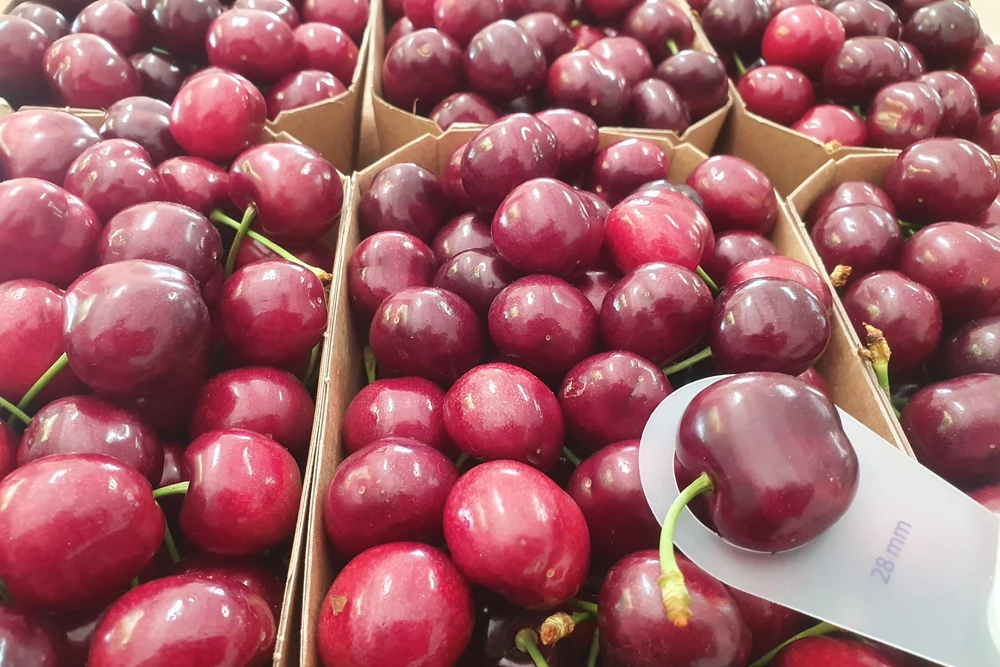
The experiment was conducted on ‘Mei Zao’ sweet cherries harvested at commercial maturity and inoculated with a standardized mixture of five representative fungal species: Penicillium expansum, Monilinia fructicola, Rhizopus stolonifer, Mucor racemosus, and Alternaria alternata.
The fruit was stored at 5, 10, 15, 20, 25, and 30 °C, while fungal populations were monitored over time.
The results showed a typical sigmoidal growth pattern and a marked temperature dependence: as temperature increased, the duration of the lag phase decreased from approximately 101 hours at 5 °C to just over 7 hours at 30 °C, while the maximum specific growth rate increased from 0.009 to 0.076 h−1.
The Baranyi model effectively described fungal growth at the different temperatures, with coefficients of determination ranging from 0.955 to 0.978.
Secondary models and dynamic validation
To extend these results to more realistic thermal conditions, the researchers subsequently integrated this primary model with two secondary models: a square-root model to describe the relationship between temperature and maximum growth rate, and a linear regression model for the duration of the lag phase.
The secondary model describing growth rate showed an R2 of 0.927, whereas the model describing the lag phase reached an R2 of 0.974, confirming the good ability of the equations to represent the response of the microorganisms to temperature.
The models were then integrated into a dynamic system capable of updating predictions of fungal growth as temperature changed over time.
Validation was performed by simulating two temperature profiles characterized by slow and rapid fluctuations, respectively.
Predictions and applicability in real supply chains
In both cases, experimental data showed good agreement with model predictions, and almost all prediction errors fell within the acceptable prediction zone, ranging from −1.0 to 0.5 log CFU/g.
The model developed may therefore represent a useful tool for transforming simple temperature monitoring into a quantitative prediction of fruit deterioration risk, providing information potentially applicable to cold-chain management and shelf-life estimation.
The researchers nevertheless emphasize that the model requires further validation under commercial conditions: the experiment used an artificially inoculated fungal consortium and experimentally defined temperature profiles, which do not necessarily reproduce the full microbiological and thermal variability encountered in real supply chains.
Future use of data collected from actual cold-chain monitoring could therefore help verify and improve the model’s operational applicability.
Source: Xing, S., Xing, W., Fan, X., & Zeng, X. (2026). Dynamic modeling of the growth of spoilage fungi on sweet cherries under fluctuating temperatures. Frontiers in Microbiology, 17, 1858080. https://doi.org/10.3389/fmicb.2026.1858080
Image credit: Stefano Lugli
Andrea Giovannini
PhD in Agricultural, Environmental and Food Science and Technology - Arboriculture and Fruitculture, University of Bologna, IT
Cherry Times - All rights reserved