Commercial production of sweet cherries in Norway is possible up to approximately 60° north latitude.
This species is one of the country’s most economically important fruit crops. Although harvest occurs relatively late in the season, yields are high, and the fruit is destined exclusively for the fresh market.
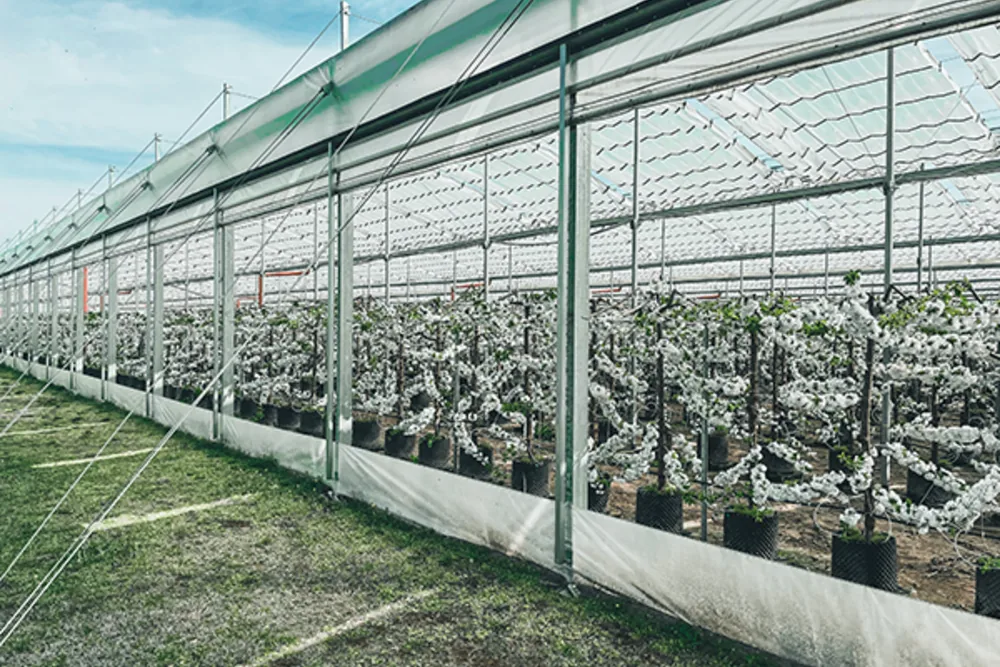
In this context, container cultivation (pots) may represent an innovative solution to increase productivity and improve control over growing conditions, particularly in protected cultivation systems.
A recent study evaluated the feasibility of this technique in high-density plastic tunnels, investigating how different nutritional strategies affect fruit quality in three cultivars: 'Van', 'Lapins', and 'Regina', grafted onto Gisela 5 rootstock and trained as spindle trees in 35-L containers.
Production and context
The objective was to assess the effects of fertigation and fertilization with slow-release fertilizers on fruit quality, identifying the most effective strategies for enhancing production.
The results confirmed that sweet cherry trees can be successfully grown in pots under tunnels, but also highlighted that nutrient management should be tailored to the physiological characteristics of each cultivar.
From a production standpoint, fertigation provided a clear advantage, achieving average yields exceeding 25 t/ha compared with approximately 8 t/ha obtained using slow-release fertilizers.
In particular, the cultivar 'Regina' produced nearly 31 t/ha under fertigated treatments, confirming the potential of this technique for high-density orchards.
Yield and quality
Analyses of the chemical composition revealed that fruit produced by pot-grown trees contained lower concentrations of sugars and organic acids than those typically reported for sweet cherries grown in open fields or in soil-based tunnel systems.
However, the fruit exhibited higher concentrations of phenolic acids and flavonoids, while mineral composition varied according to both treatment and cultivar.
Fertigation significantly increased the concentrations of the main sugars, glucose and fructose, as well as the sweetness index and several phenolic compounds, including chlorogenic acid, ferulic acid, quercetin, rutin, catechin, and hyperoside. It also enhanced the accumulation of key mineral nutrients such as potassium, phosphorus, magnesium, and calcium.
In contrast, fertilization with slow-release fertilizers promoted the accumulation of organic acids, particularly malic, shikimic, and quinic acids, while also resulting in higher total phenolic content.
Effects of nutrition
Antioxidant activity, however, did not differ significantly between the two nutritional strategies, nor did total sugar content, indicating that fertilization techniques primarily influence the distribution of individual metabolites rather than their overall concentration.
The cultivar 'Lapins' stood out for its greater accumulation of mineral elements, especially under fertigation treatments, while 'Van' showed higher concentrations of sugars, a greater sweetness index, and elevated levels of several polyphenols when subjected to the more intensive fertigation regimes.
Conversely, 'Regina' responded particularly well to slow-release fertilization, producing fruit with higher concentrations of organic acids, total phenolics, and antioxidant capacity.
Multivariate analysis also confirmed a clear separation among cultivars and nutritional strategies, demonstrating that fruit quality depends on the interaction between genotype and nutrient management.
Cultivar responses
Overall, the study demonstrates that growing sweet cherry trees in pots under tunnels in Norway is a promising production strategy for highly intensive systems targeting the fresh market, provided that fertigation and fertilization programs are carefully tailored to each cultivar and the specific microclimatic conditions.
Optimizing nutrient management therefore emerges as a key factor for combining high yields with superior nutritional quality of the fruit.
Source: Akšić, M. F., Dabić Zagorac, D., Kitanović, M., Đorđević, K., Natić, M., Frøynes, O., & Meland, M. (2026). Can We Grow Sweet Cherry Trees in Pots? Quality Assessment of Fruits Produced in Tunnels Under Different Regimes of Fertigation and Fertilisation. Agronomy, 16(9), 890. https://doi.org/10.3390/agronomy16090890
Image source: Greenhouse Canada
Andrea Giovannini
PhD in Agricultural, Environmental and Food Science and Technology – General Arboriculture and Tree Crops, University of Bologna, Italy
Cherry Times – All rights reserved