An article published in Plant Health Cases provides a comprehensive overview of bacterial canker of sweet cherry (Prunus avium), one of the most destructive diseases limiting orchard productivity in the world’s major cherry-growing regions.
The review examines the etiology of the disease, its epidemiology, and the latest integrated management strategies, highlighting how the complexity of the pathogen continues to pose a major challenge for researchers, growers, and industry professionals.
Bacterial canker is primarily caused by several members of the genus Pseudomonas syringae, a group characterized by considerable genetic diversity. The principal pathogens include Pseudomonas syringae pv. syringae, Pseudomonas amygdali pv. morsprunorum, and Pseudomonas avellanae. These microorganisms can colonize woody tissues and induce symptoms of varying severity depending on environmental conditions and the susceptibility of the host cultivar.
Pathogen variability
This biological diversity makes it particularly difficult to develop universally effective control strategies.
The article also discusses the taxonomic evolution of the bacterial complex and describes the geographical distribution of the disease, which is now present in virtually all major sweet cherry-producing regions.
Pathogen spread is facilitated by the bacteria’s ability to survive on plant surfaces, in infected crop residues, and on alternative hosts, creating multiple sources of inoculum that sustain new infections throughout the growing season.
Infection conditions
Environmental conditions, particularly cool temperatures, high humidity, and rainfall, play a crucial role in facilitating bacterial entry through pruning wounds, frost injuries, and natural openings in plant tissues.
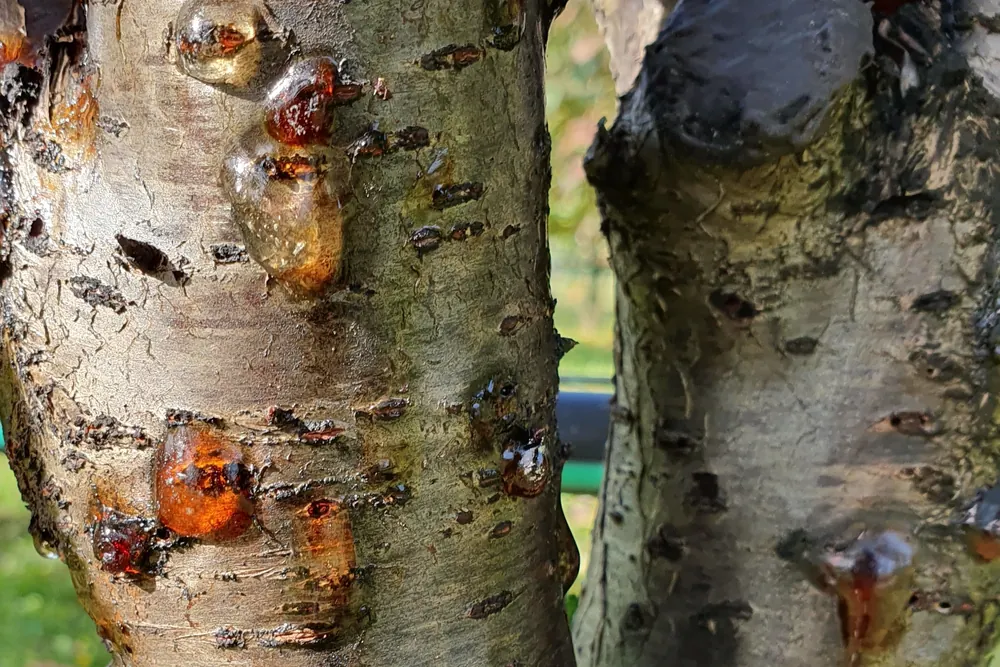
From a pathological perspective, bacterial canker is characterized by bark lesions, abundant gumming, dieback of shoots and branches, and, in severe cases, the death of entire trees.
Disease progression leads to the gradual decline of the orchard, resulting in substantial yield losses and a significant reduction in tree and orchard longevity.
Diagnosis and management
Symptoms may also resemble those caused by other pathogens or environmental stresses, making an accurate diagnosis based on microbiological and molecular techniques essential.
Unfortunately, there is currently no single definitive solution, and bacterial canker control must therefore be based on an integrated approach.
Recommended practices include the use of certified nursery stock, the selection of less susceptible cultivars and rootstocks, the prompt removal of infected tissues, careful pruning to minimize wounds during periods of high infection risk, and close monitoring of environmental conditions that influence the risk of disease outbreaks.
Treatments and future prospects
Plant protection treatments also remain an important component of disease management, although their effectiveness may be limited by pathogen variability and the increasing emphasis on the more sustainable use of crop protection products.
The authors conclude by highlighting how recent advances in understanding the biology, ecology, and epidemiology of the bacteria responsible for bacterial canker provide new opportunities to improve prevention and control strategies.
Greater integration between scientific research, epidemiological monitoring, and sound orchard management practices will make it possible to develop more effective and sustainable disease management systems, helping to reduce the impact of bacterial canker on sweet cherry production worldwide.
Source: Manna, Sheersa and Zhao, Youfu, planthealthcases.2026.0004, Plant Health Cases, doi:10.1079/planthealthcases.2026.0004, CABI, Bacterial Canker of Sweet Cherry (Prunus avium): Disease Etiology, Epidemiology, and Current Management Practices, (2026)
Image source: Stefano Lugli
Melissa Venturi
Ph.D. in Agricultural, Environmental, and Food Sciences and Technologies – Fruit Tree Physiology and Cultivation - Bologna, Italy
Cherry Times – All rights reserved