Entomophilous pollination is essential for ensuring productivity and fruit quality in sweet cherry, a species characterized by cross-pollination and therefore strongly dependent on the activity of insect pollinators during flowering.
A recent study conducted in 2025 and 2026 in a sweet cherry orchard on the Loess Plateau, in eastern Gansu Province, China, characterized the community of flower-visiting insects in this area for the first time, with particular emphasis on the comparison between Apis mellifera and Apis cerana.
Field observations identified 14 taxa belonging to four orders, with a clear predominance of Hymenoptera, which accounted for 62.36% of visitors, followed by Diptera (17.21%), Lepidoptera (11.83%), and Coleoptera (8.6%).
Abundance and functional contribution
At the species level, A. mellifera was the most abundant visitor, accounting for 47.3% of individuals, whereas A. cerana represented 13.98%. Other relevant taxa included Syrphus sp. (7.74%) and the beetle Proagopertha lucidula (8.6%).
However, differences in abundance do not necessarily appear to reflect differences in functional contribution to pollination. The two bee species indeed showed different foraging strategies.
Apis cerana concentrated its activity mainly between 12:00 and 14:00, whereas A. mellifera exhibited a broader period of high activity, approximately between 12:00 and 16:00. Their behavior on individual flowers also differed: A. mellifera remained on each flower for an average of 7.39 seconds, compared with 4.67 seconds for A. cerana.
Visit duration and pollen
In contrast, the interval between successive visits did not differ between the two species, averaging 4.21 and 4.96 seconds, respectively. Thus, the longer residence time of A. mellifera on individual flowers does not necessarily translate into a greater overall rate of movement between flowers.
Regarding pollen distribution on the body, in both species the legs represented the main site of free pollen accumulation; however, A. cerana also carried a substantial proportion of pollen on the thorax, accounting for 25.3% of the total pollen load, compared with 16.6% in A. mellifera.
The thorax is particularly important from a functional perspective because it can readily come into contact with the stigma surface during flower visits.
Nectar and pollinator activity
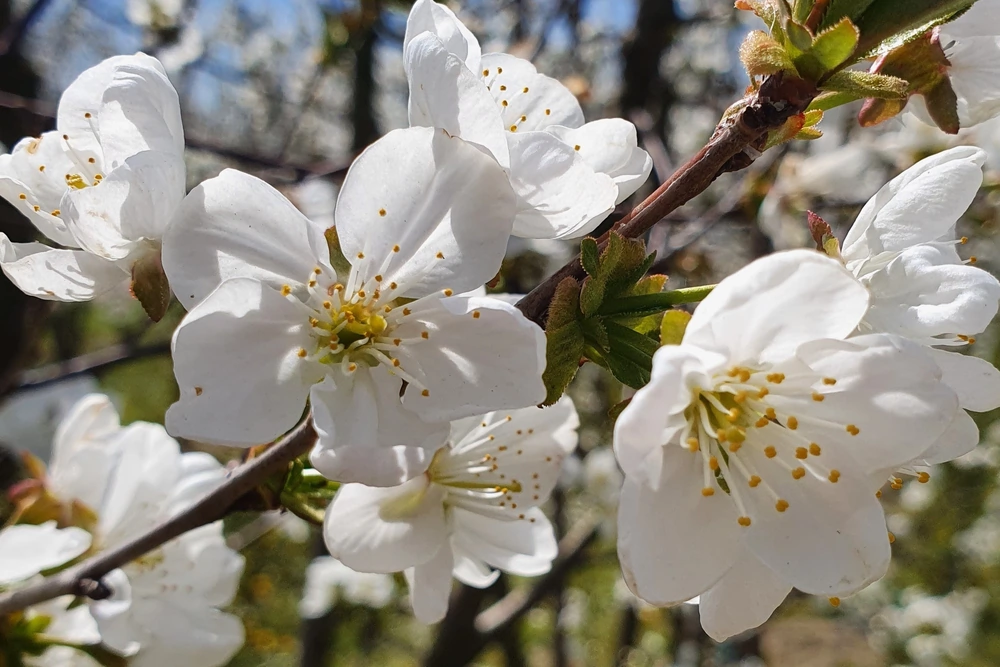
The study also highlighted a temporal synchronization between pollinator activity and nectar availability: the volume of nectar present in the flowers reached its maximum between 14:00 and 16:00, coinciding with the highest levels of bee activity and the highest temperature and light intensity values.
However, the researchers emphasized that these findings represent associations rather than causal relationships, since bee visitation did not show a direct linear dependence on individual environmental factors. Moreover, the nectar measured represented the volume accumulated in the flower rather than the instantaneous secretion rate.
Overall, the study demonstrates that pollinators cannot be evaluated solely on the basis of their numerical abundance. Although A. mellifera was the dominant species, A. cerana may provide a complementary service owing to its different pollen distribution on the body and its distinct temporal activity pattern.
It is therefore important to conserve both species and, more generally, to maintain diverse communities of insect pollinators. Functional diversity may indeed increase the resilience of the pollination service, particularly when weather conditions or other factors limit the activity of the dominant species.
Source: Xu, S., Liu, R., Zhang, Q., Zeng, W., Liang, S., Lan, G., Duo, B., & Li, X. (2026). Community Structure and Foraging Behavior of Flower-Visiting Insects in a Sweet Cherry Orchard in Eastern Gansu, China. Insects, 17(8), 786. https://doi.org/10.3390/insects17080786
Image source: Stefano Lugli
Andrea Giovannini
PhD in Agricultural, Environmental and Food Science and Technology - Arboriculture and Fruitculture, University of Bologna, IT
Cherry Times - All rights reserved