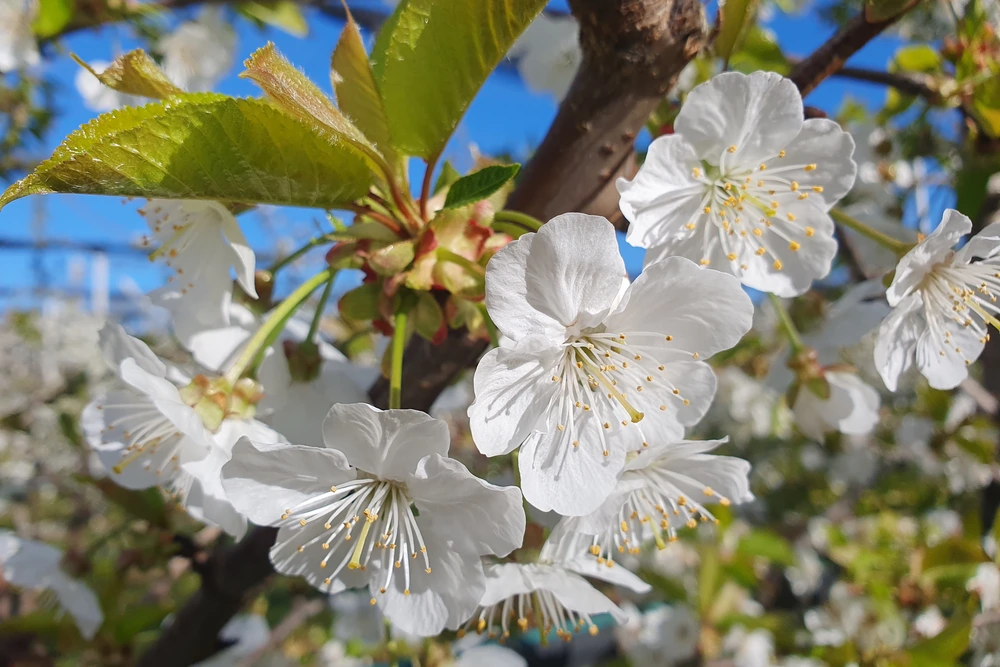
While much of the South American cherry-growing regions are still in winter dormancy, cherry trees in northern Argentina have already begun to bloom. In the first days of August, the temperate valleys of the province of Jujuy turned white and pink, marking the start of flowering for ultra-early varieties.
This is not simply a case of phenological advancement. The phenomenon represents a further step forward for a scientific and production project aimed at turning Jujuy into the origin of the first fresh cherries of the South American season.
The heart of the trial is located in the department of El Carmen and, more specifically, in the town of Monterrico, where microclimatic conditions make it possible to significantly bring forward the production calendar compared with the traditional cherry-growing areas of Patagonia and Cuyo.
With flowering already underway in August, the cycle progresses rapidly: the goal is to reach ripening and the first commercial harvests by the end of September.
Two thousand plants to test ultra-early cherry production
The project is based on a collaboration between research, business and agricultural production that has now been monitored for several seasons.
The trial involves a young orchard made up of 2,000 plants belonging to different varieties characterized by a low chilling requirement.
The project involves the Mendoza-based company Güizzo Frutas Frescas S.A., specialized in early stone fruit, local grower Oscar Machuca, whose farm hosts the trial, and the Faculty of Agricultural Sciences of the National University of Jujuy (UNJu). Technical management is entrusted to Dr Viviana Curzel.
The trial challenges one of the long-standing paradigms of cherry growing: the idea that the cherry tree must necessarily be linked to areas characterized by long, cold winters.
Minnie Royal, Royal Lee and Royal Lynn take center stage in Jujuy
The choice of genetic material is also helping make this new production frontier possible. The orchard includes licensed varieties from international breeding programs, including Minnie Royal, Royal Lee and Royal Lynn, developed by Zaiger Genetics.
These cultivars have shown a remarkable ability to adapt to the conditions of northwestern Argentina. Their main strength is their low requirement for chilling hours, a trait that allows the trees to break dormancy after Jujuy’s short winter and rapidly begin budbreak and flowering.
It is precisely this combination of genetics and local climatic conditions that makes it possible to bring forward the production calendar.
From bloom to cherry in around 45 days
The decisive factor is time. Under Jujuy conditions, the cycle from flowering to fruit ready for packing can be completed in around 45 days.
According to the reported estimates, the first cherries could therefore be harvested in week 40 of the agricultural calendar, corresponding to the final days of September.
This would allow the Argentine province to come to market more than fifteen days earlier than areas traditionally regarded as the earliest, such as Mendoza in Argentina and Ovalle in Chile.
This earliness is not only an agronomic record, but above all a potential commercial advantage.
A market window with virtually no international competition
Reaching the market when the global supply of fresh cherries is essentially absent could translate into a significant competitive advantage.
Ultra-early production from Jujuy could in fact be destined for direct air freight to high-demand, high-value markets including the European Union, the Far East and the Middle East.
The strategy therefore focuses on early volumes and premium production, targeting a window in which the international availability of fresh product is extremely limited.
The quality parameters recorded in previous trials are also promising. Sugar levels ranging from 25 to 29 degrees Brix have been reported, together with intense coloration and high firmness, characteristics consistent with the standards required for premium exports.
The challenge lies in agronomic management
Producing cherries this early in a non-traditional growing area, however, requires a very high level of technical precision.
In the valleys of Jujuy, rainfall follows a monsoon pattern and is concentrated mainly during the summer months of January and February. This distribution is an advantage during the September harvest period because it reduces fruit exposure to rain that can cause cracking.
At the same time, however, the high summer water availability makes strict control of vegetative growth and the root system necessary.
Dr Viviana Curzel and engineer Nicolás Güizzo have repeatedly highlighted nutritional monitoring, management of dormancy induction and precision irrigation as some of the key elements needed to achieve uniform flowering immediately after the low temperatures of June and July.
Jujuy aims to redraw the map of South American cherry production
The cherry blossom in Monterrico therefore takes on a significance that goes far beyond the striking image of a flowering orchard in the middle of the Southern Hemisphere winter.
If the season’s results confirm expectations, Jujuy could provide tangible proof that genetics, agronomic innovation and knowledge of local conditions can expand the traditional boundaries of cherry growing.
The next challenge will be to turn this phenological advantage into commercially stable production, while maintaining quality and uniformity at levels suitable for export. What is at stake is a window of just a few weeks, but one that could be highly strategic: that of the first fresh cherries available in the Southern Hemisphere.
Source: masp.lmneuquen.com
Image source: Stefano Lugli
Cherry Times - All rights reserved