In several production areas around the world, the effects of climate change have led to an increase in the frequency of extreme events during the cherry growing season: extreme spring temperatures, heatwaves, heavy rainfall and wildfires.
WSU has studied how this phenomenon affects fruit quality differently depending on the variety.
In Washington State, the leading cherry-producing state in the United States, year-to-year climate variability has been even more intense than “normal”, making it more difficult to predict not only the quantity but also the quality of the fruit produced.
In 2021, the West Coast of the United States — Washington, Oregon and California — experienced one of the most extreme heatwaves ever recorded worldwide.
Extreme temperatures
The event occurred during the last two weeks of June and the first week of July, corresponding to December and January in the Southern Hemisphere.
The highest temperature recorded reached nearly 47°C in some areas and was accompanied by high nighttime temperatures, with a significant and detrimental effect on fruit physiology. In the case of cherries, the phenomenon affected quality differently depending on the variety.
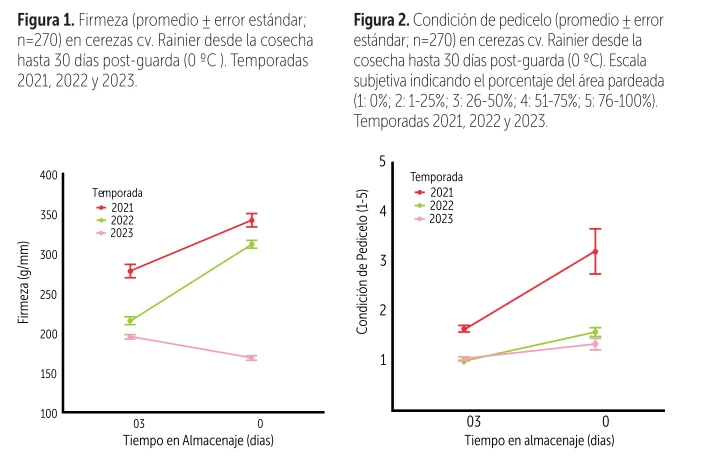
For the Rainier variety, harvested at the beginning of the heatwave, firmness (g/mm) at harvest decreased by an average of 60% compared with a “normal” year.
In this and other varieties, such as Skeena and Sweetheart, the postharvest softening rate reached −0.8 g/mm per day.
Firmness and storage
This trend is the opposite of that observed in years without extreme heat-stress events, such as 2022 and 2023, when firmness, measured by compression (g/mm), generally tends to increase during refrigerated storage (Fig. 1).
Furthermore, in all the varieties mentioned, poorer stem condition was observed at harvest in 2021, along with a higher rate of deterioration — browning and dehydration — during postharvest storage, compared with years characterized by lower environmental stress (Fig. 2).
These effects may be further intensified when harvesting takes place at more advanced stages of ripeness, a situation that is more common in Washington State than in Chile due to the different destination markets for fruit from the two origins.
Environmental stress
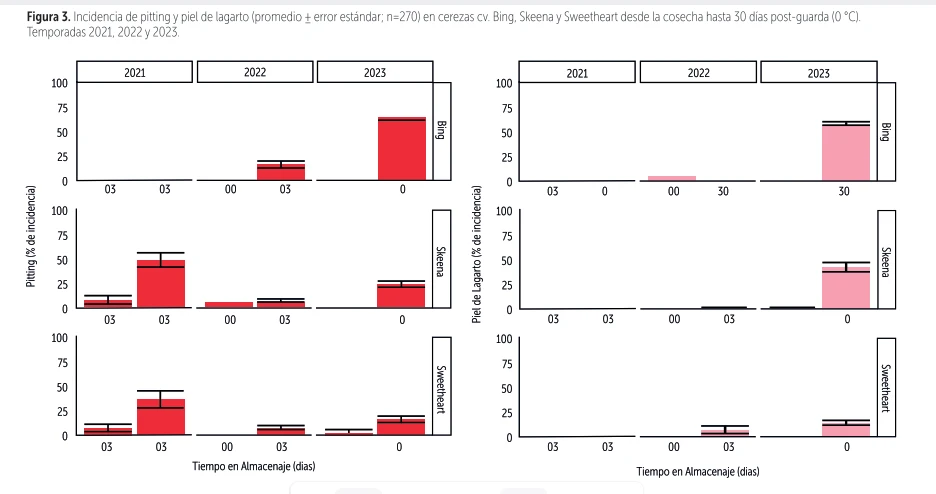
On the other hand, warm seasons characterized by consistently high temperatures during fruit growth but without extreme heat events, such as the 2023 season in Washington State, promoted the development of so-called “lizard skin” in the Bing, Skeena and Sweetheart varieties during postharvest storage (Fig. 4).
An analysis of data collected over several years also identified a positive relationship between the increased incidence of “lizard skin” and low temperatures during flowering, below 10°C, particularly in the Bing and Sweetheart varieties.
During the same season, in 2023, the incidence of pitting was also higher than in 2021 and 2022, particularly in the Bing variety.
Pitting and varieties
The stress recorded in 2021 also increased the percentage of fruit affected by pitting in the Skeena and Sweetheart varieties (Fig. 3).
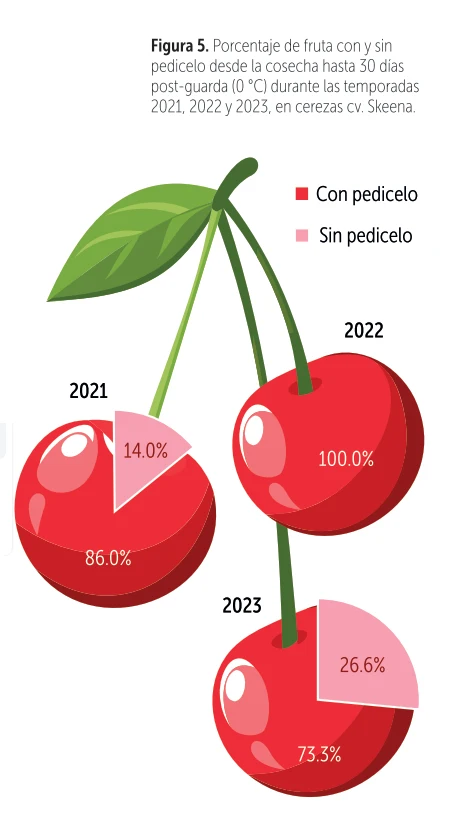
During the 2023 season, a significant reduction in stem retention force was also observed, particularly in the Skeena variety, which is suitable for mechanical harvesting (Fig. 4), resulting in a higher number of stemless fruit (Fig. 5).
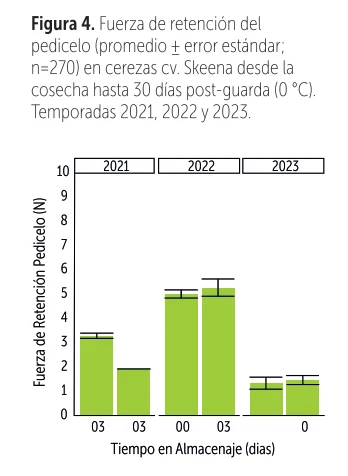
In 2023, this phenomenon was also positively correlated, across all the previously mentioned varieties, with a decrease in the maximum temperature during flowering.
The importance of timely harvesting
In years characterized by stressful conditions, timely harvesting is essential, avoiding delays that would further accelerate the loss of postharvest quality.
Cooling immediately after harvest is also essential to minimize the respiration rate, as is the correct use of modified-atmosphere technologies while avoiding temperature fluctuations during storage.
CAROLINA TORRES
Endowed Chair in Postharvest Systems in the Department of Horticulture at Washington State University’s Tree Fruit Research and Extension Center
Text and charts source: Redagrícola
Opening image source: Stefano Lugli
Cherry Times - All rights reserved