The wild cherry (Prunus avium L.) can be used in dendrochronological and dendroclimatological studies, offering interesting opportunities to investigate tree responses to different weather conditions and climate change. This is what emerged from a recent study conducted in five stands in western Poland, where 125 trees were analysed, yielding a total of 196 samples and more than 14,000 growth rings.
The study was prompted by the limited information available on the relationship between radial growth of wild cherry and climate, despite the ecological, forestry and landscape importance of this species.
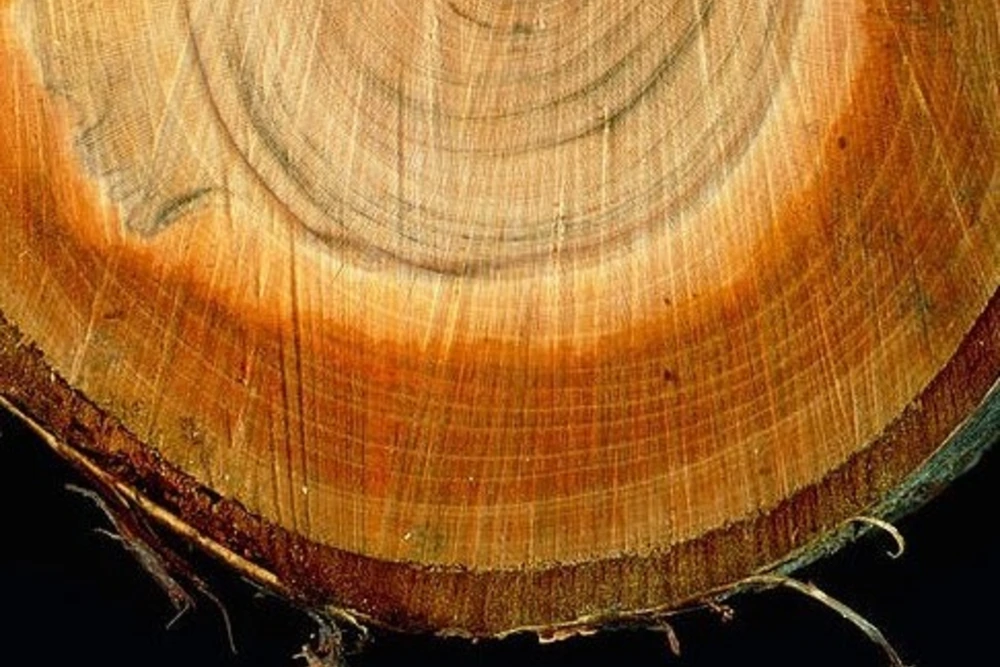
The samples showed generally well-defined annual rings and a predominantly semi-ring porous wood structure, characteristics that made it possible to identify, measure, date and synchronise the dendrochronological sequences. The resulting local chronologies covered periods ranging from 53 to 86 years, with a mean ring width of 2.70 mm/year.
Climate response and growth
Analysis of the relationship between growth and climate, conducted over the common period 1982–2021, highlighted a particularly important role of thermal and precipitation conditions during July. In particular, wider rings were associated with below-average temperatures and above-average precipitation.
The results therefore confirm the sensitivity of Prunus avium radial growth to water availability and heat stress during the growing season, consistently with the species’ preference for cool, well-watered soils.
Conditions during the preceding months and spring also showed some associations with ring width: high temperatures during April and, especially, throughout May–July tended to limit growth, whereas precipitation from May to July generally had a positive effect.
Differences among stands
The relative importance of climate, however, varied considerably among sites: the coefficients of determination of the multiple regressions ranged from 37% to 71%, indicating that a substantial proportion of growth variability also depends on non-climatic factors.
Differences among stands are probably attributable to habitat characteristics, as the trees studied grew under different conditions, ranging from forest edges to the interior of the forest and on both flat and sloping terrain.
The study also provided the first information on the number of sapwood rings in wild cherry. The median ranged from 12 to 17 rings across the different stands, while the overall number depended on tree age and recent reductions in ring width.
Directions for further studies
This parameter could therefore provide useful information for further studies on growth and environmental conditions, although the researchers emphasise the need to expand the number of stands in order to better define its ecological significance.
Overall, the results indicate that Prunus avium is a potentially useful species for dendrochronology, thanks to the good visibility of its growth rings and the possibility of constructing consistent chronologies. However, its use has some limitations related to its relatively rapid growth, generally limited lifespan, and semi-ring-porous wood structure, which makes it difficult to clearly distinguish earlywood from latewood.
Moreover, these results obtained in western Poland should be regarded as preliminary: the different responses observed among sites demonstrate that habitat and local conditions can substantially modify the relationship between climate and growth.
Further research involving a larger number of stands will therefore be necessary to identify the main factors regulating wild cherry growth and to assess more thoroughly its potential as an indicator of climate variability.
Source: Cedro, A., & Cedro, B. (2026). The influence of climatic conditions on the tree-ring width of wild cherry (Prunus avium L.) growing in western part of polish forests. Dendrochronologia, 99, 126599. https://doi.org/10.1016/j.dendro.2026.126599
Image source: Adam Hart-Davis - Science Photo Library
Andrea Giovannini
PhD in Agricultural, Environmental and Food Science and Technology - Arboriculture and Fruitculture, University of Bologna, IT
Cherry Times - All rights reserved