Bumblebees could become even more valuable allies in cherry orchards. In addition to supporting pollination, these insects are able to carry bacteriophages directly onto cherry blossoms, helping to control certain bacterial diseases.
This is the finding of a study conducted by the University of Warwick in the United Kingdom, which tested a biological delivery system designed to take advantage of the natural behaviour of bumblebees to transport naturally occurring viruses specifically active against certain bacteria onto blossoms.
Bacteriophages carried by bumblebees to cherry blossoms
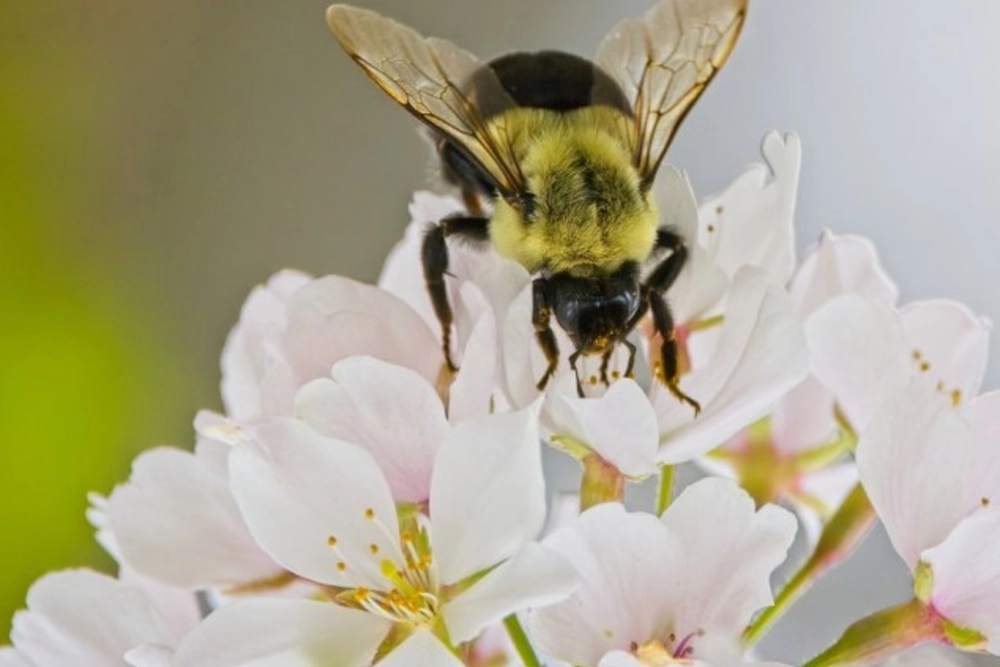
The system developed by the researchers involves bumblebees passing through a tube containing a powder formulation enriched with bacteriophages as they leave the hive. The particles adhere to the insects’ bodies through a mechanism similar to the way pollen is collected.
During trials carried out on both real and artificial cherry blossoms, bumblebees native to Great Britain belonging to the subspecies Bombus terrestris audax successfully transferred bacteriophages to up to 88% of the flowers involved in the experiment.
Once deposited on the blossoms, the bacteriophages caused a significant reduction in bacterial populations.
The goal: controlling bacterial canker in cherry trees
The idea emerged during visits to orchards carried out by the researchers to collect samples and identify naturally occurring bacteriophages potentially effective against cherry canker.
The disease is caused by the bacterium Pseudomonas syringae and is described by researchers as one of the most damaging bacterial diseases affecting cherry production.
Since many growers already use bumblebees to improve pollination, the research team explored the possibility of giving the insects a second role: transporting bacteriophages from one flower to another during their normal activity.
Highly specific natural viruses
Bacteriophages are viruses that are widespread in nature, from soil and water to plants themselves. Their distinctive feature is their ability to infect specific bacteria.
Mojgan Rabiey, a plant pathologist specialising in biological crop protection at the Warwick Crop Centre, highlights precisely this aspect: each bacteriophage is highly specific to the bacteria it can attack.
This characteristic therefore makes it possible to select bacteriophages capable of targeting the microorganisms responsible for diseases, while limiting the impact on beneficial bacteria present in the surrounding environment.
A potentially more targeted alternative for orchard protection
According to the research team, this delivery method could make the protection of fruit crops more precise and help reduce dependence on conventional pesticides and antibiotics.
The technique could also have broader applications beyond cherry production. The researchers believe the system could be adapted to other crops in which flowers represent an important entry point for bacterial infections.
Species already being considered include apple and pear, on which researchers are exploring the use of bacteriophages as a crop protection tool.
From experimental trials to testing with growers
One of the aspects highlighted by the project is the simplicity of the system. According to researcher Shannon Greer, delivering bacteriophages through bumblebees does not require any special equipment.
Following the results obtained during the experimental phase, the next step identified by the University of Warwick team will therefore be to test the treatment directly together with growers.
If the approach confirms its effectiveness under real orchard conditions, bumblebees and bacteriophages could in the future combine their natural functions with new biological crop protection strategies, bringing pollination and crop protection together in a single system.
Source: www.vidarural.pt
Image source: Pierre Williot Shutterstock
Cherry Times - All rights reserved