“The only constant is change.” This phrase has gained increasing relevance in recent times and has impacted the cherry industry over the past two seasons, pushing industry operators to seek new options. In this context, varietal innovation is emerging as one of the main tools to sustain business competitiveness.
In this scenario, Cheery Glow™, a bicolour cherry variety developed by the BLOOM FRESH™ program, has begun to attract the attention of producers, exporters and investors.
Its value proposition combines agronomic, commercial and quality characteristics that address several of the sector’s current key needs: lower chill requirement, earliness, good postharvest performance and market diversification potential.
Pedoclimatic characteristics
Cheery Glow™ shows high adaptability to different production conditions in Chile, as stated by María José Castro, commercial manager of Nueva Vid, the nursery holding the license for the new variety.
She explained that “between the Coquimbo and Maule regions lies most of the area suitable for its cultivation.” This geographical range overlaps with traditionally cherry-growing areas but also opens opportunities in earlier zones where other varieties face limitations.
Another key feature is its chill requirement, estimated at around 450 hours, considered medium-low, allowing planting even in areas with lower winter chill accumulation.
This aspect has become increasingly relevant with the progression of climate change, which has reduced both the availability and quality of chill in several production areas.
Macarena Villasante, Technical Manager Cherries Chile-Peru at BLOOM FRESH™, highlighted that this trait not only expands the production map but also reduces risks: “Varieties with lower chill requirements are more likely to reach their productive potential in seasons with insufficient winter chill.”
Productivity and quality
From a production standpoint, Cheery Glow™ shows high potential, although the technical approach prioritises quality over volume.
“Average productivity is around 15 tonnes per hectare, although it can be higher. However, to maintain high fruit quality, this load should be managed,” Castro stated.
This balance between yield and quality is crucial in a sector where returns strongly depend on fruit condition upon arrival. In this regard, the variety also stands out for its early bearing, allowing faster return on investment.
Villasante specified that technically it shows medium-high fruit set — between 15% and 20% — ensuring a solid production base. In addition, long stems facilitate harvesting without directly handling the fruit, reducing damage and improving final quality.
Earliness and commercial advantage
One of the most appreciated aspects of Cheery Glow™ is its earliness. The variety can be harvested between five and seven days before Santina, and up to ten days earlier under certain conditions.
Ignacio Bolumburu, Commercial Manager Cherries South America at BLOOM FRESH™, explained that this advance allows producers to enter the market earlier, achieving better prices and avoiding the typical peak-season congestion. It also contributes to a more balanced supply distribution.
“From a strategic perspective, this characteristic is particularly relevant in a context where oversupply during certain periods has negatively impacted industry returns,” Bolumburu stated.
Quality and consumer experience
The variety stands out for a combination of organoleptic characteristics that make it attractive for both exporters and consumers.
Villasante highlighted its high firmness, around 320 g/mm, ensuring good performance during long-distance transport. This is complemented by a high sugar content, between 20 and 22° Brix, delivering a consistently sweet taste.
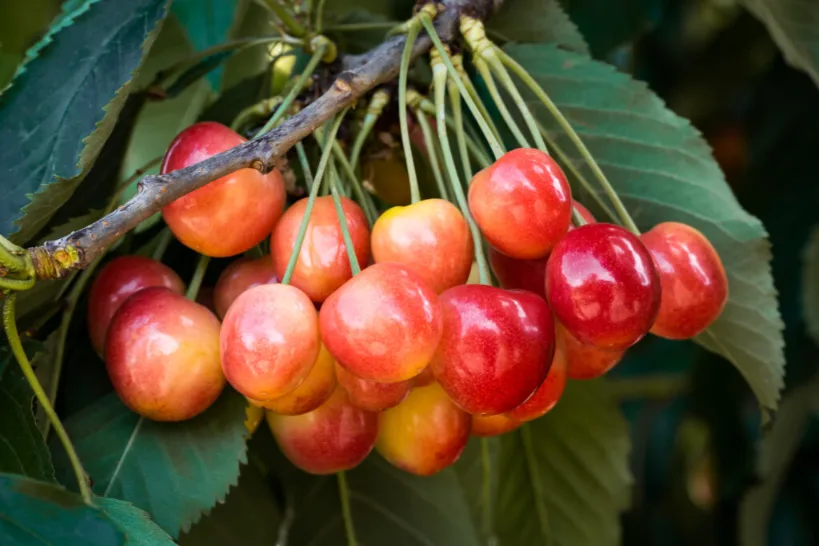
In addition, the bicolour appearance offers visual differentiation that has generated interest in several markets. “Although historically this segment has had a low share, below 1% of the volume exported to China, there is consensus on its high growth potential,” Bolumburu stated.
“The variety has shown strong acceptance not only in China, but also in Europe and the United States,” Castro added, highlighting its contribution to market diversification.
Postharvest and commercial strategy
Another distinguishing element is the fruit’s ability to maintain quality over long periods of transport. In this regard, Cheery Glow™ has shown promising results.
Shipments to China have already been carried out with positive feedback, and in Chile storage trials of up to 60 days have been conducted, with good outcomes in terms of quality and appearance.
Bolumburu added that the variety shows lower susceptibility to spotting, a common issue in bicolour cherries: “This translates into higher export percentages, which can exceed 88% under commercial conditions. This postharvest robustness provides greater logistical flexibility, allowing delays to be managed without compromising product quality.”
The BLOOM FRESH™ manager specified that the development of Cheery Glow™ responds to a long-term strategy based on quality and business sustainability.
Unlike other varietal programs, the company emphasises the importance of controlled growth: “We do not aim for indiscriminate expansion. We evaluate each area and each grower to ensure the variety performs correctly,” Villasante explained.
Currently, around 200 hectares are planted in Chile, with gradual but controlled growth. Globally, the planted area is still limited, leaving room for market positioning.
A contribution to the industry
For Nueva Vid, the introduction of Cheery Glow™ into its portfolio represents a strategic opportunity in the current market scenario.
According to María José Castro, it is essential to offer profitable and sustainable alternatives to growers: “This variety brings diversification, known management techniques and a product with strong commercial performance.”
She also noted that the company obtained the license after years of collaboration with Bloom Fresh, consolidating a relationship based on results and trust.
Despite its many advantages, managers emphasise that cultivation requires some attention. Villasante explained: “The main challenge is ensuring adequate light exposure to achieve optimal colour development, which implies controlling plant vigour through pruning and canopy management.”
She added that “despite this, the results observed so far have been positive. Growers with orchards already in production highlight fruit uniformity, quality and ease of management.”
Industry operators indicate that, looking ahead, the outlook is for steady growth, with attention to maintaining high quality standards and strengthening presence across different markets.
The Chilean cherry industry therefore continues to evolve, focusing on innovation, resilience and quality as key drivers to sustain sector profitability.
Macarena Bravo
Portal Fruticola
Image source: Portal Fruticola
Cherry Times - All rights reserved