Rain-induced fruit cracking represents an agronomic challenge of global economic significance:
just a few hours of rainfall in the days preceding harvest can render an entire crop unsellable, with fruits automatically excluded from all commercial markets.
Despite the urgency of the problem, effective solutions remain scarce.
Although rain covers have proven to be the only reliable method for reducing cracking, their cost and the considerable labor required for installation drive many growers toward commercial spray products—often lacking solid scientific evidence.
Among these is Parka®, a fatty acid-based product marketed as a "cuticular supplement," which claims to strengthen the fruit's natural barrier by supplying precursors for cutin synthesis.
The underlying hypothesis
The underlying hypothesis is interesting: by applying external fatty acids, cuticular deposition would be stimulated, reducing water permeability and thus minimizing cracking.
However, research conducted at the University of Hannover subjected this claim to rigorous experimental testing, yielding surprisingly negative results.
Researchers first demonstrated that cuticle synthesis in cherries occurs exclusively during early developmental stages (stages I and II), ceasing completely by 60 days after full bloom.
Since Parka® is applied
Since Parka® is applied according to the manufacturer's recommendations during late stages (starting from the "straw-yellow" phase onward), the treatment is administered after the biosynthetic mechanisms have already become inactive.
Isotopic tracer analyses (using ¹³C-labeled oleic acid) confirmed the absence of significant incorporation during advanced developmental stages.
The experiments assessed Parka®'s effect on four critical parameters: cuticular mass, cuticular elastic relaxation, water uptake, and cracking incidence.
Across six different cultivars
Across six different cultivars (including Regina, Sweetheart, and Hedelfinger), single or double applications failed to alter either cuticular membrane mass or wax mass in the fruit's lateral zone.
Only after twelve applications was a slight increase in cuticular mass observed—accompanied, however, by visible product residues on the surface.
These heterogeneous deposits accumulated predominantly in the peduncular cavities and stylar zone, areas naturally prone to microfissures.
Crucially, Parka® did not
Crucially, Parka® did not alter cuticle elasticity nor reduce water absorption during immersion tests.
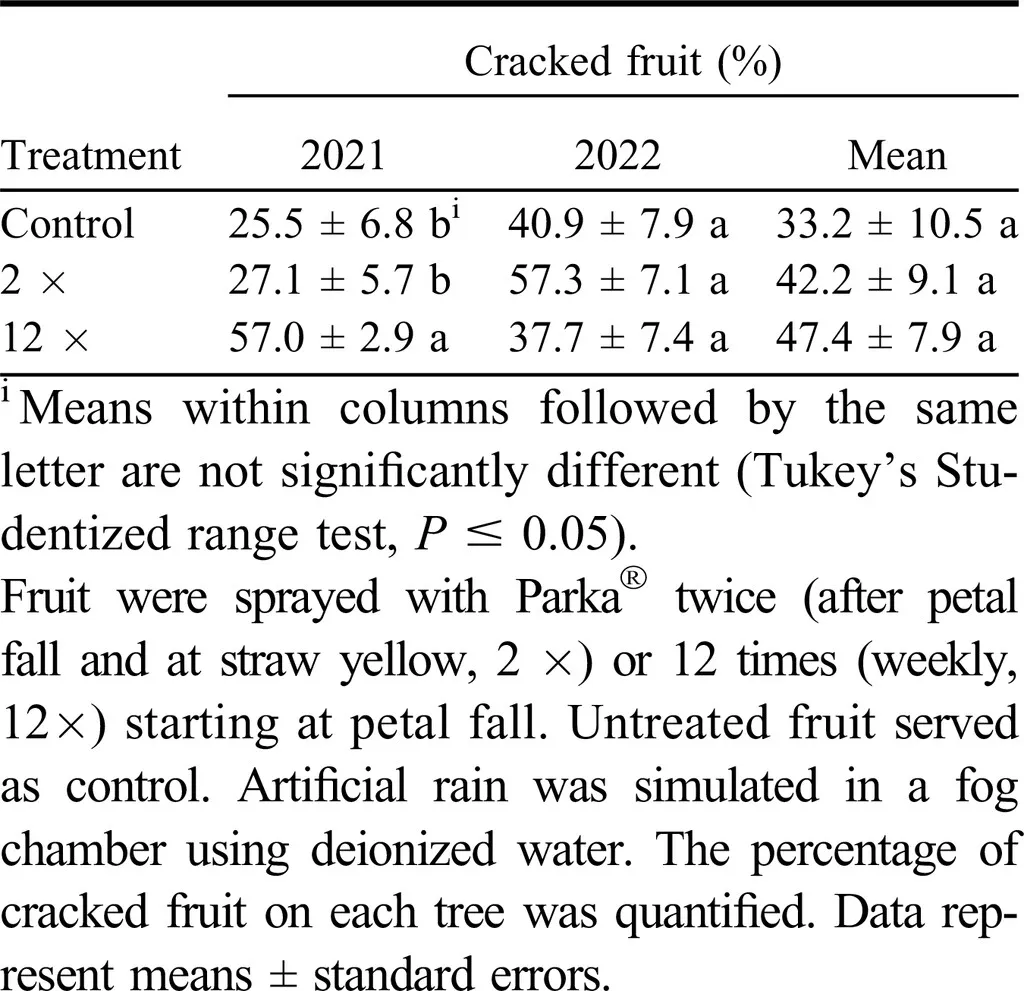
In greenhouse trials with simulated rainfall, two applications (in line with product recommendations) showed no protective effect, while twelve applications even increased cracking incidence in one of the two studied growing seasons.
Further analyses on polycarbonate films ruled out any reduction in water vapor permeability due to the product.
These results undermine
These results undermine the "cuticular supplement" hypothesis and raise questions about the utility of similar products.
The study reaffirms that, despite commercial promises, physical rain covers remain the only validated strategy for protecting sweet cherries.
The research also highlights a fundamental principle: intervening in physiological processes after their natural conclusion is destined to fail.
To drive effective innovation in agriculture, clever products alone are insufficient—deep understanding of the underlying mechanisms governing fruit development over time is equally essential.
Source: Winkler, A., Cordes, A. S., Morales Lang, P., Blumenberg, I., Khanal, B., & Knoche, M. (2025). Parka® Has No Effects on Cuticle Deposition, Strain Relaxation, Water Movement, or Cracking of Sweet Cherry Fruit. HortScience, 60(11), 1948–1954. https://doi.org/10.21273/HORTSCI18791-25
Image source: Stefano Lugli
Melissa Venturi
University of Bologna (IT)
Cherry Times - All rights reserved