Soil quality assessment is closely linked to the sustainability of production systems and the resilience of agroecosystems.
In intensive orchards, such as sweet cherry plantations, management practices significantly influence the physical, chemical, and biological properties of the soil, with direct implications for long-term fertility and productivity.
In this context, alongside conventional analytical methodologies, alternative diagnostic approaches—such as circular paper chromatography—are gaining interest, as they can provide integrated qualitative indicators of soil condition.
The study context
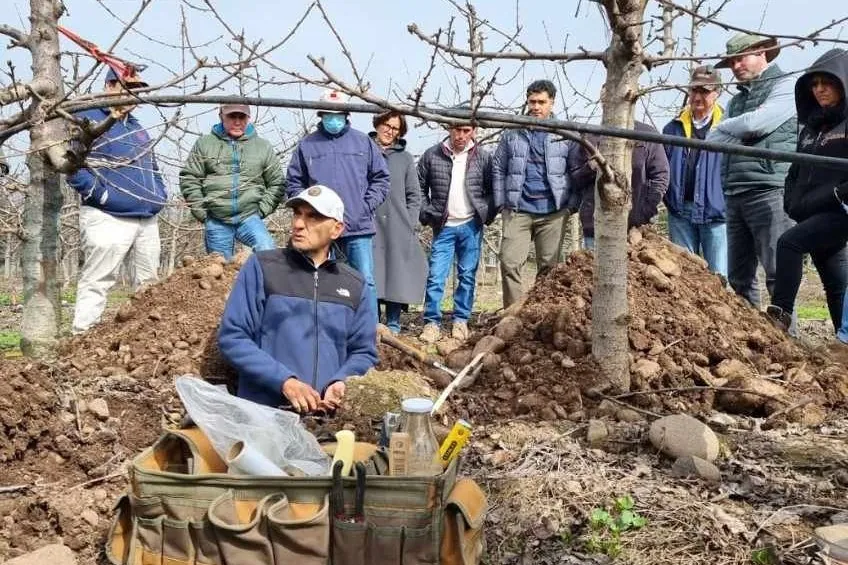
The study conducted in cherry orchards in the Maule Region (Chile) analyzed the relationships between selected physico-chemical soil properties and the patterns generated through circular paper chromatography.
The underlying hypothesis is that qualitative, low-cost, and easily applicable analytical techniques can complement conventional soil analysis methods by providing useful indicators to discriminate among different agronomic management practices.
Circular paper chromatography is a technique based on the radial diffusion of soil extracts on a paper substrate, in which the capillary mobility of the solvent generates concentric chromatic patterns. These patterns qualitatively reflect the presence and relative distribution of solubilized organic and mineral compounds.
Chromatic zones analysis
The resulting chromatic zones (central, internal, intermediate, and external zones) are analyzed in terms of radial extension, intensity, and color distribution, with these parameters considered descriptive variables correlated with the chemical and physical properties of the soil.
The experimental design included soil sampling in two farms with cherry orchards under contrasting agronomic management systems: one conventional and one agroecological. Within each site, three sampling environments were defined: (i) strips amended with organic inputs, (ii) strips with annual legumes, and (iii) strips with multispecies herbaceous cover.
Soil samples were subjected to laboratory analyses to determine standard parameters such as texture, organic matter content, pH, electrical conductivity, and other nutritional indicators.
Comparative analytical approach
In parallel, the same samples were analyzed using circular chromatography in order to compare chromatic patterns with quantitative analytical data. The results indicate that this technique is capable of significantly discriminating among soils subjected to different management regimes.
In particular, differences emerged in the coloration and radial extension of the intermediate and external zones of the chromatograms, as well as in the radius of the central zone. The latter parameter was found to be correlated with organic matter content, suggesting that circular chromatography may serve as an indirect indicator of this property.
Statistical refinement and implications
The observed chromatic variations reflect differences in the composition and mobility of soluble compounds, likely associated with management practices and the biological quality of the soil.
Statistical analysis was further refined through the application of the Random Forest method, a non-parametric machine learning technique, in order to identify the most predictive chromatographic variables.
Among these, the radius of the internal zone and the total number of chromatic channels showed strong discriminative capacity with respect to the different management systems.
Despite the qualitative nature of the technique and the intrinsic variability of agricultural soils representing methodological limitations, the study concludes that circular paper chromatography constitutes a promising, cost-effective, and easily implementable methodology for the qualitative diagnosis of soil fertility and condition in cherry orchards.
The integration of chromatographic indicators with traditional physico-chemical analyses may contribute to the development of sustainable management strategies and the agroecological monitoring of production systems.
Source: repositorio.uchile.cl
Image source: Prometeo Sánchez García
Melissa Venturi
University of Bologna (IT)
Cherry Times - All rights reserved