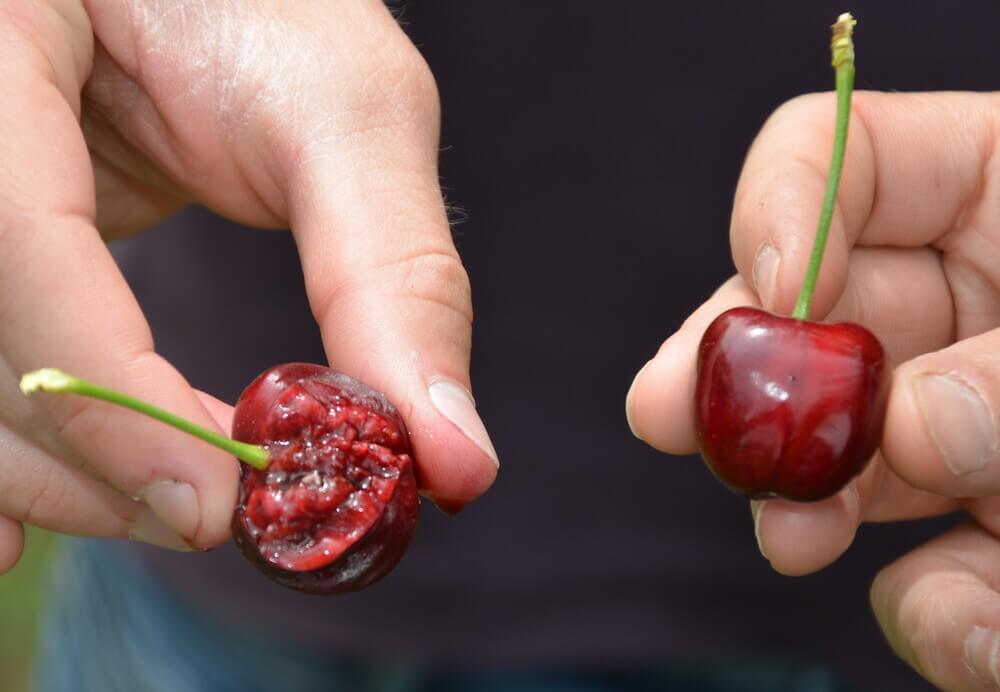
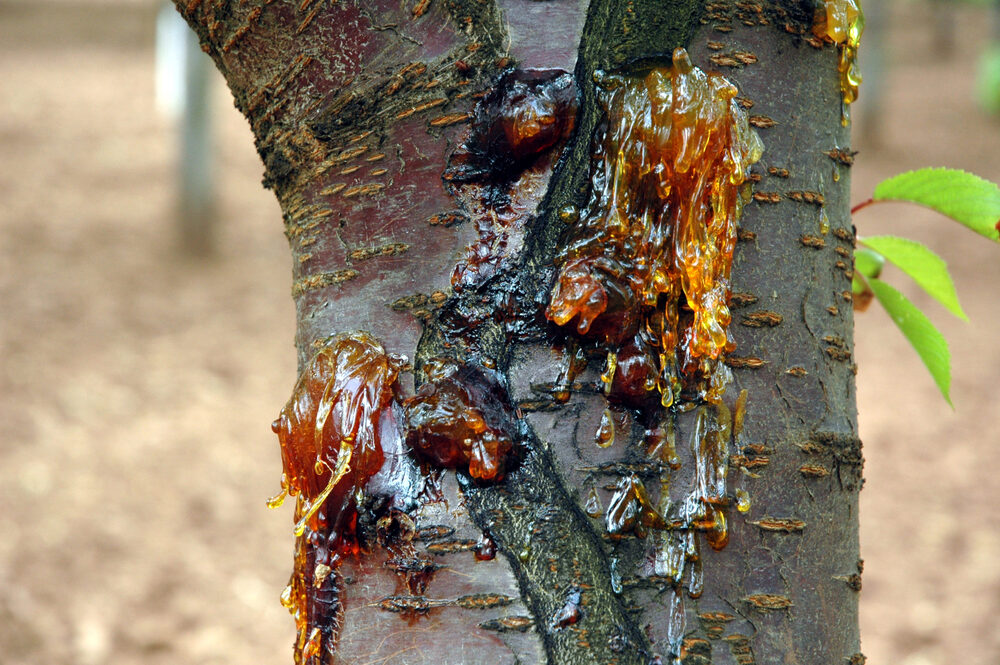
Increasing rainfall variability and the intensification of extreme weather events are among the main challenges facing sweet cherry production. Persistent rainfall during fruit ripening, hailstorms and high-humidity conditions can compromise yields through fruit cracking, increased fungal infections and deterioration in fruit quality. These issues are further compounded by temperature anomalies, which can interfere with flowering and fruit set, making orchard productivity less predictable.
In this context, rain-shelter cultivation is emerging as an adaptation strategy that can improve production stability in sweet cherry orchards. A recent review examined the effects of these systems on plant physiology, fruit yield and quality, highlighting both their potential benefits and their main limitations.
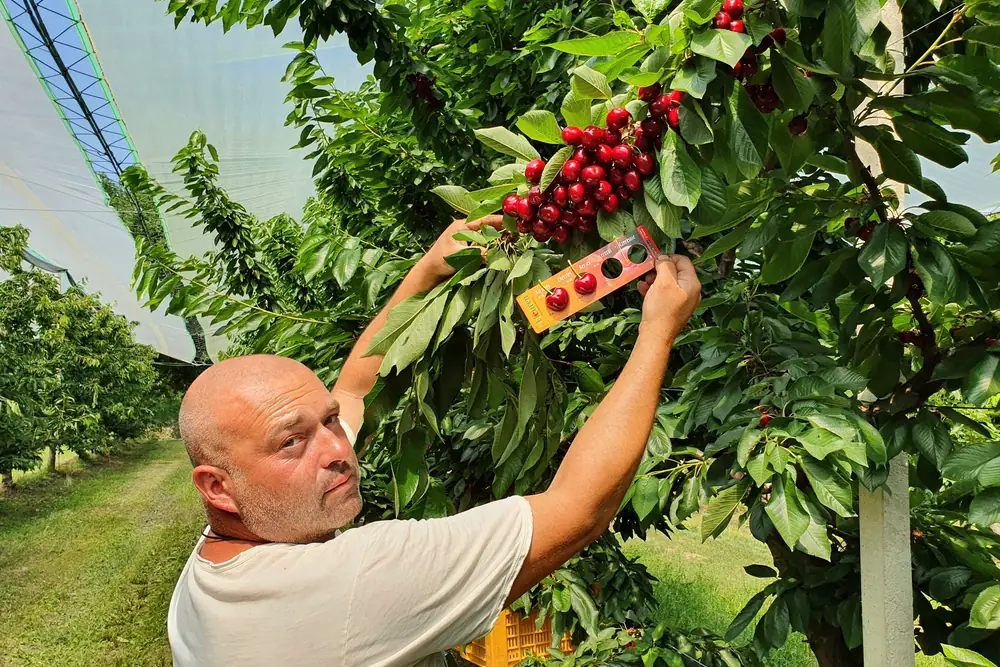
Rain shelters and reduced fruit cracking
The most evident benefit of rain shelters is the reduction in fruit cracking, achieved by limiting direct contact between water and the fruit surface and by modifying the water relations and microclimatic conditions of the growing environment. Results from different production areas demonstrate the extent of this effect: in some experiments conducted in southwestern China, the proportion of cracked fruit decreased from 95% in unprotected trees to approximately 4% under rain shelters, with yields increasing by up to fourfold. Similarly, trials conducted in Chile reported a reduction in damaged fruit from 19% to 3%.
Damaged fruit: protected and unprotected trees compared
Percentages reported in the cited experiments. All bars use the same 0–100% scale.
The southwestern China trials also reported yield increases of up to fourfold.
These findings show that the main agronomic advantage of protective structures does not necessarily lie in increasing productivity, but rather in reducing pre-harvest losses. Reduced wetting of the canopy and fruit also helps limit conditions favourable to pathogen development, lowering the risk of fruit rot and postharvest deterioration.
Effects on the microclimate and plant physiology
Beyond their physical protective function, rain shelters modify the orchard microclimate by influencing solar radiation, temperature, relative humidity and water availability. Reduced wind exposure and evaporative demand can improve plant water status and limit water consumption.
Some protected growing systems have also been associated with greater leaf expansion and increased chlorophyll content. At the physiological and molecular levels, these adaptations involve osmotic regulation, protection against oxidative stress and the activation of metabolic pathways associated with stress responses.
Fruit quality: results are not consistent
However, the effects on fruit quality are less consistent than those observed for cracking reduction. Some studies report increases in soluble solids, sugars, anthocyanins and vitamin C, whereas others have found reductions in fruit firmness, sugar concentration and colour intensity.
These differences mainly depend on the cultivar, shelter characteristics and environmental conditions. Insufficient light transmission, in particular, can limit photosynthesis and the accumulation of metabolites responsible for sensory and visual quality. The effectiveness of rain shelters must therefore be assessed at the level of the entire production system, integrating protection with ventilation, irrigation management, crop nutrition and crop-load regulation.
Costs, sustainability and smart systems
Economic viability depends on local climatic risk, the frequency of rainfall during fruit ripening and the market value of the crop protected from damage. Investment costs and the environmental impact of the materials used also make long-term sustainability assessments necessary.
Future developments are expected to focus on smart, automated structures equipped with sensors to monitor temperature, humidity and rainfall. These systems could adjust opening and ventilation according to environmental conditions.
Overall, rain shelters are a valuable tool for improving the resilience of sweet cherry production to climate change. Their success, however, depends on adapting their design and management to the varietal and soil-climatic characteristics of each growing area, integrating the shelter into a precision orchard-management strategy rather than treating it as a simple barrier against rainfall.
Source: Liu, Y. (2026). Rain-Shelter Cultivation and Its Influence on Cherry Production Stability. Bioscience Methods, 17. https://doi.org/10.5376/bm.2026.17.0021
Image source: Stefano Lugli
Andrea Giovannini
PhD in Agricultural, Environmental and Food Science and Technology - Arboriculture and Fruitculture, University of Bologna, IT
Cherry Times - All rights reserved