Chile expects to export 132 million boxes and 667,000 tonnes of cherries. However, for buyers of IQF, sulphited or dried cherries, another figure will shape the season: the 20% of the harvest that fails to meet the standards required by the fresh market.
Chile is preparing for the 2026/27 cherry season with a preliminary forecast of 132 million 5 kg boxes, equivalent to approximately 667,000 tonnes destined for export, against an estimated total production of 727,000 tonnes.
This represents a 16% increase compared with the previous season, which ended with 569,492 tonnes following a 9% decline.
For buyers of IQF cherries, sulphited cherries or dried cherries, however, the most important figure is not the potential record harvest, but the share of production that will never be loaded onto an aircraft bound for Shanghai.
A record harvest and the distribution of cultivated areas
The forecast was published by Frutas de Chile in early September and remains preliminary. The figures are updated in mid-October, following fruit set, when the number of cherries developing on the trees can be estimated more accurately.
The increase in production is not the result of new plantings, but rather of orchards established between 2021 and 2023 reaching full production, as commercially significant yields are generally achieved only from the fourth or fifth year onwards.
The potentially productive area is estimated at 76,000 hectares, out of a total of 80,000 cultivated hectares, mainly concentrated in two regions:
- Maule: 32,801 hectares, accounting for 42.2% of the national area.
- O'Higgins: 29,935 hectares, equivalent to 38.5%.
Together, these two regions account for more than 80% of Chile's cherry-growing area.
In terms of varieties, Santina, Lapins and Regina dominate, with the latter recording 13% growth. Bing, Sweetheart and Royal Dawn are losing ground, while newer varieties such as Sweet Aryana, Nimba, Pacific Red, Areko, Sweet Lorenz and Sweet Gabriel are gaining importance.
The varietal composition is also a key factor for the processing industry, as it determines fruit size, firmness and, above all, Brix levels, a decisive parameter in assessing whether a batch is suitable for drying.
20% of the harvest excluded from the fresh market
Every cherry harvest includes a proportion of fruit that fails to meet the standards required for fresh exports. The main reasons for rejection include insufficient fruit size, bruising and skin depressions (pitting), rain-induced cracking, stem detachment and uneven ripening.
Bruno Ceroni, commercial director of GoodValley, a company specialising in cherry drying in the Colchagua Valley, estimates that this share accounts for approximately 20% of total production.
Applying this percentage to the forecast 727,000 tonnes results in an indicative volume of 145,000 tonnes that must find an industrial outlet or risk being left in the orchards.
This volume represents the raw material available for processing into frozen, sulphited and dried cherries.
This explains why a record season for the fresh market can simultaneously result in an abundant supply of fruit for the processing industry: as the overall harvest increases, the potential volume available for processing also grows in absolute terms.
ddc.cl
The sorting line is where the destination of each batch is determined: fruit that fails to meet fresh-market standards is directed towards industrial processing.
Frozen, sulphited and dried cherries: three different industrial applications
All three products originate from the same raw material, but require different production processes, quality characteristics and target markets.
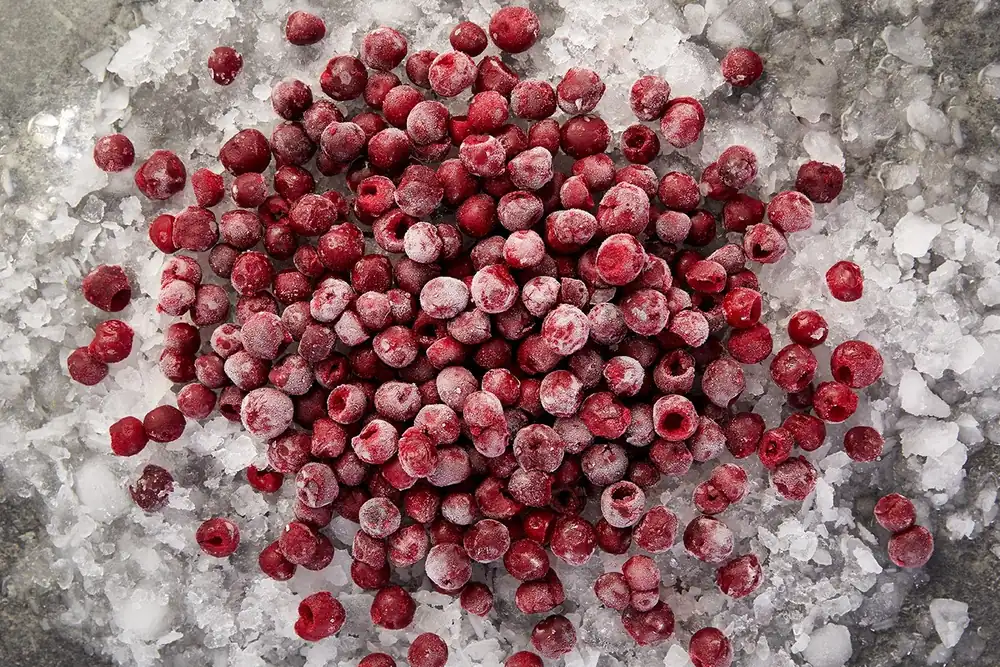
The frozen segment has recorded the fastest growth. In 2024, Chile exported 8,690 tonnes of frozen cherries, while forecasts for 2025 indicated a volume approaching 19,000 tonnes.
The product is almost always marketed pitted, which requires a dedicated processing line involving stem removal, pitting, washing, freezing and sorting based on colour and shape, together with X-ray inspections.
This is a slower process than conventional packing lines for fresh fruit.
In the IQF (Individual Quick Freezing) system, rapid freezing promotes the formation of very small ice crystals, limiting damage to cellular structures and reducing liquid loss during thawing.
The main destination markets are the United States, Canada, China and Japan, while Europe and Turkey are showing significant growth.
Gonzalo Bachelet, general manager of Vitafoods and president of Chilealimentos, indicated a price of approximately US$0.50 per kilogram (around €0.43 per kilogram) for frozen cherries: a value considerably lower than that of fresh fruit, but still higher than the value of fruit left unused in the fields.
Sulphited cherries
Sulphited cherries represent the most traditional form of processing in the Chilean cherry industry, but also the segment that has experienced the sharpest contraction in recent years.
Preservation is achieved using a solution containing sulphur dioxide (SO₂), which stabilises the product at room temperature and makes it suitable for subsequent industrial processing.
The main applications include the production of candied fruit, liqueurs and confectionery decorations.
In this segment, fruit size and firmness are more important than flavour characteristics.
Dried cherries
Drying represents one of the newer opportunities for the Chilean industry, but it is also one of the most demanding processes in terms of raw material quality.
According to Ceroni, early-ripening varieties are not suitable for drying, as they generally have Brix levels that are too low, potentially resulting in a final product lacking flavour.
For this process, preference must therefore be given to mid-season and late-ripening varieties.
Chile's main competitive advantage comes from using sweet cherries, which make it possible to produce a product without added sugar, unlike the sour cherries that dominate the import market.
This characteristic is particularly appreciated in China, where consumers are placing increasing importance on the natural qualities of food.
GoodValley processes between 200 and 300 tonnes of cherries annually, mainly destined for China, Thailand, Singapore and Malaysia and, to a lesser extent, North America.
Despite five years of operations, the company's processing volumes have remained largely stable. Ceroni identifies the main obstacle as a lack of commercial development, rather than limitations in production capacity.
Why September and October are crucial for the season
The Chilean cherry harvest is concentrated between November and January.
Purchasing programmes for processed products, covering volumes, fruit sizes, formats, Incoterms conditions and shipping windows, must be finalised before the fruit arrives at the processing facilities.
These agreements determine the organisation of production lines and the selection of raw materials intended for the different processing methods.
Operators who wait until December to request quotations risk having access only to remaining volumes, rather than the product that actually meets their requirements.
Another factor to consider is the gradual diversification of export markets.
China and Hong Kong accounted for 87% of Chilean fresh cherry shipments, the lowest share recorded in approximately eight years. Meanwhile, exports to alternative markets increased by 27%, reaching 74,535 tonnes.
This commercial diversification is also affecting the processing sector.
When a single market can no longer absorb most of the supply, operators throughout the supply chain seek alternative solutions, including formats offering longer shelf life and the ability to reach more distant destinations.
What are the prospects for the sector? Prunavita's perspective
Based on Prunavita's experience in purchasing and shipping processed fruit, one of the most costly mistakes an importer entering the market for the first time can make is not necessarily paying too high a price, but establishing insufficiently precise technical specifications.
Simply requesting frozen cherries, without specifying whether they must be pitted, the desired fruit size and the acceptable defect tolerances, may result in the delivery of a batch that formally complies with the contract but is unsuitable for the buyer's production line.
The same principle applies to dried cherries: two batches marketed under the same product description but with different Brix levels can produce finished products with sensory differences that consumers can immediately perceive.
For this reason, Prunavita makes technical specifications available before preparing commercial quotations.
Each format in the prunavita.cl range, including IQF, pitted, sulphited, dried and pulp products, has its own prunavita.cl, containing information on fruit size, Brix levels, moisture content, microbiological parameters and shelf life.
For operations managed from abroad, the prunavita.cl service also includes supplier verification, pre-shipment inspections and supervision of loading operations.
With production expected to reach record levels and a potential industrial surplus set to increase proportionally, the 2026/27 season could offer a good supply of cherries intended for processing.
However, the window for finalising commercial programmes closes in October.
Source: prunavita.cl
Image source: Fruiterra
Cherry Times - All rights reserved