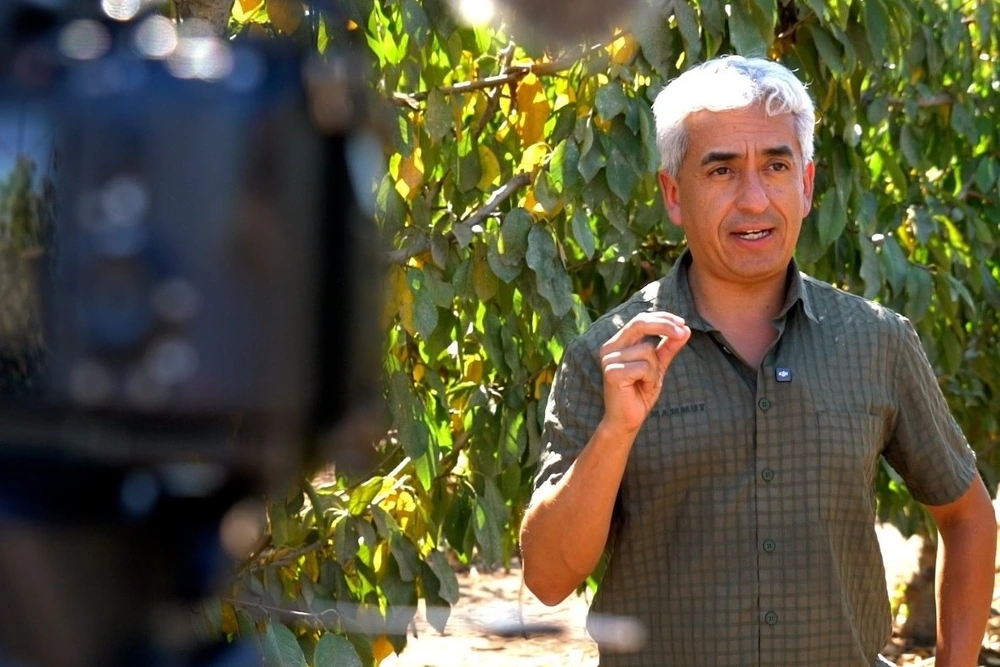
The next cherry season in Chile will largely be shaped during the winter. According to Walter Masman, a specialist cherry advisor, the agronomic decisions made over the coming months will be crucial not only for fruit quality, but also for the economic sustainability of orchards.
In an interview with Portalfruticola.com, Masman stressed that the business model has changed: producing premium cherries remains essential, but today it is no longer enough. To maintain profitability, volume has also become a key factor.
The new balance between quality and volume
With the season’s settlements now almost finalized, many Chilean growers have already begun to assess their blocks more rigorously. The aim is to understand which varieties are still capable of generating margins and which, instead, can no longer support production costs.
According to Masman, each grower must carry out an in-depth analysis of their orchards and determine which varieties truly allow them to remain competitive. This issue particularly concerns late varieties and areas where economic returns have not been sufficient to cover costs.
The most evident change concerns the weight of volume in profitability. In the past, the advisor explained, a grower could obtain 7,000 kilos per hectare and still maintain a positive economic result. Today, that scenario is no longer realistic.
For a variety such as Lapins, in early areas with harvests around the end of November, Masman indicates a minimum threshold of 14,000 exportable kilos per hectare. In later areas, where fruit reaches the market during weeks marked by greater supply, the required level rises to around 18,000 kilos per hectare.
Quality, however, does not lose its central role. For Masman, it remains “the big umbrella of the business”: size, firmness and premium standards continue to be decisive, but they must be accompanied by adequate yields.
Winter as a technical turning point for the season
Winter operations will play a crucial role in defining the production potential of the next campaign. Pruning and bud thinning account for a significant share of costs and, if managed incorrectly, can directly compromise profitability.
Masman pointed out that several growers carried out overly drastic pruning in an attempt to obtain larger fruit. This strategy has not always delivered the expected results, partly because of difficulties related to chill accumulation.
For this reason, the advisor urges caution: before carrying out intensive pruning, it is necessary to observe how winter develops and understand the quality of the chill accumulated. Carrying out operations too early may force growers to return to the orchard, directly increasing costs.
Monitoring “chill portions” has therefore become an increasingly important tool for forecasting budbreak and bud fertility. In early areas such as Ovalle, Valparaíso or some parts of the Metropolitan Region, exceeding 15 chill portions by May 31 is considered a favourable sign.
If this threshold is not reached, the season may prove more complex. Conversely, higher values may indicate a year with high production potential. Masman recalled that in the 2024 season, when Chile went from 83 to 125 million exported boxes, early areas had already recorded more than 7 chill portions by the end of May.
Keeping costs under control and focusing on “good wood”
In addition to production management, cost control will be one of the main challenges. Pruning, phytosanitary programmes, weed management, spider mite control and the efficiency of field operations must all be assessed with greater precision.
Masman noted that some growers spent double or triple on spider mite control because of incorrect technical decisions. The same applies to weed management. In the new context, every peso invested must be justified by a precise agronomic decision.
Hence the advisor’s central message: the sector has reached the moment to “do real agronomy”. Competitiveness will no longer depend only on the variety or the commercial window, but on the ability to read every detail of the orchard.
Another element that is becoming increasingly important is the quality of productive wood. According to Masman, fruit with better condition and greater post-harvest performance develops on specific vegetative structures. Growers must therefore learn to identify and preserve the most suitable branches within the tree.
Although there is still no fully standardized parameter for the entire industry, the advisor believes that a good-quality branch should have a basal diameter of between 22 and 26 millimetres.
Conclusion
Walter Masman’s message is clear: the new phase of Chilean cherry growing requires more selective decisions, greater technical precision and a realistic assessment of the competitiveness of each plot.
Those unable to reach minimum volumes while maintaining premium quality will have to consider more radical scenarios, from conversion to orchard removal. In an increasingly demanding market, cherry profitability will depend on the ability to combine quality, productivity and cost control.
Walter Masman, together with the leading Chilean advisors specialized in cherries, will speak at the 4th edition of CherryTech, the largest technical event in the cherry industry, scheduled for June 17 at the Monticello Events Center in Chile.
Source: portalfruticola.com
Image source: Smartcherry
Macarena Bravo
Portal Fruiticola
Cherry Times - All rights reserved