A formula that mimics fruit, reduces the use of insecticides and could change the management of spotted-wing drosophila in orchards. Decoy technology, developed by Oregon State University, is attracting the attention of U.S. growers for its targeted, low-impact approach.
A bait that changes insect behavior
Against spotted-wing drosophila, one of the most feared pests for cherries, blueberries and other thin-skinned fruits, a new strategy aims to target the pest with greater precision. The Decoy system, developed by the laboratory of Oregon State University Extension entomologist Vaughn Walton, uses a liquid formulation that mimics fruit and acts as a “behavioral arrestant”.
According to T.J. Hafner, agronomy manager at AgriCare in Oregon, the technology is still being tested on selected blocks, but early feedback has been encouraging. “We’re not treating all of our acreage with it, but we are trialing it on different blocks here and there,” Hafner explained, describing it as a “promising” solution.
Less chemistry, greater precision
The liquid formulation can be combined with a reduced dose of insecticide and applied with a ground-based airblast sprayer or by drone. The principle is that of attract-and-kill: the insect is drawn to the treated point and dies after exposure to the active ingredient.
Walton emphasizes that the system allows existing tools to be used more efficiently. The pesticide rate can be reduced by up to 10 times, while maintaining results comparable to full-cover treatments. According to Hafner, this is an advantage for both the environment and costs, even when drone use is taken into account.
The mixture also includes a phagostimulant, a substance that encourages feeding by the target insect. Both products approved for organic farming and conventional pesticides can be used.
The slow-release tablet version
In addition to the liquid formulation, Walton’s laboratory has developed a second application method: a slow-release gummy tablet. In this case, the drosophila is attracted to the carrier and remains trapped there for the rest of its life.
The researcher compares the mechanism to mating disruption, with one key difference: the target is females, which are responsible for direct damage to fruit. In some cases, they may lay eggs in the tablet, but these do not hatch. In most cases, the insects dehydrate and die. The technology has recently been refined to require only one application per season.
The products are manufactured by TerrAmor, a company founded by Walton in Salem, Oregon, and distributed by Pratum Co-op.
Seventeen years of pressure in orchards
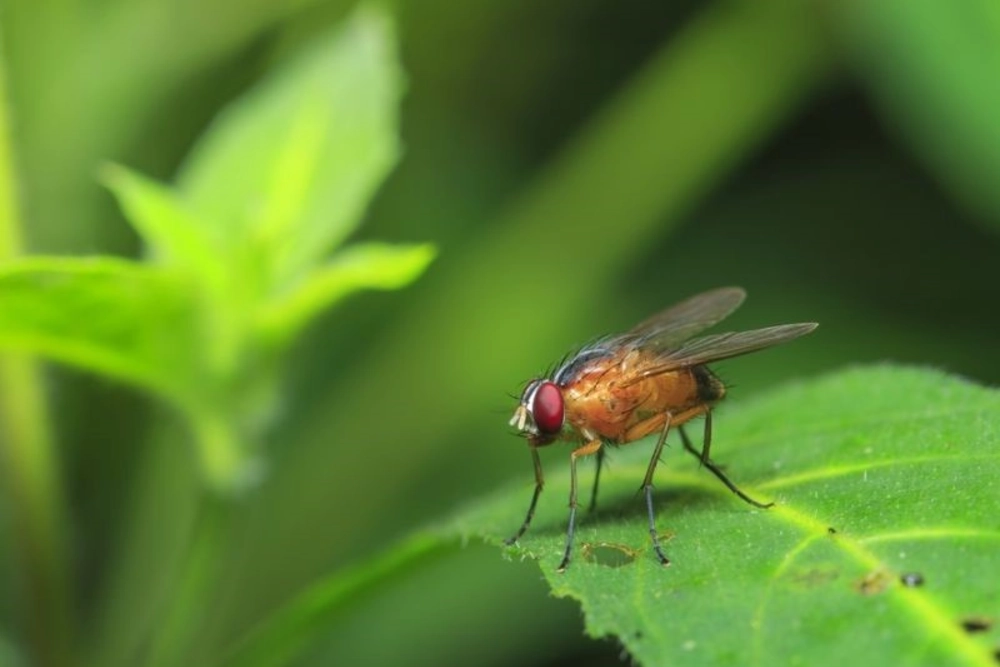
Spotted-wing drosophila, or Drosophila suzukii, punctures the skin of fruit with a serrated ovipositor and lays its eggs inside. Under high-pressure conditions, it can compromise a crop within just a few weeks. According to the National Invasive Species Information Center, in the United States it causes an estimated 500 million dollars, about 429.5 million euros, in damage each year.
Before the pest arrived in Oregon, blueberry growers generally applied insecticides once or twice a year. With the spread of SWD, the situation changed dramatically, reaching as many as 10 treatments per season in some cases.
Hafner recalls that, for about five years, the intensity of treatments also encouraged secondary pest issues, particularly with scales. According to the agronomy manager, this was due to the reduction of beneficial insects naturally involved in controlling these pests.
From calendar-based treatments to monitoring
According to Scott Lukas, Extension berry specialist and head of OSU’s Northwest Berry Program, in the early years the combination of crop-loss risk and zero tolerance at packing facilities pushed many growers to intervene very frequently.
Over time, however, management has evolved. Many farms have moved away from calendar-based treatments and now rely on scouting to decide when to intervene. In the case of AgriCare, when conditions favor the pest’s movement into fields from vegetated borders, staff may check fields as often as three times a week.
When the fruit begins to color, company scouts collect samples and check for the presence of larvae. If signs of infestation are detected, the pest management program is adjusted. This approach, Hafner explains, has made it possible to reduce applications and intervene before the problem becomes significant at delivery to the packing facility.
Biocontrol and new field tactics
In addition to Decoy, growers are testing more targeted strategies, such as treating only the outer rows to hinder the pest’s entry into fields.
Since 2022, researchers have been releasing Ganaspis brasiliensis, a parasitoid wasp capable of killing spotted-wing drosophila, at strategic sites in Oregon. The goal is to support its stable establishment so that, over time, populations can increase and play an important role, especially in the vegetation surrounding orchards.
Decoy technology is also reported to be effective against the brown marmorated stink bug, further expanding its potential interest for fruit-growing operations.
A high-pressure season
The situation remains complex. According to Jason Myer of the Northwest Berry Foundation, which monitors spotted-wing drosophila in the region, two consecutive mild winters have created the conditions for a particularly high population at the start of the season.
As of May 27, trap catches were four times higher than in a normal year. This signal confirms how much SWD management requires flexible, timely and integrated tools.
A possible turning point for cherries and berries
After almost two decades of intensive control against spotted-wing drosophila, the integration of attract-and-kill technologies, slow-release carriers, field monitoring and biological control could open a new phase for growers.
For sensitive supply chains such as cherries, blueberries and berries, the outlook is clear: reduce chemical pressure without lowering standards for crop quality. Decoy does not eliminate the complexity of pest management, but it offers one more tool toward more selective, sustainable and resilient fruit growing.
Source: Mitch Lies, Farm Progress
Image source: Confagricoltura
Cherry Times - All rights reserved