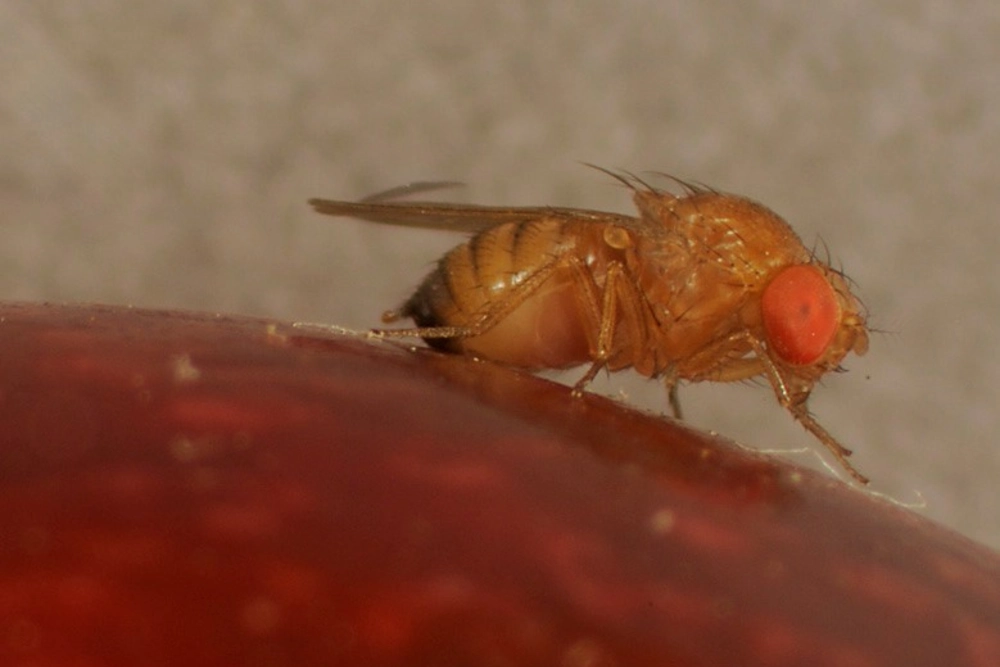
Drosophila suzukii, the spotted-wing drosophila native to East Asia, is currently one of the most important invasive pests worldwide, capable of attacking healthy and ripening fruits and causing substantial economic losses. Unlike other species of the genus Drosophila, it lays eggs directly into intact fruit tissues using a serrated ovipositor, promoting endophytic larval development and rendering many conventional control strategies ineffective.
The widespread use of synthetic chemical insecticides, in addition to posing environmental and health risks, is challenged by resistance issues and the need to reduce residue levels on produce. In this context, a recent study proposes an innovative approach based on three biotechnological control strategies: the Sterile Insect Technique (SIT), viral biocontrol, and RNA interference (RNAi), evaluating their effectiveness, limitations, and potential integration into sustainable pest management programs.
Sterile insect technique
Regarding the Sterile Insect Technique (SIT), the results highlight significant technical advancements achieved. An optimal combination of X-ray sterilization (90 kV/40 Gy) was identified, capable of ensuring high levels of sterility with limited impacts on the fitness of treated individuals, a crucial factor for the competitiveness of released males in the field.
In parallel, an alternative method based on exposure to elevated temperatures (30 °C) was proposed, exploiting the thermosensitivity of male fertility. Although effective in reducing fertility, this approach results in a significant decline in vitality, indicating the need for further optimization. An additional innovative aspect concerns a non-destructive sexing method based on pupal weight, which revealed differences between males and females.
Viral biocontrol
If further refined, this approach could represent a practical and acceptable alternative to genetic methods, which are often constrained by regulatory issues and public perception. The second research focus addresses the potential of La Jolla virus (LJV) as a biocontrol agent.
The study demonstrates that the virus can be transmitted through multiple routes, particularly oral and fecal pathways, facilitating its spread within natural populations. Infection with LJV leads to a significant reduction in fitness, with approximately a 33% decrease in egg-to-adult survival, along with negative effects on fecundity, feeding behavior, and food-searching capacity, especially in females.
RNAi approach
These findings suggest that the virus could contribute to the progressive suppression of D. suzukii populations, making it a promising candidate for biological control strategies within integrated pest management programs. Finally, the RNAi-based approach, although theoretically very promising due to its specificity and sustainability, did not yield significant results under experimental conditions.
Neither the induction of sterility nor sex manipulation or mortality through gene silencing showed meaningful effects. The observed limitations are mainly attributed to low uptake efficiency and non-systemic RNAi response in D. suzukii, as well as the possible degradation of dsRNA during oral delivery.
Control perspectives
These results highlight that, despite its great potential, the practical application of RNAi still requires further development, particularly in terms of delivery systems and molecular stability. Overall, the study provides an important contribution to development of targeted and environmentally friendly control strategies for Drosophila suzukii.
SIT emerges as the most mature and readily applicable technique, while viral biocontrol represents a promising complementary tool. RNAi, although still an emerging technology, requires significant technological advancements. The integration of these approaches into integrated pest management programs represents a realistic and promising pathway toward more sustainable and efficient fruit production systems.
Source: Abdelhafiz, I. A. (2025). Biotechnological Control Strategies for Managing Drosophila suzukii. https://doi.org/10.22029/jlupub-20617
Image source: E. Beers, WSU
Andrea Giovannini
PhD in Agricultural, Environmental and Food Science and Technology - Arboriculture and Fruitculture, University of Bologna, IT
Cherry Times - All rights reserved