On the one hand, the female population of the spotted-wing drosophila remained high at the end of last season. On the other hand, winter and spring favored the survival of the pest.
In the previous season, Drosophila suzukii appeared earlier, catching some growers by surprise. “Especially in varieties like Lapins, greater spotted-wing drosophila pressure was observed compared to previous years,” says entomologist Luis Devotto. This occurred in a context where cherries are among the earliest available fruits, allowing the pest to restart its reproductive cycle.
This fly, first reported in Chile in 2017 and capable of affecting numerous fruit species, has required 4 to 5 applications per season in cherries, spaced 5–7 days apart, from the moment the fruit reaches a straw-yellow color until harvest, to avoid leaving any gap. In other words, a major complication, because now chemical insecticides must be applied until shortly before harvest.
Evolution of the pest over time
Since cherries are harvested progressively depending on the variety, while the pest population increases over time, is greater damage expected toward the end of the season?
The increase in damage over time is more evident in berries. In cherries, the season is so short that the pest barely manages to complete a biological cycle on this fruit. However, to understand the issue in cherries, one must understand the pest’s behavior.
It is known that Drosophila has a short biological cycle and lays many eggs, but this occurs during summer and autumn when fruit is available and its reproductive capacity is high. However, there comes a time of the year, which varies by region, when all commercial and wild fruit disappears.
At that point, as you said, the pest gradually moves from one variety to another, then switches to another fruit species, and so on, until it finds no fruit for reproduction. At that moment, the fly “changes mode”: it stops trying to reproduce and prioritizes survival until the first fruits of the next season appear.
Seasonal strategies and survival
This may occur between May, June or July, while the first fruits reappear only in late October or November. A reproductive pause is therefore created, and a generation of females emerges that enters a kind of dormancy, taking shelter in various areas of the territory.
Strictly speaking, the first damaged fruits are attacked by rather “old” females, with weeks and sometimes months of life. At this stage, their only objective is to lay eggs and die.
The cherry is one of the earliest fruits and therefore one of the first to be attacked by Drosophila suzukii. Because the cherry season is so short, one, two or three cycles do not occur as in berries; in practice, it is only one generation of Drosophila that attacks this fruit.
Impact of the previous season
So will the intensity of the attack depend on the size of the population at the end of the previous season?
Exactly. It will largely depend on how the previous season ended. It is not the same to end a season with one million females entering dormancy as with 100 million. This determines whether the starting point is higher or lower.
Some of these females die during winter, and in central Chile what kills them is the lack of food: nectar, sap, honeydew, that is, energy sources found in the wild vegetation where they overwinter.
And how did last season end, to understand what to expect in the next one?
The population of the spotted-wing drosophila at the end of the season was rather high. Fortunately, berry prices were relatively good, so fruit was harvested until the end, reducing reproduction sites for the pest.
Future outlook and monitoring
However, what favored the fly was the fact that the last three winters were relatively rainy, after 14–15 years of megadrought, with rainfall lasting into August and September. The hillsides are greener, with much more plant biomass.
As mentioned, what makes a big difference in the survival of females until the next fruiting season is the energy available in the environment. This year there is plenty of “fuel,” and it is a favorable spring for Drosophila, because all this biomass provides the necessary energy. The females, which were barely surviving, find nectar-rich flowers or sap-releasing plants and thus manage to live weeks longer instead of dying.
This is what is being observed today: a more favorable spring for fly survival.
In the long term, have pest populations increased?
At the beginning of the arrival of Drosophila in Chile, SAG received emergency funds and installed traps across the country. When the emergency was declared over, the monitoring system was dismantled, although fortunately some traps remained active and have been capturing flies for 5–6 consecutive years.
What remains of the system has shown that although the pest initially displayed a rising trend in trap captures, that curve now appears to have flattened.
 Image 1. Dr. Luis Devotto, entomologist specialist in Drosophila suzukii
Territorial distribution
And from the perspective of its territorial spread?
From a territorial standpoint, the pest is permanently present and causing economic losses from the Valparaíso region down to the Los Lagos region. There is another group of regions where occasional captures or very localized field detections have been recorded, such as Atacama, Coquimbo and Aysén. Added to these are Antofagasta and Tarapacá, where there are no orchards, climate or favorable conditions, yet some specimens have been found in markets and agricultural fairs in the Norte Grande. Finally, there are two regions where no captures have ever occurred: Arica y Parinacota and Magallanes.
This refers to latitude. But how is it distributed from the Andes to the coast? Are there differences?
This fly prefers areas with high humidity, and in central Chile there is an environmental gradient from the Andes to the secano interior. From Route 5 eastward, toward the Andes, the entire area is much more humid than the land west of the highway. The preferred places for Drosophila suzukii are at the foothills of the Andes, and growers must pay particular attention there, also because it is where fruit growing is concentrated. For example, in the river headwaters.
This is well known because it is monitored; it is not theoretical. All the river headwaters in central Chile, such as Teno, Claro and Achibueno, spread like a fan as they descend from the Andes and are surrounded by orchards. It is also where irrigation canals originate, so the area has a high density of waterways. These areas have great water availability, favoring abundant blackberry growth, creating a combination of factors that benefit Drosophila.
Conversely, toward the secano interior, fruit production is much scarcer and, outside orchards, the landscape is practically a desert. There are only espinos (spiny acacias), which offer no useful resources for the fly.
For this reason, at the foothills of the Andes there is a 30–40 kilometer belt where females survive easily, and it is precisely there where they strike hardest once the pest cycle restarts.
Pest incidence and economic losses
What is the highest percentage of damage you have seen in a cherry orchard?
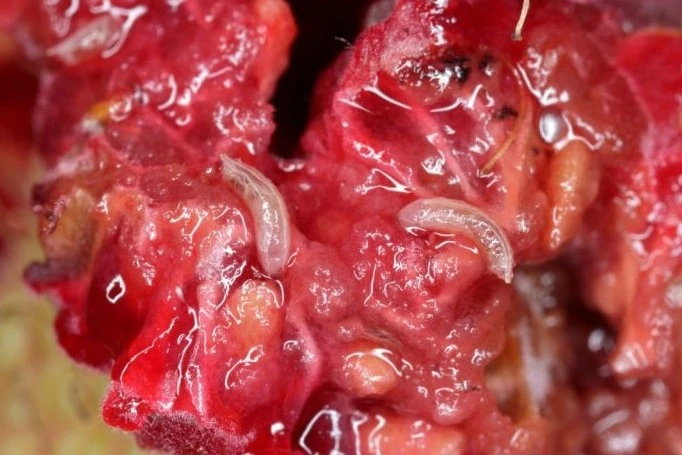
In abandoned commercial orchards, I have seen up to 90% damage. I have observed cherries individually containing 15 or even 20 larvae. In commercial orchards where treatments should have been applied but were not for some reason, I have seen up to 60% damage.
However, it is not necessary to reach such high levels: with just 0.5%, 1% or 1.5% visible damage, the packing house already eliminates the batch from the processing line.
I imagine that some slightly damaged fruit still slips through at the packing house, correct?
This will cause rot at destination... If a bit of damaged fruit passes through, once cherries come out of the cold chain during the Pacific journey and warm up slightly, they begin to rot.
Sorting machines, however, can detect slightly softer fruit. When a cherry receives the oviposition puncture, it remains firm for 12–24 hours. After the first 24 hours, the fruit starts to soften, becoming softer than a normal cherry, so the machine detects it.
This way, the packing facility discovers that something unusual is happening in certain lots because the machine begins discarding large volumes of soft fruit. At that point they stop the process and check the remaining bins. If they determine that the issue is damage caused by Drosophila, the grower’s fruit is excluded from the line.
Many exporters also have technical teams that inspect orchards before fruit is sent to the facility. Fortunately, only a small percentage of growers is excluded from the export process, because it is extremely difficult not to export in the current context.
Direct control tools
How much is integrated pest management being implemented?
When the pest is very aggressive and has very fast cycles, all strategies that are not direct and “strong” are often neglected.
The average cherry grower nonetheless follows many of the basic practices of integrated management: in 99% of cases there are no excessively tall weeds between rows, emitters and hoses are not damaged, so there are no water puddles, pruning is almost always well done, etc.
All of this falls under cultural practices that help reduce Drosophila suzukii attacks. In other words, in export-oriented cherry orchards, much of integrated management is applied almost “by default,” even if not as a specific phytosanitary measure.
And what is missing to complete the integrated management framework?
In this context, only one component was missing, which previously did not exist: the four or five pesticide applications before harvest.
Before the arrival of Drosophila suzukii in Chile, pests were mainly controlled until cherries reached the straw-yellow stage. With the arrival of the fly in 2017, the time window from straw-yellow to harvest, about four weeks, became the critical phase.
During this period, at least four pesticide applications are needed, one per week. In high-pressure areas, some producers tighten the schedule and spray every five days, shifting from four to five treatments.
With good products applied at the right time, growers typically reach harvest free of Drosophila suzukii.
Fruit residues
Since these products are applied close to harvest, have residues attributable to fly control appeared?
In this sense, growers are in a sort of straitjacket. Even for the Chinese market, no one wants more than four active substances on fruit, two of which must be reserved for fungicides.
Fortunately, the insecticides used have relatively short preharvest intervals of three or four days, so if residues do appear, they will be below the maximum allowable limit. An insecticide applied three or four weeks before harvest likely will not appear in the multiresidue analysis performed on that batch.
Product rotation and resistance
The products registered for the control of Drosophila suzukii in cherries on the SAG website, despite the pest’s recent arrival, are numerous. What happens if we group them by mode of action? How many modes of action do we have to rotate and avoid resistance?
Everyone wants to be part of the cherry market, which explains why the SAG list includes more than 30 products. It is the crop with the highest number of authorized insecticides among those affected by D. suzukii.
Considering the full group of insecticides registered for cherries, there are more than six modes of action. From the standpoint of rotation, it is recommended to alternate among four modes of action, so from this standpoint we are covered.
However, not all insecticides have the same effectiveness against Drosophila suzukii. There is a narrower group consisting of the “front-line” active ingredients for pest control, which includes only three modes of action.
Therefore, in terms of avoiding resistance, we are exactly at the limit for achieving acceptable rotation.
Resistance reported in Chile
Has any sign of resistance development to a chemical group ever been reported in our country?
No. In Chile, no increase in the expression of resistance genes has been reported.
Even when “resistance” is sometimes mentioned, upon investigation it turns out to be the result of incorrect product choices. Not all active ingredients have the same efficacy.
From a cost perspective, it would be ideal to buy an insecticide that, with a single application, simultaneously solves three or four major issues: mealybug, Drosophila, Cydia and perhaps other pests as well.
The “universal” product does not yet exist
The entomologist, a specialist in Drosophila suzukii, states that the “unicorn” insecticide dreamed of by growers unfortunately does not exist, at least for now.
“We currently have spectacular products against moths, which also offer some degree of control over the spotted-wing drosophila; others are highly effective against mealybugs, with some activity on Drosophila, and vice versa.”
However, the sector continues to be highly motivated by fly control and by the enormous economic value of export cherries.
For this reason, various phytosanitary companies are evaluating new products, with new modes of action, so that they may be available to growers within one or two seasons.
Image source: Redagricola
Redagricola Team
Cherry Times - All rights reserved